Bitcoin Mining Stocks Plummet as Costs Hit $137K per BTC, Miners Pivot to Survive
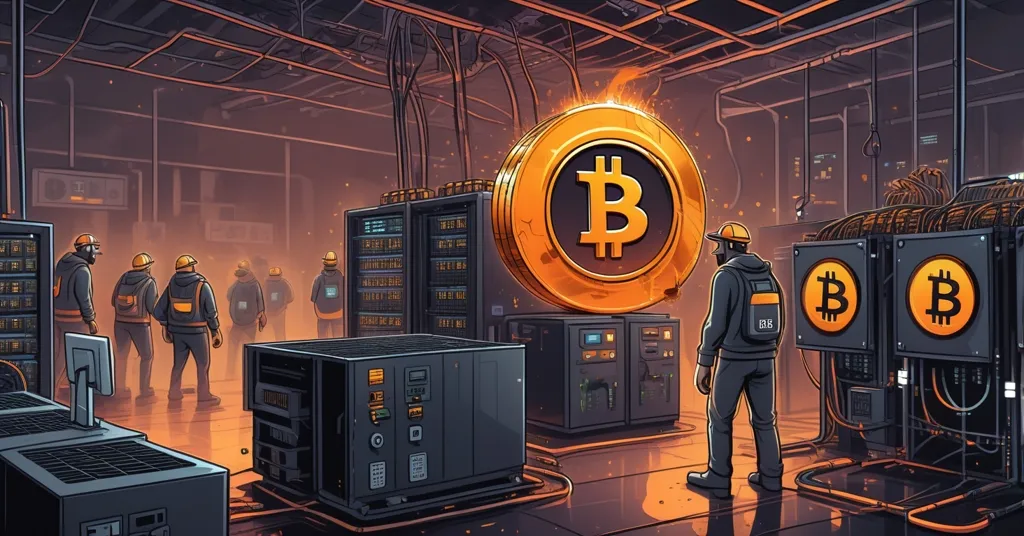
 LTB
LTB Bitcoin Mining Stocks Crash as Production Costs Soar to $137K per BTC
Bitcoin mining stocks are in a tailspin, caught in a perfect storm of skyrocketing production costs and fierce network competition. As the industry grapples with shrinking margins and a record-breaking hashrate, many miners are fighting for survival—some pivoting to new tech frontiers, others bleeding value fast. This isn’t just a market dip; it’s a wake-up call for an industry that’s long ridden Bitcoin’s bullish waves.
- Market Downturn: Bitcoin mining stocks fell 1.8% week-over-week, with trading volume plunging 25.66%.
- Cost Explosion: Average cash cost to mine one BTC hits $74,600, with all-in costs at a staggering $137,800.
- Survival Pivot: Miners are shifting to AI and high-performance computing (HPC) to escape diminishing returns.
The Cost Crunch: Mining Bitcoin at a Loss
The numbers don’t lie—mining Bitcoin has become a financial gauntlet. Last week, the sector’s market cap shrank from $69.12 billion on November 28 to $67.89 billion by December 5. Trading volume collapsed even harder, dropping 25.66% from $413.5k to a measly $307.35k. Of the 34 publicly listed Bitcoin mining companies, 25 closed the week in negative territory, painting a bleak picture for an industry already on edge. So, what’s driving this brutal crunch?
At the core is an unprecedented surge in production costs. The average cash cost to mine a single Bitcoin now stands at $74,600—think electricity, cooling, and raw operational expenses. Factor in depreciation of hardware, stock-based compensation for employees, and other overheads, and the all-in cost skyrockets to $137,800 per BTC. Compare that to Bitcoin’s current trading price of around $91,000 (up 2.2% in the last 24 hours), and the math gets ugly fast. Many miners are underwater, spending more to produce a coin than they can sell it for. Even at $91k, Bitcoin’s price isn’t the golden ticket it was post-2021 halving when costs were lower and margins fatter. Today’s miners are battling a different beast. For more on the plunging value of Bitcoin mining stocks amidst rising costs, the data speaks volumes.
The biggest culprit? Bitcoin’s network hashrate—essentially the total computational power securing the blockchain—has blasted past 1 zettahashes per second (ZH/s), a mind-boggling milestone. For those new to the game, hashrate measures how much processing muscle miners collectively throw at solving complex math problems to validate transactions and earn BTC rewards. A higher hashrate means a more secure network, but it also means more competition for the same fixed block rewards. It’s like a gold rush where thousands more miners show up with better picks, but the gold vein doesn’t get any bigger—everyone’s slice shrinks. This intensifies electricity and hardware demands, pushing costs through the roof. Electricity alone can account for 60-70% of mining expenses, and not every operation has access to dirt-cheap hydropower or renewable energy deals. Miners in high-cost regions like parts of the US or Europe are getting hammered harder than those in energy-rich areas like Central Asia.
Then there’s the looming shadow of the Bitcoin halving cycle. Every four years or so, the reward for mining a block gets cut in half, a mechanism baked into Bitcoin’s code to control supply and mimic gold’s scarcity. The last halving in 2020 slashed rewards from 12.5 to 6.25 BTC per block, and the next one in 2024 will drop it further to 3.125. Historically, halvings squeeze miner profitability unless Bitcoin’s price spikes dramatically to offset the loss. With costs already outpacing price for many, the upcoming halving could be a death knell for smaller or inefficient players. Is this a crisis, or just the natural evolution of a maturing network? That’s the million-dollar—or $91,000—question.
Winners and Losers: A Sector Divided
Not all miners are sinking in sync. Amid the downturn, a few standouts managed to defy gravity. Applied Digital Corporation (APLD) surged 15.20% over the week, while Core Scientific, Inc. (CORZ) eked out a 1.30% gain. Others like SATO Technologies Corp., SOS Limited, Cathedra Bitcoin, Inc., and Ebang International Holdings, Inc. also posted modest upticks. But for every winner, there’s a bigger loser. American Bitcoin Corp. (ABTC), co-founded by Eric Trump, took a gut punch with a 47.40% stock price drop, sliding from $5.75 to just $2.23. What separates the survivors from the casualties?
For ABTC, the collapse stems from a share unlock event—a moment when early investors, previously restricted, get the green light to sell their holdings. This often floods the market with supply, tanking the price as demand struggles to keep up. Eric Trump offered a blunt take on the volatility:
“Today our pre-merger private placement shares unlocked — these early investors are freely available to cash in on their profits for the first time, which is why we will see volatility.”
ABTC’s troubles don’t stop there. Its public listing came via a reverse merger with Gryphon Digital in September—a shortcut to going public by merging with an already-listed entity, often seen as riskier than a traditional IPO due to lighter scrutiny. Add in the political baggage of the Trump name, and you’ve got a speculative cocktail that’s more hype than hash. Investors should tread carefully; Bitcoin doesn’t play favorites, and political pedigree doesn’t mine blocks—market fundamentals do. This kind of volatility is a stark reminder that not every mining stock is a safe bet, especially when the business model looks more like a gamble than a grind.
Meanwhile, the disparity between large-scale operators and smaller miners is widening. Corporate giants like Core Scientific can weather the storm with economies of scale, diversified revenue, or investor backing—VR Advisory Services, for instance, scooped up over 1.2 million CORZ shares in Q3, per a November 14 SEC filing. But solo miners or small pools? They’re getting priced out, unable to compete with industrial setups or afford the latest ASIC rigs (specialized hardware for Bitcoin mining). This raises a red flag for decentralization, a core Bitcoin ethos. If mining power consolidates among a few big players, the network risks becoming less democratic—ironic for a technology born to disrupt centralized control.
Survival Strategies: Beyond Bitcoin Mining
With traditional mining profitability in the gutter, many companies are pivoting hard to stay afloat. Applied Digital Corporation is leading the charge, dropping $25 million into Corintis, a Swiss outfit specializing in advanced chip-cooling solutions. The play here isn’t just about mining efficiency—it’s about optimizing data centers for AI workloads and high-performance computing (HPC), sectors with fatter margins than Bitcoin mining in its current state. This isn’t a side hustle; it’s a lifeline. Other miners are following suit, repositioning themselves as tech companies rather than pure crypto plays. But is this pivot a stroke of genius or a desperate leap into another volatile arena?
On the upside, the shift to AI and HPC aligns with the decentralized spirit of finding new ways to disrupt stagnant systems. Bitcoin miners already have the infrastructure—massive data centers, cheap energy access in some cases—that can be repurposed for cutting-edge computing tasks. If successful, this could redefine the industry, proving that adaptability is as valuable as hashing power. On the flip side, critics argue miners are jumping from one energy-hungry, speculative ship to another. AI’s power demands can rival Bitcoin mining’s notorious appetite, and the market for such services isn’t guaranteed. If the AI boom fizzles—or if energy costs keep climbing—this gamble could backfire spectacularly. Survival isn’t just about pivoting; it’s about picking the right direction to pivot to.
Bitcoin’s Paradox: Strong Network, Weak Profits
Here’s the rub: Bitcoin’s network has never been stronger. A hashrate of 1 ZH/s isn’t just a technical milestone; it’s a testament to the blockchain’s resilience, making it damn near impossible for bad actors to launch a 51% attack (where someone controls over half the network’s power to manipulate transactions). From a security standpoint, this is Bitcoin maximalism’s wet dream—proof that the protocol can withstand anything, even as miners sweat bullets to keep up. But that strength comes at a cost. The higher the hashrate, the tougher the competition, and the more expensive it gets to stay in the game. It’s a paradox: the network thrives while the humans powering it struggle.
Then there’s the market sentiment. Despite Bitcoin trading at $91k with a modest daily uptick, the Fear and Greed Index—a barometer of investor mood—screams “extreme fear.” Why the jitters? It’s not just about mining costs. Regulatory shadows are looming larger than ever. Governments worldwide are eyeing energy-intensive mining with suspicion, especially amid climate concerns. Stricter environmental laws or outright bans in key markets could gut operations overnight. Broader economic headwinds—think inflation, interest rates, or geopolitical mess—might also be spooking investors. Bitcoin was sold as a hedge against fiat chaos, yet here we are, watching miners burn cash while the blockchain hums along. If that’s not a head-scratcher, what is?
Playing devil’s advocate, though, could this crisis be a feature, not a bug? High costs and hashrate might act as a natural filter, weeding out inefficient players and forcing innovation. Bitcoin isn’t here to coddle miners; it’s here to disrupt global finance. Maybe these growing pains are the forge—only the toughest, or most clever, will emerge to push decentralization to the next level. That’s the effective accelerationist take: let the chaos burn, and something better rises from the ashes. But tell that to a small miner shutting down rigs because the electric bill’s due. Theory’s one thing; reality’s a colder beast.
What’s Next for Bitcoin Mining?
The Bitcoin mining sector is at a brutal crossroads. Adaptation isn’t optional—it’s do or die. Whether through tech pivots like AI, financial wizardry, or sheer grit, miners must rewrite their playbooks or risk being hashed out of existence. For investors, the volatility of mining stocks is a double-edged sword—high risk, high reward, but with no promise of striking digital gold. And for Bitcoin purists, this is a gut check. The network’s unshakable core at 1 ZH/s proves its mettle, but the human and corporate toll of keeping it running? That’s a price we’re only starting to reckon with.
Will mining evolve into a tech survival game, or is this the start of a great purge? Only the blockchain—and maybe a few savvy CEOs—holds the answer. One thing’s clear: in the race to disrupt the status quo, complacency is the first casualty. Bitcoin didn’t come this far to play nice, and neither should the industry powering it. Let’s see who’s left standing when the dust settles.
Key Takeaways and Questions
- What’s causing the drop in Bitcoin mining stocks?
A 1.8% market decline and 25.66% trading volume drop, combined with soaring production costs and intense competition from a record hashrate, are dragging the sector down. - Why are Bitcoin mining costs so high right now?
With the network hashrate exceeding 1 ZH/s, competition has intensified, pushing cash costs to $74,600 and all-in costs to $137,800 per BTC—often above Bitcoin’s $91k price. - How are miners adapting to shrinking profitability?
Many are pivoting to AI and high-performance computing, like Applied Digital’s $25 million investment in Corintis, seeking higher margins outside traditional mining. - What triggered American Bitcoin Corp.’s massive stock loss?
A 47.40% price drop was sparked by a share unlock, allowing early investors to sell off, fueling volatility as noted by co-founder Eric Trump, alongside risks from its reverse merger setup. - Why does market sentiment show fear despite Bitcoin’s price rise?
Even with BTC at $91k and a 2.2% daily gain, the Fear and Greed Index signals extreme fear, likely tied to regulatory uncertainty or broader economic concerns. - Could regulations further impact Bitcoin mining?
Absolutely—stricter environmental laws targeting energy-intensive mining or broader crypto crackdowns in key markets could cripple operations, adding to investor unease. - Is centralization a growing threat to Bitcoin’s ethos?
Yes, as small miners get priced out and power consolidates among corporate giants, the risk of centralized control grows, clashing with Bitcoin’s decentralized promise.