Bitcoin Hash Ribbons Buy Signal Returns: Is This the Next Accumulation Phase?
 LTB
LTB Classic Bitcoin Buy Signal Returns: Are Miners Hinting at the Next Accumulation Phase?
Bitcoin is teetering just above $90,000, stuck in a frustrating limbo of consolidation and bearish whispers. Yet, amid this market malaise, a classic on-chain indicator—the Hash Ribbons buy signal—has flickered back to life, raising eyebrows and sparking debate. Could this be a golden window for patient investors to stack sats, or is it a trap set by a volatile market with skeletons like the 2021 China mining ban in its closet?
- Price Limbo: Bitcoin trades above $90,000 with little upward push, signaling market hesitation.
- Hash Ribbons Signal: A historically bullish indicator tied to miner stress suggests a potential accumulation zone.
- Technical Tension: Support holds for now, but short-term bearish trends loom large.
Decoding Hash Ribbons: A Miner’s Distress Call
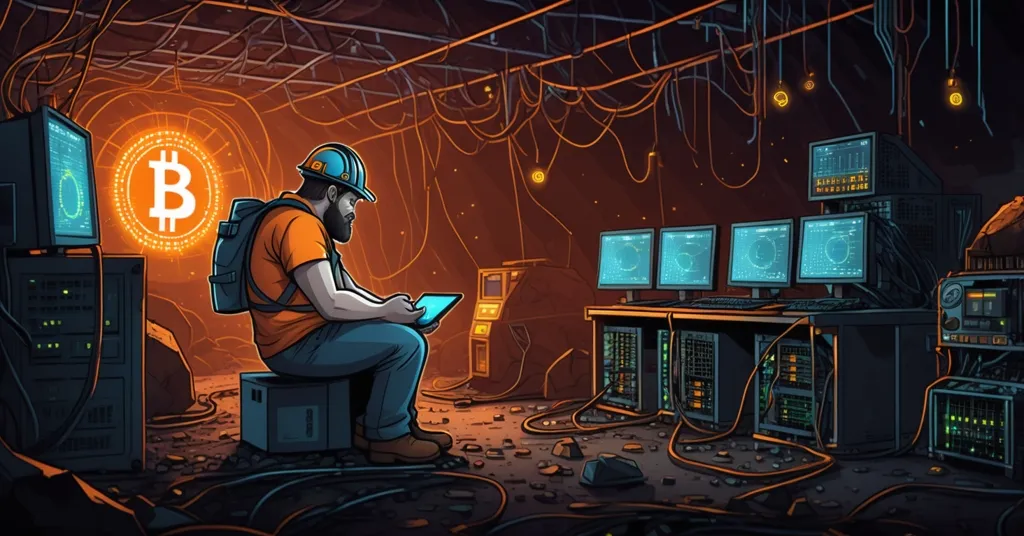
Let’s cut through the noise and get to the meat of this signal. The Hash Ribbons indicator is a data-driven tool that tracks the pulse of Bitcoin’s mining ecosystem. It compares the 30-day and 60-day moving averages of the network’s hashrate—the raw computational muscle miners pump into securing the blockchain. When the shorter 30-day average slips below the 60-day, it’s a red flag: miners are struggling, often because mining difficulty is climbing while profitability takes a nosedive. Think of it as a canary in the coal mine for miner stress. For more insights on this signal, check out this detailed analysis on Bitcoin miner accumulation phases.
This stress often leads to what we call miner capitulation. Picture small businesses shutting down during a recession, offloading inventory at a loss to pay the bills—that’s what happens when less efficient miners can’t hack it. They turn off their rigs and dump their Bitcoin reserves on the market to cover costs, dragging prices down in the short term. But here’s the flip side: once these weaker players are out, selling pressure eases, and the market often finds a floor. Analyst Darkfost captures this dynamic well, noting,
“These periods of stress historically present strong mid-cycle accumulation opportunities.”
It’s not a green light to go all-in, but a nudge to pay attention, as Darkfost wisely cautions,
“This signal is not a cue to rush blindly into the market, but rather a meaningful piece of data worth highlighting.”
Historically, Hash Ribbons buy signals have been a beacon for savvy investors. They’ve often marked the early stages of major recoveries, giving those with diamond hands a data-backed edge. But before you start dreaming of lambos, let’s talk about the elephant in the room: history doesn’t always repeat, especially when external shocks hit. The 2021 China mining ban was a brutal outlier. Back then, China housed a massive chunk of Bitcoin’s global hashrate, and when the government cracked down, miners were forced to unplug or flee overnight. The resulting chaos threw the Hash Ribbons signal out of whack, and the expected rally never materialized. It’s a harsh reminder that no indicator, no matter how reliable, is immune to geopolitical gut punches.
What’s Driving Miner Stress in 2023?
Fast forward to today, and miners aren’t exactly popping champagne. Rising energy costs are squeezing margins—mining rigs don’t run on hopes and dreams, and with global electricity prices spiking in many regions, even efficient operations feel the burn. Then there’s the ever-looming Bitcoin halving, expected around April 2024, which will slash block rewards in half and make profitability an even tougher nut to crack. Add to that the relentless march of mining difficulty, which adjusts roughly every two weeks to keep block production steady, and you’ve got a recipe for pain. When difficulty spikes while Bitcoin’s price stagnates, miners get caught in a vise.
For the uninitiated, mining difficulty is how hard it is to solve the cryptographic puzzles needed to validate transactions and earn Bitcoin. Too many miners jumping in? Difficulty ramps up. Price drops while costs stay high? Tough luck. Hashrate, on the other hand, reflects the total computing power miners contribute. A dropping hashrate, as flagged by Hash Ribbons, often means miners are waving the white flag—but it can also signal a bottom as the network recalibrates. Are we seeing small-scale miners crumble while big pools hold strong? On-chain data suggests Bitcoin outflows from miner wallets to exchanges are ticking up, a classic sign of capitulation, though major mining pools seem to be weathering the storm for now.
Regulatory headwinds aren’t helping either. While China’s ban is old news, new policies in the U.S. and EU are casting shadows. From proposed energy taxes on mining to outright bans in some jurisdictions, miners face a gauntlet of uncertainty. So, are miners signaling a buying opportunity, or are they just the first domino in a broader market meltdown? That’s the million-dollar question.
Bitcoin’s Price Chart: Bullish Hope or Bearish Trap?
Shifting gears to Bitcoin’s price action, the technicals paint a mixed picture. Bitcoin recently bounced off its 100-day moving average—a key support level traders watch like hawks as a gauge of longer-term bullish strength. Holding here is a small victory, a sign the market hasn’t completely rolled over. But don’t pop the confetti just yet. Bitcoin remains below its 50-day moving average, which is sloping downward, a textbook bearish signal for short-term momentum. Worse, trading volume is pitifully low, suggesting the market is twiddling its thumbs, waiting for a catalyst to pick a direction.
If Bitcoin can cling to the $90,000–$88,000 range, it might build a base for a rebound, possibly reclaiming higher ground. But slip below, and the next stop could be the mid-$80,000s, testing the nerves of even the most battle-hardened HODLers. It’s a knife-edge moment, and with macroeconomic storm clouds like interest rate hikes and inflation still swirling, there’s no guarantee of a happy ending. Institutional hesitancy—think big players like ETFs or corporations sitting on the sidelines—could keep the lid on any breakout, Hash Ribbons or not.
Broader Data: Does the Signal Hold Water?
Hash Ribbons isn’t the only on-chain metric worth a glance. Let’s layer in a couple more for a fuller picture. The Puell Multiple, which measures miner revenue against historical averages, often signals when miners are over or underpaid. Right now, it’s leaning toward the lower end, hinting that miners are indeed under pressure—corroborating the Hash Ribbons story. Then there’s the Stock-to-Flow model, a controversial but popular gauge of Bitcoin’s scarcity-driven value. It suggests Bitcoin remains undervalued relative to its halving cycles, though critics argue it’s more hype than science. For newbies, think of these as extra lenses to view the market—none are gospel, but together they help spot trends.
Still, let’s not drink the Kool-Aid. On-chain data is powerful, but it doesn’t account for whale manipulation—those big players who can dump or pump with a single trade—or sudden regulatory bombshells. The Hash Ribbons signal might scream “buy,” but if a major economy slaps new restrictions on crypto, all bets are off. We’ve seen this rodeo before, and it rarely ends with a clean bull run.
Bitcoin Maximalism and the Proof-of-Work Edge
As champions of decentralization, let’s take a moment to appreciate why Bitcoin stands apart, even in turbulent times like these. Unlike altcoins with their centralized staking schemes or shady premines, Bitcoin’s proof-of-work system is the ultimate test of skin in the game. Miners bleed for every satoshi, pouring real-world resources into securing the network. When they capitulate, it’s not just a market signal—it’s a purge of inefficiency, making Bitcoin’s antifragile core even stronger. Altcoins can play their niche roles in DeFi or smart contracts, but Bitcoin’s grind is the bedrock of this financial revolution. So, while we nod to Ethereum and others filling gaps Bitcoin doesn’t aim to, our heart beats for the OG crypto that flips the bird at centralized control.
Could This Be the Setup for a 2024 Rally?
Here’s where we play devil’s advocate with a speculative twist. If the Hash Ribbons signal holds true to its historical batting average, and if the upcoming halving in 2024 acts as the scarcity shock it often does, we could be eyeing the early innings of a major rally. Halvings have historically lit a fire under Bitcoin’s price by slashing supply growth—miners get half the rewards, new coins trickle slower, and demand often surges. Pair that with a potential easing of miner stress as difficulty adjusts post-capitulation, and the stars might align for a breakout.
But let’s slap some cold water on that fantasy. Macro conditions are a wild card—central banks aren’t exactly crypto’s best pals, and persistent inflation or a recession could choke any bullish momentum. Plus, let’s be real: the crypto graveyard is packed with suckers who FOMO’d on signals like this, only to get rekt by a black swan event. The Hash Ribbons signal is a compelling data point, not a crystal ball. Stack sats if you believe in the long game, but don’t bet the farm on a single indicator. Bitcoin’s strength isn’t in short-term pumps—it’s in outlasting every system that tries to cage it.
Key Takeaways and Questions
- What does the Hash Ribbons buy signal mean for Bitcoin investors?
It hints at a potential accumulation phase, historically linked to strong buying opportunities as miner selling pressure fades. - Why should caution prevail despite this bullish indicator?
Past disruptions like the 2021 China mining ban prove external shocks can derail patterns, and current technicals show lingering bearish momentum. - How does miner stress impact Bitcoin’s price?
Struggling miners sell reserves to cover costs, creating short-term downward pressure, but this often marks market bottoms as weaker players exit. - What are the critical price levels to watch for Bitcoin?
Holding $90,000–$88,000 could pave the way for a rebound, while a break below risks a slide to the mid-$80,000s. - What broader factors could undermine this signal?
Rising energy costs, regulatory crackdowns, and macro pressures like inflation or interest rate hikes could spoil any bullish setup.
Bitcoin’s path is a rollercoaster, and that’s what keeps us hooked. The Hash Ribbons signal dangles a carrot for those hunting bargains, but it’s no free lunch. Mining stress might purge the weak, fortifying Bitcoin’s network, yet the technicals and macro minefield remind us to keep our guard up. As torchbearers of decentralization and disruption, we see Bitcoin not just as an asset but as a defiant stand against the status quo. Whether this signal sparks the next big accumulation phase or fizzles into a footnote, the revolution rolls on. History’s watching—will you stack sats now, or wait for the market to show its hand?