XRP Stands Firm While Mutuum Finance Peddles 5,000% Scam Hype
 LTB
LTB XRP Holds Ground as Mutuum Finance Pushes a 5,000% Fantasy
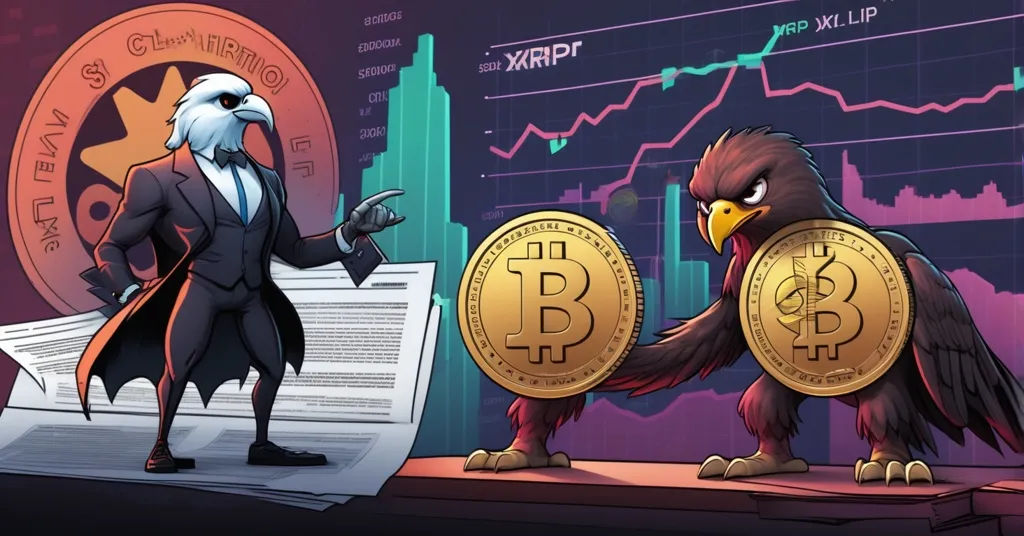
Bitcoin continues to stand as the unshakable pillar of cryptocurrency, but the altcoin world never fails to deliver its share of intrigue and insanity. Right now, two stories are grabbing headlines: XRP, tied to Ripple’s payment disruption dreams, is clinging to a key price level with signs of a possible short-term uptick, while Mutuum Finance (MUTM), a DeFi presale project, is being hyped with a ludicrous 5,000% rally promise. Let’s strip away the fluff and dig into what’s real and what’s likely a trap waiting to spring.
- XRP’s Current Stand: Anchored at a critical support level, showing potential for a bounce within a descending triangle pattern.
- MUTM’s Outrageous Claim: DeFi presale project touts a 5,000% price surge, raising $19.5M, yet offers no solid proof of credibility.
- Our Verdict: XRP merits cautious attention due to legal and technical factors; MUTM screams scam—approach with extreme skepticism.
XRP: Navigating Technicals and Legal Minefields
XRP, the native token of Ripple, has long been a polarizing force in the crypto space, primarily due to its ambitious goal of revolutionizing cross-border payments and its ongoing battle with the U.S. Securities and Exchange Commission (SEC). For those unfamiliar, Ripple seeks to make international transactions faster and cheaper than traditional banking systems by using XRP as a bridge between different fiat currencies. However, the SEC lawsuit, which claims XRP is an unregistered security rather than a currency, casts a shadow over its future. A loss could severely restrict Ripple’s operations, while a win might open doors to widespread adoption. This legal uncertainty has kept XRP in a volatile limbo, yet it retains a dedicated community that often fuels speculative spikes during broader market rallies.
At this moment, XRP is perched at a crucial support level—a price point where historical buying interest has prevented further declines. Technical analysts are pointing to a descending triangle pattern on the charts, a setup where the price is compressed between a flat support line and a downward-sloping resistance line. Picture it as a coiled spring: if enough buyers step in, we could see a short-term pop toward that resistance, potentially yielding a quick gain for traders. Recent trading volume data shows steady, if not overwhelming, interest, and online sentiment among XRP holders leans toward guarded hope. Looking back, similar chart patterns during past legal updates—like partial courtroom wins in 2022—have triggered 10-20% price jumps, though past performance is no crystal ball in this unpredictable market.
Let’s keep perspective, though. While the charts offer a flicker of optimism, XRP’s destiny is tied far more to judicial rulings than to technical indicators. A favorable outcome in the SEC case could accelerate Ripple’s partnerships—recent moves in Asia and the Middle East show banks testing its tech for cross-border transfers—but a negative ruling might gut its value and utility overnight. As someone who leans toward Bitcoin maximalism, I see XRP as a centralized experiment compared to Bitcoin’s peerless decentralization and focus on being sound money. That said, I can’t dismiss its potential to chip away at banking monopolies if it dodges the regulatory hammer. For now, it’s a high-stakes gamble with real-world implications. Keep an eye on Ripple’s legal updates as much as the price action if you’re considering a position.
Mutuum Finance: DeFi Dream or Dangerous Delusion?
Now, let’s turn to a story that reeks of the worst kind of crypto hype: Mutuum Finance, known as MUTM, a DeFi project in its presale phase being peddled as the next jackpot. For newcomers, a presale is when a project sells tokens at a discounted rate before they’re listed on public exchanges, often pitching huge returns to early investors. MUTM’s tokens are currently priced at $0.035 in Phase 6, with claims of having raised over $19.5 million from more than 18,590 participants. Reports suggest Phase 6 is 99% sold out, with Phase 7 set to increase to $0.04 and a launch price pegged at $0.06. Sounds like a typical presale setup—until you hear the absurd prediction of a 5,000% rally, with tokens supposedly soaring to $2.50 from under a nickel. That’s not a forecast; it’s a carnival barker screaming for you to empty your pockets on a rigged game.
Let’s give MUTM a fair shake and examine their pitch. They position themselves as a utility-focused DeFi platform, short for decentralized finance, which recreates financial services like lending and savings on blockchain tech without intermediaries like banks. MUTM claims to offer two models: Peer-to-Contract (P2C) lending, where users lend stable assets through smart contracts for dynamic Annual Percentage Yields (APYs)—think interest rates that shift based on market supply and demand—and Peer-to-Peer (P2P) lending, allowing direct transactions of riskier, volatile tokens between users. They also dangle the carrot of passive income via liquidity markets, where users supply assets to trading pools and earn fees. Conceptually, it’s an interesting niche within DeFi, especially since Bitcoin doesn’t prioritize complex lending mechanisms, sticking instead to its role as unassailable money. Ethereum has long led DeFi with projects like Aave and Compound, so there’s theoretical room for new players if they can deliver.
Here’s the glaring issue: where’s the delivery? There’s no sign of a functioning product, no named team, no audited code, and no whitepaper worth the screen it’s displayed on. A $19.5 million raise without a shred of transparency is a giant warning siren. Dig into social channels or community chatter, and you’ll find nothing but anonymous hype or paid shills on platforms like Telegram. Compare this to established DeFi protocols—Aave offers APYs of 5-10%, not 5,000% pipe dreams. The crypto space has seen this movie before: presale frenzies, especially ahead of anticipated bull markets like 2025, exploit fear of missing out (FOMO). Most of these projects collapse or reveal themselves as scams—over 80% of 2017 ICOs failed or defrauded investors, according to Coinopsy. Remember BitConnect? MUTM’s wild claims and deafening silence on basics suggest it’s less about building DeFi and more about building someone’s yacht fund.
Freedom, Fundamentals, and the Fine Line of Risk
Stepping back, our ethos here is clear: we’re all about decentralization, privacy, and shaking up the financial status quo through effective accelerationism—driving tech forward to redefine money itself. XRP, despite its centralized undertones, could strike a blow against banking cartels if it navigates the legal storm. MUTM, on the other hand, embodies the ugly flip side of an open market: scammers preying on the uninformed with promises too good to be true. Bitcoin remains the ultimate benchmark in this revolution—battle-hardened, decentralized, and laser-focused on being money, not a gimmick. Altcoins and DeFi have their place; Ethereum’s smart contracts and innovations like Polygon’s scaling or Avalanche’s speed prove there are gaps to fill. But when a project like MUTM hawks absurd gains with zero substance, it’s not innovating—it’s exploiting. Worse, such schemes could tarnish DeFi’s credibility and invite heavier regulatory scrutiny, setting back legitimate progress.
Final Call: Where Should You Stand?
So, what’s the takeaway from this dual narrative? XRP’s technical position and legal stakes make it a speculative watchlist candidate, especially if you track Ripple’s courtroom battles and international traction. Personally, I’d still bet on Bitcoin’s store-of-value dominance over any altcoin’s utility play, but XRP’s fight against traditional finance aligns with our disruptive spirit—just don’t bank on it without due diligence. As for Mutuum Finance, I’m staying miles away until there’s concrete evidence of legitimacy, whether it’s an audited smart contract, a transparent team, or a working product. The crypto landscape is littered with the corpses of hyped-up failures that crushed early investors. Scammers feast when we prioritize moonshots over fundamentals. Do your homework, demand proof, and back projects with real-world impact. Let’s starve the predators, not become their prey.
Key Takeaways and Questions
- What’s the current state of XRP’s market position?
XRP is holding at a vital support level, forming a descending triangle that could signal a short-term upward move if buying pressure sustains, though its fate largely rests on the SEC lawsuit resolution. - How does the SEC case affect XRP’s future?
The SEC argues XRP is an unregistered security, which could cripple Ripple’s operations and XRP’s value if the ruling goes against them, while a victory might spur global adoption and partnerships. - What is Mutuum Finance (MUTM) pitching to investors?
MUTM is a DeFi presale project centered on lending and borrowing, promising a staggering 5,000% price jump to $2.50 per token from under $0.05, with $19.5 million reportedly raised. - Can Mutuum Finance be trusted as an investment?
Highly unlikely—there’s no transparency, verifiable team, or product evidence, and such extreme predictions often point to scams or pump-and-dump schemes designed to fleece investors. - What makes DeFi presales like MUTM so risky?
They frequently lack accountability, have high failure or fraud rates, and bank on FOMO-driven hype, often damaging retail investors and the broader reputation of DeFi innovation.