Bitcoin Whales Stack Coins as Retail Sells Off: Market Split Signals Volatility
 LTB
LTB Bitcoin Whales Buy the Dip as Small Investors Sell: Market Divide Deepens
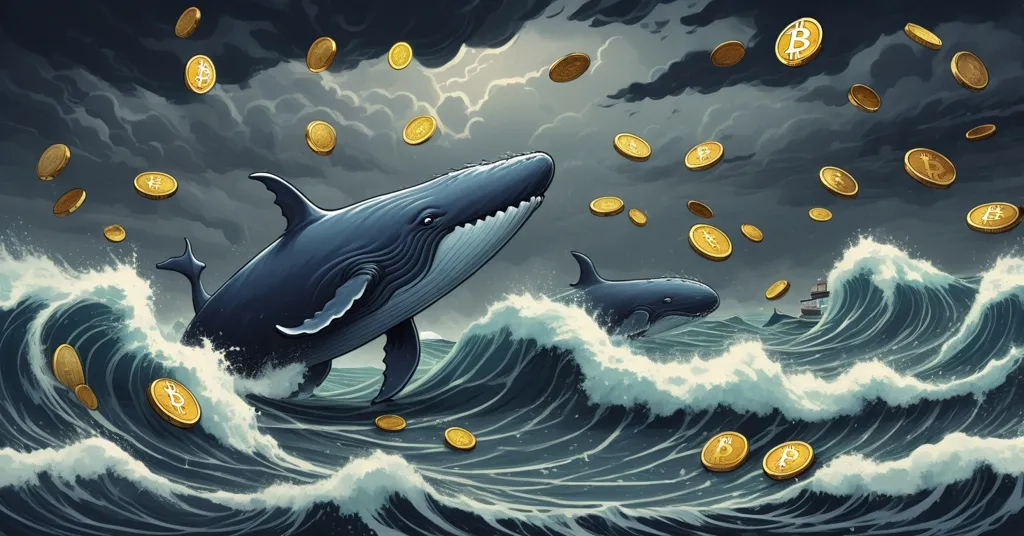
Bitcoin’s latest price slump to around $88,000 has split the market down the middle: whales with millions to spare are gobbling up coins like it’s a Black Friday sale, while smaller investors are bolting for the exit, spooked by uncertainty. Is this a golden chance to buy low, or a warning of tougher times ahead? Let’s dive into the data, decode the sentiment, and weigh the stakes in this high-stakes crypto clash.
- Whale Accumulation: Large holders (1,000-10,000 BTC) are aggressively buying during the price dip.
- Retail Sell-Off: Smaller investors with less than 1,000 BTC are offloading their holdings.
- Market Fear: Sentiment sits at “fear” with the Crypto Fear and Greed Index at 25.
Understanding the Bitcoin Market Split
For those new to the crypto game, Bitcoin’s market isn’t a monolith—it’s a battlefield of players with wildly different resources and mindsets. “Whales” are the big fish, individuals or entities holding massive amounts of Bitcoin, often thousands of coins worth millions of dollars. They can sway prices with a single trade. On the other end are retail investors—everyday folks with smaller stacks, sometimes just a fraction of a Bitcoin (often called “sats,” short for satoshis, the smallest unit of BTC). Price dips like the current one, where Bitcoin has fallen over 30% from its peak of $126,198 in October to around $88,000, expose the divide between these groups. Dips happen due to profit-taking, panic, or external pressures like economic uncertainty, but they also reveal who’s playing the long game and who’s just along for the ride. Let’s break down the dynamics driving this split.
Whale Accumulation: Betting on the Future
The heavyweights of the Bitcoin world are making their move. On-chain data from Glassnode, a blockchain analytics platform, shows that whales holding between 1,000 and 10,000 BTC have been the dominant buyers over the past 15 days. Their Accumulation Trend Score—a metric that measures buying versus selling activity—is close to 1, meaning they’re stacking coins at a furious pace. With Bitcoin trading between $85,000 and $95,000 since late November, down sharply from its all-time high, these players see a bargain, as highlighted in a recent analysis of large Bitcoin holders snapping up the dip. They’re not just gambling; many view Bitcoin as digital gold, a hedge against inflation and fiat currency devaluation, especially in uncertain economic times. Their confidence suggests a belief that today’s dip is tomorrow’s jackpot—or at least a stable store of value.
Interestingly, the biggest whales, those with over 10,000 BTC, have slowed their buying since late November but aren’t selling either. This contrasts with their behavior earlier this year when Bitcoin touched $100,000, and some cashed out hefty chunks. Their current “wait and see” stance hints at cautious optimism—perhaps holding off for a clearer market direction. It’s a chess game, not a sprint, and these mega-holders know a single misstep could ripple through the market. For Bitcoin maximalists like us, this whale behavior screams conviction in BTC’s long-term potential to upend traditional finance, even if the path is bumpy.
Retail Sell-Off: Fear Takes Hold
While whales build their arsenals, the story for smaller investors is starkly different. Those holding less than 1,000 BTC—often retail traders or hobbyists—are in full distribution mode, selling off their stacks around the $80,000 to $90,000 range. Why the rush to the exits? The Crypto Fear and Greed Index, a market mood thermometer tracked by Coinglass, sits at a grim 25, deep in “fear” territory. This index gauges sentiment using factors like price volatility, social media chatter, and trading volumes; a low score like this often means panic is spreading. It’s been stuck in fear or extreme fear for a month now, signaling that many smaller players might be capitulating—cutting losses or locking in profits after Bitcoin’s earlier surge.
Picture this: you’re a regular Joe holding half a Bitcoin, watching its value drop 30% from the peak. Your $60,000 investment is now worth $44,000, and headlines scream uncertainty. Do you hold (or “HODL,” in crypto lingo) or sell before it gets worse? For many, fear wins. Beyond sentiment, external pressures likely fuel this retail retreat. Rising interest rates make risky assets like Bitcoin less appealing compared to safer bonds. Whispers of regulatory crackdowns—whether in the U.S. or EU—add to the jitters. Even global inflation, ironically what Bitcoin aims to hedge against, might force cash-strapped investors to liquidate. This isn’t just FUD (Fear, Uncertainty, Doubt) fever; it’s a rational response to a brutal market for those without deep pockets to weather the storm.
Corporate Giants Double Down
Amid the retail panic, corporate titans are planting their flag. MicroStrategy, the largest corporate Bitcoin holder and a poster child for BTC adoption in the boardroom, just scooped up another 1,229 BTC for about $109 million at an average price near $88,500 per coin. This pushes their total stash to over 670,000 BTC, valued at roughly $59 billion—a treasury reserve that rivals small nations. Led by the relentlessly bullish Michael Saylor, MicroStrategy treats Bitcoin as a superior store of value to cash, a shield against fiat erosion. Their latest buy isn’t about timing the market; it’s a middle finger to inflation and a bet on Bitcoin as the ultimate hard money.
Bitcoin will hit $21 million in 21 years.
— Michael Saylor
They’re not alone. Hyperscale Data, another U.S.-based publicly listed firm, has also expanded its Bitcoin holdings recently, though details are thin. This corporate wave matters because it’s a stabilizing force. When retail investors flee, firms with billions in BTC signal to the market that this isn’t a passing fad—it’s a legitimate asset class. MicroStrategy’s moves can bolster confidence, potentially acting as a price floor during dips. But there’s a flip side: if their stock tanks due to overexposure to Bitcoin’s volatility, it could spook others. Still, their involvement underscores decentralization’s appeal—it’s not just for cypherpunks; it’s for anyone daring to challenge the financial status quo.
Market Risks: ETF Outflows and Price Pressure
Not everything points to smooth sailing. U.S. spot Bitcoin ETFs, investment funds that let mainstream players bet on BTC without owning it directly, saw outflows of nearly $276 million on December 26 alone. That’s part of a six-day streak of withdrawals totaling over $1 billion, according to SosoValue data. In plain terms, this means money is being pulled out of these funds—potentially a sign of institutional doubt or profit-taking after earlier gains. Compared to the massive inflows during Bitcoin’s rally to $126,000, this reversal stings. Are big players spooked by macroeconomic headwinds, like tightening monetary policy, or just reallocating capital? Without specifics on which funds—think Grayscale or BlackRock—saw the heaviest exits, it’s hard to say, but it’s a red flag for near-term price stability.
Bitcoin’s own performance isn’t calming nerves either. At around $87,700, it’s down 0.5% in the last 24 hours and over 2% in the past week, per CoinMarketCap. Analysts warn that slipping below $80,000—a psychological threshold—could unleash a wave of selling across the crypto ecosystem. It’s not just Bitcoin at stake; correlated assets like Ethereum, or even speculative meme coins, often tank harder when BTC falters. Add in external pressures—regulatory uncertainty from bodies like the U.S. SEC, or energy debates around Bitcoin mining’s carbon footprint—and the risks stack up. Even whales and corporates might not stem the tide if fear spirals into a full-blown capitulation event.
Playing Devil’s Advocate: Challenging the Bullish Narrative
Let’s pump the brakes on the hopium for a second. Sure, whale accumulation and corporate buys are exciting, and voices like Bitwise’s Matt Hougan or Galaxy researchers paint a rosy long-term picture for Bitcoin. Michael Saylor’s $21 million prediction in 21 years sounds like a maximalist’s dream. But let’s get real: such forecasts are speculative at best, borderline delusional at worst. Bitcoin’s history is a rollercoaster of booms and busts—remember 2018 when it crashed 80%? Volatility isn’t going away overnight. Regulatory hurdles could choke adoption; imagine a U.S. ban on crypto trading or punitive taxes. Competition from other blockchains like Ethereum, which powers DeFi and smart contracts—niches Bitcoin doesn’t touch—could dilute BTC’s dominance. I’m all for effective accelerationism, pushing disruptive tech like Bitcoin to reshape finance, but blind faith is a fool’s errand. The road to mass adoption is littered with potholes, and no amount of whale stacking guarantees a smooth ride.
Bitcoin and the Bigger Picture: Ecosystem Dynamics
Let’s zoom out. Bitcoin might be the king of decentralization and sound money, but it’s not the only player in town. Altcoins and other protocols fill gaps BTC doesn’t aim to address. Ethereum’s smart contracts enable decentralized apps and finance (DeFi) that Bitcoin’s simplicity can’t match. Projects like Solana or Polkadot tackle scalability in ways Bitcoin’s network, bogged down by energy-intensive mining, struggles with. A Bitcoin dip below $80,000 wouldn’t just hurt BTC holders; it could drag the entire market down, as altcoins often follow the leader. Yet, this diversity is a strength—while I lean Bitcoin maximalist, I see the value in a varied ecosystem. It’s a financial revolution, not a one-coin dictatorship, and each blockchain carves out its role in disrupting the old guard.
What’s Next for Bitcoin?
Bitcoin’s current limbo near $88,000 is a tug-of-war between conviction and capitulation. Whales and corporates bet on a future where BTC redefines money, while retail panic and ETF outflows scream caution. Historical cycles—like the 2018 bear market or 2021 correction—show this isn’t new; whales often buy when blood’s in the streets, and retail tends to sell at the worst time. But history doesn’t guarantee outcomes. Macro factors, from inflation to regulatory bombshells, loom large. Bitcoin’s fundamentals—scarcity, security, freedom from central control—keep us rooting for it, yet the risks are undeniable. Are you siding with the whales, banking on their foresight, or bracing for a storm if $80,000 cracks? Think hard—crypto rewards the bold, but it punishes the reckless just as fast.
Key Questions and Takeaways on Bitcoin’s Market Divide
- Why are Bitcoin whales buying during this price dip?
Whales holding 1,000 to 10,000 BTC see the $85,000-$95,000 range as a discount after the drop from $126,198, betting on long-term growth or stability, with Glassnode data showing heavy accumulation over two weeks. - What’s pushing small investors to sell Bitcoin now?
Market fear, reflected by the Crypto Fear and Greed Index at 25, combined with economic uncertainty like rising interest rates and regulatory worries, drives retail investors to cut losses or take profits. - How do corporate buys like MicroStrategy’s impact Bitcoin sentiment?
Their massive $59 billion Bitcoin holdings signal institutional confidence, potentially stabilizing prices and reinforcing BTC’s legitimacy as a treasury asset against retail panic. - Why are ETF outflows a concern for Bitcoin’s price?
Over $1 billion withdrawn from U.S. spot Bitcoin ETFs in six days suggests institutional hesitation or profit-taking, which could pressure prices downward if the trend continues. - Should we worry if Bitcoin falls below $80,000?
Yes, analysts note this psychological level breaking could trigger widespread selling, deepening losses not just for BTC but across correlated crypto assets like Ethereum. - Are long-term Bitcoin predictions like $21 million realistic?
Such forecasts, like Michael Saylor’s, are highly speculative, relying on mass adoption and ideal conditions over decades, while ignoring volatility and regulatory risks. - What role do external factors play in Bitcoin’s market sentiment?
Global inflation, interest rate hikes, and potential regulatory crackdowns can spook investors, fueling retail sell-offs while testing even whale and corporate resolve.
One final jab: ignore the social media shillers peddling baseless $200,000 Bitcoin targets with zero data to back it up. That’s not analysis; it’s snake oil. Focus on the fundamentals—Bitcoin’s security, its capped supply of 21 million coins, its promise of financial sovereignty. Whales and corporates get it, even if their war chests dwarf ours. For the rest of us, navigating this market means tuning out hype, weighing the risks, and remembering why we’re here: to build a freer, decentralized future. Whether Bitcoin holds $80,000 or not, that mission doesn’t change. Buckle up—this ride’s far from over.