Russia’s 2026 Crypto Overhaul: Bitcoin Boost or State Control Trap?
 LTB
LTB Russia’s 2026 Crypto Regulation Overhaul: Bitcoin, CBDCs, and Investor Impacts
Russia is poised to redefine its relationship with cryptocurrencies through a groundbreaking draft bill set for the State Duma in spring 2026. Under the weight of Western sanctions and a pressing need for financial innovation, this overhaul could transform digital assets from fringe players to key components of the nation’s economic strategy. But is this a genuine embrace of blockchain’s potential or a tightly controlled power play?
- Regulatory Shift: Digital assets to exit the restrictive “special financial regulation” category, paving the way for wider market access.
- Retail Barriers: Non-qualified investors capped at 300,000 rubles (~$3,800) in crypto purchases, with risk tests looming.
- Strategic Plays: Russian digital tokens eyed for cross-border trade and crypto mining potentially classified as an export activity.
- Digital Ruble Push: Full rollout planned for September 2026, signaling a state-controlled digital finance era.
Russia’s Rocky Road with Crypto: A Brief History
Before diving into the new bill, let’s set the stage with Russia’s turbulent crypto past. For years, the Kremlin viewed digital currencies with deep suspicion, often equating them to tools for money laundering or tax evasion. Back in 2014, officials floated outright bans, calling Bitcoin a “surrogate currency.” By 2020, a landmark law recognized digital assets as property but explicitly barred their use as payment within the country—basically, you could own Bitcoin, but good luck spending it legally. This flip-flopping stance reflected a broader tension: a desire to harness blockchain’s innovation while fearing its decentralized, uncontrollable nature. Fast forward to today, and geopolitical realities—namely, Western sanctions cutting Russia off from global banking systems like SWIFT (a worldwide network for international money transfers)—have forced a rethink. This 2026 overhaul isn’t just policy; it’s a survival tactic in a financially isolated landscape.
Regulatory Shift: From Outcast to Mainstream
At the heart of the upcoming legislation, led by Anatoly Aksakov, chairman of the Financial Markets Committee, is a radical reclassification of cryptocurrencies. Currently, digital assets fall under a “special financial regulation” category in Russia—a designation that treats them as high-risk, niche instruments with limited legal clarity. Think of it as a regulatory quarantine zone, keeping crypto at arm’s length from mainstream finance. The new bill aims to scrap this label, integrating digital currencies into the broader financial system. This move signals a seismic shift: Russia is no longer just tolerating crypto but positioning it as a legitimate player in its economy. For everyday Russians, this could mean clearer pathways to adoption—think buying Bitcoin without fearing a sudden crackdown. For the state, it’s a chance to tap into blockchain’s potential while keeping a firm grip on the reins. For deeper insights into the implications, explore Russia’s crypto regulation changes and their impact on investors.
Retail Restrictions: Protection or Gatekeeping?
Don’t get too excited yet—this isn’t a free-for-all. The bill introduces strict limits for retail investors, specifically those not deemed “qualified” by financial authorities. If you’re an average citizen looking to dip your toes into crypto, you’ll be capped at purchasing just 300,000 rubles’ worth—about $3,800 at current rates. That’s barely enough to snag a fraction of a Bitcoin during a bull run, let alone diversify into altcoins. Worse, the Bank of Russia is considering mandatory risk-awareness tests for these non-qualified investors. Picture a financial pop quiz: fail to prove you understand crypto’s wild volatility, and you’re sidelined from trading. On the surface, this is framed as protecting the masses from scams and market meltdowns. But let’s call it what it is—gatekeeping in a space that was built on tearing down barriers. Meanwhile, qualified investors (typically high-net-worth individuals or institutional players with proven financial chops) and big firms get unrestricted access. It’s a glaring double standard: the rich play freely while the rest get babysat. Does this really foster adoption, or just widen the wealth gap in a decentralized realm?
Cross-Border Payments: A Sanctions Lifeline
Perhaps the most intriguing facet of this overhaul is Russia’s plan to use cryptocurrencies for cross-border payments. With Western sanctions strangling access to traditional financial networks, the bill explores Russian-issued digital tokens as a workaround. These tokens, likely under heavy state oversight, could enable businesses to settle international transactions without touching sanctioned banking systems. It’s a cunning move—turning blockchain, a tech born from anti-establishment ideals, into a geopolitical chess piece. Aksakov has hinted at these tokens gaining traction in foreign markets, though details are sparse. If successful, this could redefine how sanctioned nations leverage crypto, potentially inspiring others like Iran or Venezuela to follow suit. But here’s the rub: state-controlled tokens are a far cry from Bitcoin’s borderless ethos. Are we witnessing innovation or just a new form of centralized control dressed in blockchain clothing?
Mining Powerhouse: Exporting Digital Gold
Russia’s also eyeing its massive crypto mining sector as a strategic asset. Thanks to cheap energy and vast infrastructure, the country is already a global leader in mining—some estimates suggest it accounts for over 10% of Bitcoin’s total hash rate (the computational power securing the network). The draft bill considers classifying mining as an export-related activity, recognizing its role in generating foreign currency. Here’s how it works: miners use powerful computers to solve complex mathematical puzzles, earning Bitcoin or other coins that can be sold internationally for hard cash—essentially exporting digital labor. If formalized, this could supercharge the industry, funneling revenue into state coffers. Yet, there’s a dark side. Mining’s energy hunger is notorious, and Russia’s reliance on fossil fuels raises red flags for environmental impact. Will the Kremlin prioritize profit over planet, or can sustainable policies keep up? This dual-edged sword is one to watch as the bill unfolds.
Privacy Coins: No Room for Anonymity
For fans of privacy-focused cryptocurrencies like Monero or Zcash, there’s no good news here. The Bank of Russia remains dead-set against anonymity-driven coins, and the new framework will uphold their ban. The reasoning is predictable—concerns over money laundering, tax evasion, and other illicit activities that privacy coins, with their untraceable transactions, can facilitate. In a nation where state surveillance often overshadows personal freedom, this isn’t a shocker. But it’s a gut punch to crypto purists who see privacy as blockchain’s beating heart. Globally, approaches vary—some jurisdictions regulate rather than ban these coins, aiming for transparency without outright prohibition. Russia’s hardline stance begs the question: is this truly about security, or just another way to ensure no financial corner escapes Moscow’s gaze? For now, if you’re in Russia, anonymity in crypto remains a pipe dream.
Digital Ruble: State-Controlled Blockchain
Running parallel to the crypto overhaul is Russia’s digital ruble project, set for a full rollout by September 2026 across state financial systems. For the uninitiated, the digital ruble is a central bank digital currency (CBDC)—a state-issued, blockchain-based version of the national currency, fully controlled by the Bank of Russia. Unlike Bitcoin, which thrives on freedom from central authority, this is Big Brother’s digital wallet, trackable down to the last transaction. It’s pitched as a modernization of financial infrastructure, promising efficiency and compliance. Paired with regulated crypto markets, it suggests a dual digital economy: one state-sanctioned, the other cautiously tolerated. But here’s the tension—can true decentralization coexist with a Kremlin-stamped blockchain? For Bitcoin maximalists, this smells like a betrayal of Satoshi’s vision. Yet, pragmatically, a state-backed digital currency might stabilize markets enough to boost Bitcoin’s legitimacy in the region. It’s a philosophical clash with real-world stakes.
Global Ripple Effects: What’s at Stake?
Russia’s regulatory pivot doesn’t exist in a bubble—it could send shockwaves through the global crypto landscape. If cross-border tokens gain traction, other sanctioned nations might adopt similar blockchain workarounds, fragmenting the altcoin market with state-backed coins that rival stablecoins like USDT. On the mining front, a Russian boom could bolster Bitcoin’s network security by diversifying hash power—good news for BTC’s resilience, though potentially bad for energy sustainability. For adoption, Russia’s half-open, half-controlled approach might inspire a middle-ground model elsewhere, balancing innovation with oversight. But here’s the flip side: heavy state intervention could deter the cypherpunk crowd, reinforcing fears that governments will co-opt blockchain for power rather than progress. And let’s not ignore history—Russia’s financial opacity raises a nagging doubt: could crypto revenue just line the wrong pockets? This isn’t just a local story; it’s a test case for how geopolitics and digital money collide.
High Stakes, Uncertain Future
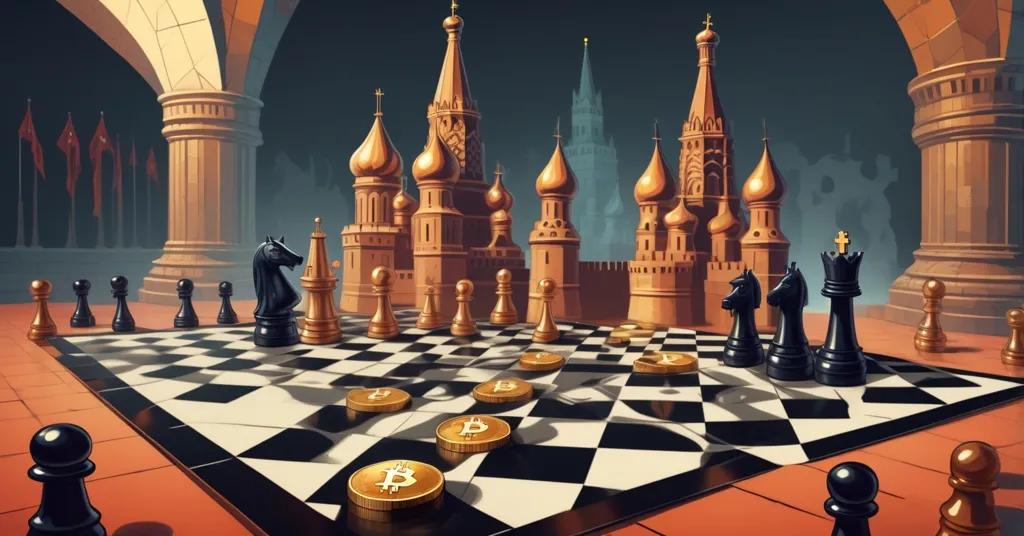
Russia’s crypto chess game is just getting started. By 2026, we’ll see if this overhaul crowns Bitcoin a regional heavyweight or binds decentralization in bureaucratic chains. With sanctions as the backdrop, digital assets are no longer just a speculative toy—they’re a lifeline, a weapon, and a gamble. Whether this sparks a financial revolution or tightens the state’s iron grip, one thing’s certain: the Kremlin’s moves will ripple far beyond its borders. Stay sharp, because this high-stakes play could rewrite the rules of the blockchain battlefield.
Key Questions and Takeaways
- What’s driving Russia’s crypto regulation overhaul?
The push stems from a need to integrate digital assets into mainstream finance, driven by Western sanctions limiting traditional banking access, while protecting retail investors with strict limits. - How will retail investors be affected by these changes?
Non-qualified investors are restricted to buying just 300,000 rubles (~$3,800) in crypto and may face risk-awareness tests, potentially curbing grassroots adoption. - Why is Russia exploring crypto for cross-border payments?
Facing sanctions, Russia sees state-issued digital tokens as a way to bypass restricted financial networks, enabling international trade outside traditional systems. - What’s the significance of classifying crypto mining as an export?
Recognizing mining as an export activity could boost Russia’s already massive industry, generating foreign currency, though it raises environmental concerns over energy use. - How does the digital ruble fit into this crypto landscape?
Set for a 2026 rollout, the state-controlled CBDC contrasts with decentralized crypto like Bitcoin, aiming to modernize finance under tight governmental oversight. - Why are privacy coins still banned under the new framework?
The Bank of Russia cites risks of illicit activity, prioritizing transparency over anonymity, a stance that clashes with blockchain’s privacy ethos. - Could Russia’s strategy reshape Bitcoin’s role in geopolitics?
Absolutely—state-driven adoption and mining boosts could strengthen Bitcoin regionally, but heavy control risks alienating decentralization advocates and skewing global dynamics.