Bitcoin Hit by Storm Fern: Foundry Down 60%, DeepSnitch AI’s $1.35M Presale Under Scrutiny
 LTB
LTB Bitcoin Mining Slammed by Winter Storm Fern: Is DeepSnitch AI’s $1.35M Presale the Fix or Just More Noise?
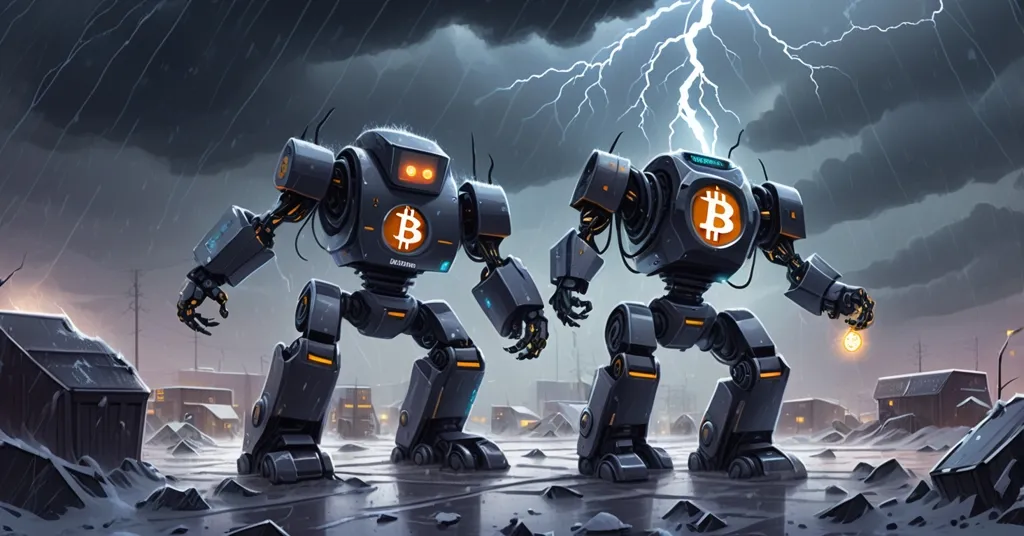
Bitcoin’s battle-hardened network faced a brutal hit as winter storm Fern ripped through the U.S., tanking Foundry USA’s hashrate by 60% and exposing cracks in crypto’s infrastructure. Meanwhile, DeepSnitch AI, a new project touting AI-driven market tools, has raised $1.35M in its presale, positioning itself as a solution to such volatility—but the hype smells like a classic crypto overpromise. Let’s cut through the chaos and dig into what’s really happening.
- Foundry USA Crisis: 60% hashrate drop triggered by power grid failures from winter storm Fern.
- DeepSnitch AI Hype: $1.35M raised in Stage 4 presale for DSNT token at $0.03681, promising AI trading tools.
- Reality Check: Bitcoin’s vulnerabilities are real, but presale promises of 100x gains raise serious red flags.
Bitcoin Mining Under Siege: Winter Storm Fern’s Fallout
The Bitcoin network, often hailed as an unshakeable fortress of decentralization, got a harsh reality check when winter storm Fern barreled through the United States in late January. The storm disrupted electrical grids across key mining regions, forcing Foundry USA—one of the largest Bitcoin mining pools—to slash its operations by a staggering 60%. For the uninitiated, hashrate is the measure of computational power securing Bitcoin’s blockchain. When it drops, the network slows down, meaning transactions take longer to confirm and fees can skyrocket as users bid for scarce block space. This isn’t just a tech hiccup; it’s a direct hit to Bitcoin’s usability and market stability, often spurring volatility as traders react to delays or fear network weakness.
The impact was immediate. Miners at Foundry USA, based heavily in storm-hit areas like Texas and the Midwest, curtailed operations to avoid overloading fragile local power systems—a move that echoes past grid stress events during extreme weather. Slower block production (the process of adding new transactions to Bitcoin’s ledger) means the network’s heartbeat weakens, and the ripple effects hit everyone from day traders to long-term hodlers. Historically, significant hashrate drops—like the 50% plunge after China’s 2021 mining ban—have led to temporary price dips and heightened uncertainty. While Foundry’s outage isn’t on that scale globally, it underscores a persistent flaw: Bitcoin mining’s reliance on concentrated, vulnerable infrastructure. Since the U.S. became a mining powerhouse post-China ban, hosting over 35% of global hashrate, regional disruptions like Fern can punch above their weight. Are we building a truly decentralized system, or just trading one point of failure for another?
Beyond the immediate chaos, this event raises bigger questions for Bitcoin’s future. Miners pulling back to stabilize grids is a noble gesture, but it exposes how tied the network remains to real-world bottlenecks. If a single pool’s downtime can rattle the ecosystem, what happens during larger crises—think nationwide blackouts or geopolitical clampdowns? Bitcoin maximalists might argue the network’s design ensures survival through difficulty adjustments (where mining gets easier if hashrate stays low), but that’s cold comfort when your transaction’s stuck for hours. The storm’s fallout isn’t just a technical footnote; it’s a glaring reminder that decentralization must extend beyond code to physical infrastructure.
Fighting Back: Solutions for Bitcoin Mining Resilience
So, how do we bulletproof Bitcoin against nature’s wrath and grid failures? The Foundry USA outage isn’t a one-off—it’s a symptom of deeper systemic risks that demand action. One path forward is geographic diversification. Mining power needs to spread beyond U.S. hotspots like Texas to regions with stabler climates and grids, or even untapped areas in Latin America or Northern Europe with cheap, renewable energy. Think of it as not putting all your eggs in one storm-prone basket. Kazakhstan tried this post-China ban, briefly hosting 18% of global hashrate before political instability kicked miners out. The lesson? Location matters, but so does political reliability.
Another angle is energy innovation. Bitcoin mining’s energy hunger—often pegged at over 150 terawatt-hours annually, rivaling small nations—makes it a lightning rod for criticism. Shifting to renewables like solar or wind could insulate miners from grid dependency, especially in remote setups where storms hit less hard. Projects like Square and Blockstream’s solar-powered mining in Texas are baby steps, but scaling this globally could be a game-changer. Then there’s the push for truly decentralized mining pools—smaller, community-run setups that dilute the impact of any single outage. Foundry USA’s dominance (often 20-30% of total hashrate) is a liability; imagine a world where no pool holds more than 5%. It’s a tall order, but tech like Stratum V2, which lets miners choose transactions directly, could nudge us closer.
These fixes aren’t overnight miracles. They require capital, coordination, and a willingness to rethink mining’s status quo—hallmarks of effective accelerationism we champion. Bitcoin’s strength is its adaptability; let’s not waste crises like Fern on finger-pointing when we could be building resilience. The question is whether miners, often profit-driven, will prioritize long-term network health over short-term gains. History says don’t hold your breath, but necessity might force their hand.
DeepSnitch AI Presale: Innovation or Just Another Shill?
Enter DeepSnitch AI, a project riding the wave of Bitcoin’s latest disruption with a shiny $1.35M presale haul in its Stage 4 round, pricing its DSNT token at $0.03681. Their pitch is seductive: a decentralized surveillance platform powered by five AI agents—SnitchFeed for real-time market news, SnitchScan for blockchain analytics, SnitchGPT for personalized insights, SnitchCast for predictive modeling, and AuditSnitch for security checks—all accessible via Telegram. The idea is to arm traders with instant data to navigate shocks like Foundry’s hashrate crash, where volatility can gut portfolios in hours. Over 22 million DSNT tokens are already staked, hinting at a potential supply squeeze if demand spikes, and a delayed public launch supposedly gives early holders an edge. On paper, it’s a tantalizing fix for a market screaming for better tools. For more on their presale milestone, check out the recent coverage of DeepSnitch AI’s $1.35M achievement.
But let’s not get dazzled by the buzzwords. DeepSnitch AI’s marketing is a masterclass in crypto hype, complete with absurd claims of 100x gains and a 150% bonus code (DSNTVIP150) for big-ticket buys over $10K. This isn’t a tech breakthrough; it’s a lottery ticket masquerading as innovation. The crypto graveyard is packed with presale darlings that promised the moon—think Bitconnect or countless 2017 ICOs—only to vanish with investor cash or limp into obscurity. DeepSnitch’s lack of transparency doesn’t help: there’s no public audit of their tech, scant team credentials, and zero proof these AI agents deliver beyond slick branding. Even their staking numbers could be gamed—locked tokens mean nothing if the project’s a mirage. The hosting platform’s disclaimer distancing itself from endorsement only deepens the skepticism. Is this the future of trading, or just another FOMO trap?
Playing devil’s advocate, real-time data tools aren’t a bad idea. Bitcoin’s wild swings and mining disruptions do leave traders blind without fast intel—Chainalysis and Glassnode have carved niches with analytics, proving demand exists. If DeepSnitch AI stripped the hype and focused on verifiable utility, it could fill a gap, especially for retail investors outpaced by whales. But pinning hopes on an untested presale, especially one dripping with shill tactics, is a gamble most can’t afford. As champions of decentralization, we love disruptive ideas, but not when they smell like opportunism. Until DeepSnitch shows hard evidence—say, a working beta or third-party validation—it’s just noise in a crowded, scam-ridden space.
Market Snapshot: XRP and Avantis in the Volatility Mix
To ground this chaos in broader market trends, let’s zoom out to two other coins often floated alongside speculative projects like DSNT—XRP and Avantis (AVNT). XRP, the token tied to Ripple’s cross-border payment network, sat at around $1.90 on January 26, stuck in a sideways crawl between $1.85 and $1.95 with support at $1.8209. Unlike Bitcoin’s decentralized ethos, XRP’s centralized supply (Ripple Labs holds a huge chunk) and ongoing SEC lawsuit over its security status make it a divisive pick. It’s stable amid Bitcoin’s mining mess, but offers no spark for traders betting on big moves. Could its reliability be a hedge when hashrate shocks rattle BTC? Maybe, but don’t expect fireworks.
Avantis (AVNT), a lesser-known altcoin, popped 27% to $0.3 on the same day, boasting a Total Value Locked (TVL) over $104M—think of TVL as the money users have parked in a project’s protocols, signaling trust or hype. Hitting resistance at $0.36, its pump might fizzle, but it reflects the speculative fever altcoins thrive on during Bitcoin uncertainty. Both XRP and AVNT contrast with DSNT’s wild promises, yet none come with concrete roadmaps to predict where they’re headed. Price chatter without fundamentals is just noise—traders beware of anyone peddling surefire gains in this fog.
Lessons for the Crypto Frontier
Stepping back, the Foundry USA outage and DeepSnitch AI’s presale circus paint a dual picture of crypto’s promise and peril. Bitcoin’s network is a marvel, but its physical anchors—concentrated mining power in storm-prone zones—remain a weak link. Fixes like geographic spread and renewable energy aren’t sexy, but they’re vital for a system that claims to defy centralized failure. Meanwhile, projects like DeepSnitch AI tap into real needs for data and speed, yet cloaking themselves in 100x fantasies and bonus gimmicks undermines any credibility. Bitcoin maximalists might scoff at altcoin distractions, and rightly so—BTC’s battle-tested network effects tower over most—but dismissing niche experiments risks missing genuine innovation. The trick is filtering signal from static.
As we push for effective accelerationism, rushing headlong into tech’s future, let’s not trip over hype machines or ignore Bitcoin’s real-world flaws. Foundry’s stumble is a call to build tougher infrastructure, not just pray for calmer weather. DeepSnitch AI might be a footnote or a fluke, but its existence begs us to ask: are we crafting tools for a decentralized tomorrow, or just chasing the next shiny distraction in a storm of our own making?
Key Takeaways and Questions
- What caused Foundry USA’s 60% hashrate drop, and why should Bitcoin users care?
Winter storm Fern crippled the U.S. electrical grid, forcing miners to scale back, slowing Bitcoin transactions, hiking fees, and spiking volatility—a direct hit to usability and network trust. - How can Bitcoin mining become more resilient to disruptions like Fern?
Geographic diversification to stable regions, adopting renewable energy, and decentralizing mining pools to limit single-point failures are key steps to shield the network from real-world shocks. - Does DeepSnitch AI offer a real solution for crypto volatility?
Its AI tools for real-time market and blockchain data address a genuine trader pain point, but unproven tech and outrageous 100x gain claims scream hype over substance—proceed with extreme caution. - Where do XRP and Avantis fit in amid Bitcoin’s challenges?
XRP’s $1.90 stability could be a safe haven during BTC disruptions, while AVNT’s $0.3 surge reflects altcoin speculation; neither matches DSNT’s wild promises nor Bitcoin’s proven grit. - What’s the broader takeaway for decentralization advocates?
Bitcoin’s physical vulnerabilities and presale scams highlight that true decentralization demands both robust infrastructure and skepticism of quick fixes—innovation must be real, not just rhetoric.