UBS Warns Investors as Silver Market Volatility Hits Record 100% with 30% Crash
 LTB
LTB UBS Issues Stark Warning as Silver Market Volatility Reaches Explosive Heights
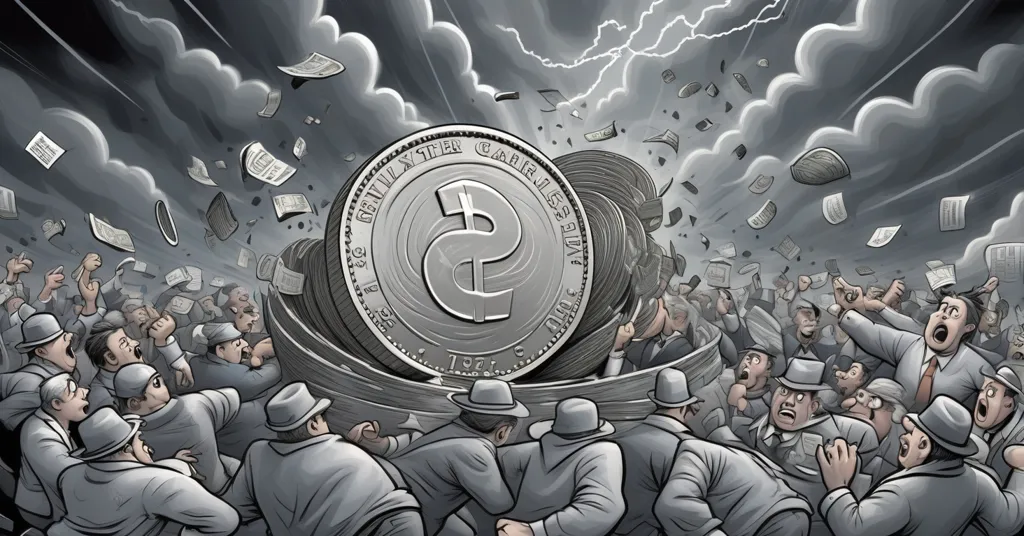
The silver market is in absolute turmoil, with price swings so violent they could give even the most seasoned trader whiplash. UBS, a global financial titan, has sounded the alarm, cautioning investors to steer clear as volatility in one-month silver contracts surpasses 100%, following a jaw-dropping near-30% crash in a single day. While this chaos might seem distant from the crypto sphere, the parallels to speculative frenzy and leveraged gambling are impossible to ignore.
- Historic Volatility: One-month silver contracts exceed 100% volatility, per UBS.
- Massive Crash: A 33% intraday drop on January 30, fueled by a $4 billion futures sell-off from the AGQ ETF.
- Crypto Parallels: Silver’s speculative mania mirrors meme-driven pumps in crypto markets.
What Sparked the Silver Market Meltdown?
On a single Friday last week, silver prices tanked nearly 30%, only to stagger through erratic bounces in the days that followed, landing at $73 per ounce spot price by Thursday night at 11:30 p.m. ET. New York silver futures weren’t spared, trading at $72.34, down over 5% that same night. If that doesn’t scream instability, consider this: since January, silver has endured 11 days with price shifts of at least 5%, according to LSEG data. That’s not trading; that’s a financial free-for-all.
The culprits behind this mess are a toxic brew of retail speculation and modern financial wizardry gone wrong. Retail investors, especially from regions like China and the West, drove a massive rally in January, treating silver less as a store of value and more as a speculative lottery ticket. Social media buzz, accessible trading apps, and economic uncertainty—think global debt and a weakening dollar—likely fanned the flames, though hard stats on exact retail losses remain elusive. When the bubble burst, it did so spectacularly. On January 30, the AGQ ETF (2x ProShares Ultra Silver ETF) unloaded nearly $4 billion in silver futures during a routine daily adjustment, triggering a historic 33% intraday crash—the worst in silver’s trading history, as confirmed by Saxo Bank’s Ole Hansen. For the uninitiated, an “intraday crash” means a sudden, brutal price drop within a single trading day, often leaving investors no time to react.
The Dangerous Dance of Leveraged ETFs
Let’s unpack the role of leveraged ETFs, because they’re a massive driver of this instability. Products like the AGQ ETF and WisdomTree Silver 3x Daily Leveraged ETF are designed to magnify daily price movements of silver futures—often doubling or tripling the gains or losses. Sounds like a thrill ride when prices are climbing, but when they nosedive, the damage is catastrophic. These funds reset their leverage ratio daily through a process called “rebalancing,” which can force massive buying or selling of underlying assets to maintain their promised multiplier. On January 30, AGQ’s rebalancing meant dumping $4 billion in futures, a move that amplified an already shaky market into a full-blown collapse.
The real kicker? This isn’t a niche issue. Bloomberg Intelligence notes that nearly a third of new ETFs launched last year included leverage, turning traditional commodities like silver into high-stakes casinos. The impact on retail investors—many of whom may not fully grasp these mechanics—is devastating, with amplified losses wiping out portfolios in hours. It’s a stark reminder of how modern financial tools can distort markets, much like over-leveraged trading on crypto exchanges has burned countless speculators. Are these ETFs innovative tools or reckless dynamite? For now, they’re lighting fuses left and right.
UBS’s Blunt Warning to Investors
UBS isn’t playing around with polite suggestions—they’re practically shouting from the rooftops for investors to back off.
“Significant price swings are likely in the near term,”
their analysts warned clients, pointing to volatility in one-month silver contracts exceeding 100%. To put that in perspective, such a figure means prices could theoretically double or halve in a blink, making any bet on silver right now akin to rolling dice in a hurricane. UBS’s stance, as detailed in a recent report cautioning against market volatility, is clear: current levels are a minefield, and jumping in is more likely to blow up your portfolio than build it.
This caution isn’t just about numbers—it’s about the sheer unpredictability of a market hijacked by speculative mania. Nicky Shiels from MKS Pamp nailed it when she said,
“Silver is certainly being labeled as a meme stock or commodity given its outsized volatility.”
When a centuries-old precious metal starts mimicking the wild swings of a Reddit-hyped stock, you know the game has changed—and not for the better.
Long-Term Outlook: Hope Amid the Havoc?
Despite the current dumpster fire, not everyone is writing silver off entirely. UBS projects a 300 million ounce supply shortfall this year, with investment demand possibly hitting 400 million ounces. That kind of imbalance could bolster prices over time, especially as economic recovery forecasts and expected lower interest rates by 2026 make precious metals more appealing as safe havens. Silver’s industrial role adds another dimension—it’s critical in solar technology, electronics, and catalysts, unlike gold which largely sits in vaults. Vasu Menon from OCBC summed up this duality, noting,
“Silver can be viewed as a hybrid asset with characteristics of a precious metal, industrial metal, and elements of speculation.”
His bold call? Silver hitting $134 per ounce by March 2027.
Let’s pump the brakes on that optimism, though. Forecasting $134 in this environment is more crystal ball gazing than cold analysis—markets this unhinged mock precision. And there are real risks to the bullish case. If economic recovery stalls, industrial demand for silver could crater. Alternative materials might also reduce silver’s tech relevance. Plus, as long as retail hype and leveraged products dominate, any upward trend could be derailed by another sudden crash. Long-term potential? Sure. But betting on it now is a gamble, not a strategy.
Parallels to Crypto: A Cautionary Tale
Silver’s wild ride isn’t just a commodity quirk—it’s a screaming red flag for anyone in the crypto space. The speculative frenzy, fueled by retail investors chasing quick gains, mirrors the meme-driven pumps we’ve seen with coins like Dogecoin in 2021 or the disastrous Terra-Luna collapse. Leveraged ETFs distorting silver prices aren’t far off from the over-leveraged derivatives trading on centralized crypto exchanges, where liquidations can cascade into market-wide panic. Just as AGQ’s $4 billion dump tanked silver, over-leveraged Bitcoin futures have triggered flash crashes on platforms like Binance during volatile periods.
But here’s where Bitcoin and decentralized tech might offer a counterpoint. Unlike silver, which is manipulated by centralized financial instruments, Bitcoin’s core value lies in its decentralized nature—no single ETF or fund can “dump” the network itself. Sure, leveraged trading in crypto exists, but initiatives in decentralized finance (DeFi) aim to prioritize transparency and reduce systemic risks through open protocols. Could DeFi offer a safer haven than traditional assets caught in speculative spirals? Possibly. Yet, Bitcoin isn’t immune to hype—its price has soared and crashed on sentiment alone. Silver’s “meme commodity” status begs the question: if a precious metal can be turned into a social media plaything, what’s stopping Bitcoin from facing similar distortions, or is its peer-to-peer backbone the ultimate defense?
This overlap of speculative bubbles across markets underscores why we champion decentralization. Centralized systems—be they leveraged ETFs or traditional exchanges—often amplify instability through opacity and overcomplexity. Silver’s plight is a stark reminder that unchecked speculation can overrun fundamentals, a lesson crypto investors know all too well. Perhaps blockchain-based alternatives, with their emphasis on transparency and user control, could point to a better way forward, assuming we avoid turning every token into the next hype train.
Key Takeaways and Burning Questions on Silver’s Turmoil
- What triggered the recent silver market upheaval?
Retail speculation from regions like China and the West, paired with a $4 billion futures dump by the AGQ ETF on January 30, caused a historic 33% intraday crash and sustained violent swings. - Why is UBS urging investors to avoid silver right now?
With one-month contract volatility over 100% and significant near-term price swings expected, UBS views current levels as dangerously unpredictable. - Does silver hold any long-term investment promise?
Potentially, as UBS highlights a 300 million ounce supply shortfall, industrial uses in solar tech, and economic recovery by 2026 as supportive factors, though risks like stalled demand loom large. - How do leveraged ETFs contribute to silver’s instability?
Products like AGQ and WisdomTree Silver 3x magnify daily price moves, distorting the market via forced rebalancing trades, transforming silver into a speculative “meme commodity.” - What lessons can crypto enthusiasts draw from silver’s volatility?
Silver’s speculative bubble mirrors crypto’s meme coin frenzies and leveraged trading risks, highlighting the need for decentralized systems that prioritize transparency over centralized distortions. - Is Bitcoin a safer bet than silver in volatile times?
Bitcoin’s decentralized structure avoids some centralized pitfalls like ETF dumps, but it’s not immune to speculative hype; DeFi could offer a more stable alternative if executed right.
Let’s call a spade a spade: the silver market is a disaster zone right now. Caught between its legacy as a precious metal, its utility in industry, and its bizarre new role as a speculative toy, silver exemplifies what happens when hype overtakes reason. UBS’s warning isn’t just a suggestion—it’s a wake-up call for anyone tempted to jump into this firestorm. Yet, for those with patience and a tolerance for pain, the fundamentals—supply shortages, industrial demand, macro tailwinds—hint at a possible comeback down the road. Just don’t hold your breath today unless you’re fine with financial asphyxiation.
For us in the crypto world, silver’s meltdown is a mirror held up to our own market’s past sins. It’s a brutal reminder that speculation can poison even the oldest assets, and a nudge to keep pushing for decentralized solutions that cut through the noise of centralized gambling. If silver can become a meme overnight, Bitcoin’s resilience will be tested too—unless its decentralized roots prove to be the shield we’ve been banking on. Until then, tread carefully, whether you’re eyeing silver ounces or satoshis. Markets don’t care about your dreams, only your discipline.