China Intensifies Crypto Crackdown: Bans Target Offshore Issuers and Yuan-Pegged Stablecoins
 LTB
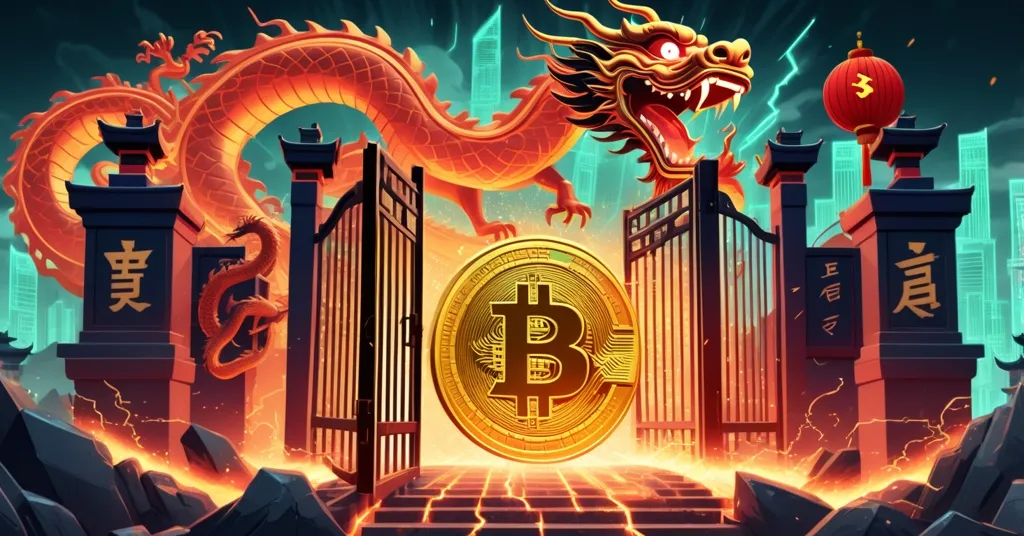
LTB China Slams the Iron Gate on Crypto: New Bans Target Offshore Issuers and Stablecoins
China is dropping the hammer on cryptocurrencies with a ferocity that could rattle even the most hardened Bitcoin HODLers. The latest wave of restrictions not only doubles down on the country’s long-standing ban but also takes aim at domestic firms and their overseas affiliates issuing virtual currencies or yuan-pegged stablecoins. Led by the People’s Bank of China (PBOC), Beijing’s message is crystal clear: the state-backed digital yuan is the only game in town, and anything else—especially decentralized tokens—is a financial outlaw.
- Reaffirmed Ban: China reinforces its prohibition on crypto, declaring it invalid as legal tender.
- Offshore Restrictions: Domestic companies and their global entities can’t issue tokens or yuan-pegged stablecoins without state approval.
- Digital Yuan Dominance: Beijing pushes its centralized digital currency as the sole legitimate option.
A History of Hostility: China’s War on Crypto
China’s beef with crypto isn’t new—it’s been a slow-burning vendetta since 2017, when the government banned initial coin offerings (ICOs) and shut down local exchanges. That move alone gutted a nascent industry, sending shockwaves through Bitcoin’s price and forcing projects to flee overseas. Fast forward to 2021, and Beijing delivered another blow by outlawing crypto mining—a sector where China once controlled over 60% of Bitcoin’s global hash rate. Miners packed up, relocating to places like Kazakhstan and Texas, while the network took a temporary hit before bouncing back stronger than ever. These weren’t just policy tweaks; they were calculated strikes to cripple decentralization within China’s borders.
Now, in 2023, the PBOC, alongside seven other government agencies, has issued a joint statement reiterating that virtual currencies have no legal standing as fiat money. Their justification? A surge in speculative activity—think wild altcoin pumps and soul-crushing dumps—has introduced “new risks” to a financial system Beijing keeps on a tight leash. This isn’t about saving retail investors from losing their shirts; it’s about ensuring no decentralized network dares challenge the state’s stranglehold on monetary policy. Capital outflows, market volatility, and the specter of untracked transactions keep regulators up at night, and they’re not messing around. For more on this latest regulatory hammer drop, check out the detailed report on China’s intensified crypto restrictions.
Stablecoins: China’s New Boogeyman
The spotlight in this crackdown shines brightest on stablecoins, particularly those pegged to the Chinese yuan. For the uninitiated, stablecoins are cryptocurrencies designed to hold a steady value, often tied to a real-world currency like the US dollar or, in this case, the yuan. Think of them as digital IOUs that mimic cash—useful for trading, remittances, or dodging exchange rate chaos. But for China, they’re a nightmare. These tokens can bypass the country’s strict capital controls, which limit how much money can leave its borders to maintain economic stability. A yuan-pegged stablecoin circulating on a global exchange is like a backdoor to financial freedom—one Beijing wants slammed shut.
Why the obsession with stablecoins now? Their adoption has exploded, fueled by decentralized finance (DeFi) platforms and cross-border trading. Unlike Bitcoin’s volatility, stablecoins offer a faux-fiat reliability that makes them a sneaky tool for capital flight. Imagine a Chinese investor converting yuan to a stablecoin, trading it on a foreign exchange, and cashing out in dollars—all without tripping the government’s alarms. As Winston Ma, an adjunct professor at NYU School of Law, bluntly stated:
“The message from regulators is that there will be no tolerance for a mix of private yuan-based stablecoins circulating on global crypto exchanges.”
The risk isn’t theoretical. Globally, stablecoins like Tether (USDT) have been tangled in controversies over money laundering and sanction evasion. For Beijing, a yuan-pegged equivalent could undermine trust in the currency itself, destabilizing an economy already wrestling with internal pressures. So, the new rules are ruthless: no domestic company, nor their overseas subsidiaries, can issue virtual currencies or stablecoins without explicit government approval. It’s a digital blockade, pure and simple.
Digital Yuan: A Government Chokehold, Not a Currency
Enter the digital yuan, China’s answer to the crypto conundrum. Unlike Bitcoin or Ethereum, which thrive on permissionless, decentralized networks, the digital yuan—also known as e-CNY—is a centralized system fully controlled by the PBOC. Picture it as a government-issued debit card with real-time tracking: every transaction is monitored, every user is identifiable, and the state holds the kill switch. This isn’t crypto in any meaningful sense; it’s a surveillance tool dressed up as innovation. Beijing loves it precisely because it reinforces control, not freedom.
But can the digital yuan compete with the borderless allure of true cryptocurrencies? Adoption has been sluggish, with many Chinese citizens still favoring established payment systems like WeChat Pay or Alipay for daily transactions. Privacy concerns loom large—why trust a currency where every coffee purchase could be logged by the state? While exact usage stats are murky, pilot programs in cities like Shenzhen show modest uptake, far from the revolutionary shift Beijing envisions. The digital yuan might dominate within China’s tightly guarded borders, but it lacks the soul of blockchain: the ability to operate beyond any government’s reach.
A Blockchain Future—With Strings Attached?
Amid the iron-fisted bans, there’s a curious sliver of nuance in the regulations—a mention of real-world asset (RWA) tokenization. For those new to the concept, RWA tokenization means digitizing ownership of physical assets like real estate, art, or commodities using blockchain technology. Imagine tokenizing a Shanghai skyscraper so 1,000 investors worldwide can own a tiny slice of it, like crowdfunding property with a digital twist. While China remains hostile to decentralized crypto, this language hints at a potential framework for state-sanctioned blockchain applications.
Louis Wan, Chief Executive of Unified Labs, sees this as a turning point:
“The key change lies in the clear separation between virtual currencies and RWA tokenization… For China’s RWA sector, [this move is] a milestone.”
Don’t pop the champagne just yet. Any RWA framework in China will likely be more shackled than a prison yard. Think government-approved real estate tokens with strict oversight, not a free-for-all marketplace. This isn’t about embracing decentralization; it’s about cherry-picking blockchain’s benefits while gutting its anti-authoritarian core. Still, it raises a question: could China accidentally spark controlled innovation that other nations mimic? Or will this just be another half-measure, hyping blockchain’s utility without its liberating essence?
Is China Right to Fear Crypto Chaos?
Let’s flip the script and play devil’s advocate. Is Beijing’s paranoia completely unwarranted? Crypto isn’t exactly a saintly ecosystem. Stablecoins have been implicated in money laundering and tax evasion worldwide, while speculative bubbles—like the 2021 altcoin frenzy—have torched countless retail investors. Decentralized systems, by design, evade oversight, making them a magnet for illicit activity. For a government obsessed with stability, crypto’s Wild West vibe is a legitimate threat. Add in the risk of capital flight eroding the yuan’s strength, and you can see why Beijing’s sweating.
But here’s the rub: by blanket-banning an entire technology, is China shooting itself in the foot? Blockchain isn’t just about speculative trading or meme coins; it’s a foundational shift in how value and trust are managed globally. The digital yuan might keep the state in the driver’s seat, but it can’t replicate the permissionless, borderless nature that makes Bitcoin a revolutionary force. Bitcoin maximalists might even argue that China’s crackdown purifies the network—pushing out centralized actors and reinforcing BTC’s censorship-resistant roots. It’s a trade-off: absolute control for potential obsolescence. Will China wake up a decade from now, realizing it missed the boat while the decentralized world sailed ahead?
Global Ripple Effects: A Domino in the Making?
Zooming out, China’s hardline stance contrasts sharply with the messy, varied approaches of other nations. El Salvador has made Bitcoin legal tender, betting its economy on decentralization. The European Union is crafting the Markets in Crypto-Assets (MiCA) regulation to balance innovation with oversight. Meanwhile, countries like India and Russia waver between cautious openness and outright bans. China’s latest move could tip the scales for these fence-sitters. If yuan-pegged stablecoins become a proven vector for capital flight, expect other governments to scrutinize tokens like Tether or USDC with renewed vigor.
For the global crypto community, China’s actions are a stark reminder: not every major economy buys into the decentralization gospel. This could embolden other authoritarian regimes to follow suit, creating a patchwork of digital iron curtains. Yet, for Bitcoin purists, it’s just another chapter in a saga of resilience. Governments can ban, block, and bluster, but the blockchain’s spirit—rooted in code, not compliance—keeps chugging along. China’s war on crypto might suppress it locally, but globally, it’s like trying to ban the internet. Good luck with that.
Key Takeaways and Burning Questions
- Why is China ramping up its crypto crackdown in 2023?
A spike in speculative trading and the growing threat of yuan-pegged stablecoins have regulators on edge, fearing financial instability and loss of monetary control. - What makes yuan-pegged stablecoins such a target?
They act as digital stand-ins for fiat, enabling capital outflows and bypassing Beijing’s strict financial barriers, directly challenging state authority. - Does China see any value in blockchain tech?
Yes, but only under tight control—mentions of RWA tokenization suggest a future for regulated asset digitization, not decentralized freedom. - How does China’s stance stack up against the world?
While some nations embrace or cautiously regulate crypto, China prioritizes centralized power, banning decentralization in favor of the digital yuan. - Could China’s ban backfire on its tech ambitions?
Potentially—shunning decentralized systems might isolate China from global blockchain innovation, even as it co-opts the tech for state purposes.
So, where does this leave us? For crypto enthusiasts in China, it’s a brutal reality check—trading, mining, and now offshore issuance are dead ends under the PBOC’s watchful eye. Globally, it’s a cold splash of water: the fight for financial freedom isn’t won yet, and major powers can still wage war on decentralization. But if history teaches us anything, it’s that Bitcoin and its ilk don’t bow to bans. China can build its digital walls, but the blockchain’s borderless nature always finds a crack to slip through. Will Beijing’s iron grip crush crypto within its borders, or will decentralization prove, once again, that it’s an idea no state can kill?