EU Proposes Full Ban on Russian Crypto Transactions to Stop Sanctions Evasion
 LTB
LTB EU Targets Russian Crypto Transactions with Sweeping Ban to Curb Sanctions Evasion
The European Union is taking a sledgehammer to sanctions evasion, proposing a complete ban on cryptocurrency transactions tied to Russia. With tensions still high from the 2022 invasion of Ukraine, the European Commission aims to shut down digital backdoors that have let Russian entities slip through Western financial restrictions like ghosts in the blockchain night.
- EU’s Iron Grip: A total ban on Russian crypto transactions to block sanctions evasion.
- Key Targets: Platforms like Garantex and A7, with its ruble-pegged stablecoin, in the crosshairs.
- Russia’s Defiance: Pushing domestic crypto regulations and corporate adoption despite pressure.
EU’s Crypto Crackdown: Shutting Down Russian Digital Lifelines
The European Commission’s latest move, as detailed by the Financial Times, is nothing short of a digital blockade. The proposal seeks to prohibit any engagement with crypto asset service providers or platforms based in Russia. This isn’t a mere warning shot—it’s a direct assault on the shadowy networks enabling billions to flow past sanctions. An internal EU document lays out the intent with stark clarity:
“In order to ensure that sanctions achieve their intended effect [the EU] prohibits to engage with any crypto asset service provider, or to make use of any platform allowing the transfer and exchange of crypto assets that is established in Russia.”
The focus falls on specific bad actors. Garantex, a crypto exchange sanctioned by the US in 2022 for being a cybercriminal’s playground, is a prime target, along with its successors. Then there’s the A7 payments platform, linked to the ruble-pegged A7A5 stablecoin, which has reportedly handled a jaw-dropping $100 billion in cross-border transactions despite existing restrictions, as noted in a recent report on EU sanctions efforts. For those new to the space, a stablecoin is a cryptocurrency designed to hold a steady value by being tied to a traditional currency, like the Russian ruble here. This peg makes it a handy tool for moving money without the wild price swings of something like Bitcoin, but it also means huge sums can slide through decentralized networks, often invisible to traditional banking oversight.
The web gets murkier with Grinex, a Kyrgyz exchange connected to Garantex for shuffling funds via A7A5. These platforms exploit the borderless nature of blockchain—the tech behind cryptocurrencies like Bitcoin—which operates on a peer-to-peer network. Think of it as a global ledger where no single person owns the book, but everyone can verify the entries. It’s brilliant for freedom and privacy, but a nightmare for regulators trying to pin down illicit flows. The EU knows that just slapping sanctions on one platform often leads to another popping up. As the European Commission bluntly noted:
“Any further listing of individual crypto asset service providers … is therefore likely to result in the set-up of new ones to circumvent those listings.”
Hence, the push for a blanket ban—cut off the entire ecosystem at the root. It’s a brutal tactic, acknowledging that decentralized tech can outrun centralized control faster than a Bitcoin transaction confirms.
Beyond Crypto: Digital Ruble and Dual-Use Goods Under Fire
The EU isn’t stopping at cryptocurrencies. The proposal extends to sanctioning 20 more Russian banks and banning transactions tied to the digital ruble, a state-backed digital currency being developed by the Central Bank of Russia. Unlike decentralized cryptos like Bitcoin, which thrive on community-driven networks with no central boss, the digital ruble is a government-controlled tool. It’s essentially a digital version of cash, but with the potential for state-orchestrated evasion at scale—think massive transactions bypassing sanctions under official cover. The EU sees this as a direct threat to its economic stranglehold on Russia.
Additionally, the plan targets exports of dual-use goods to Kyrgyzstan, a country suspected of reselling these items to Russia. Dual-use goods are products that can serve both civilian and military purposes—think drones or certain tech components. The suspicion is that Kyrgyzstan acts as a middleman, funneling prohibited items to aid Russia’s war efforts. This multi-layered approach shows the EU’s determination to close every loophole, digital or physical. But here’s the catch: unanimous consent from all 27 EU member states is required to enact these measures, and three countries are already voicing doubts. That hesitation could stall the entire operation, leaving the proposal as little more than a strongly worded threat.
Russia’s Defiant Pivot: Building a Crypto Fortress
While the EU sharpens its digital sanctions, Russia isn’t just playing defense—it’s constructing its own crypto stronghold. The country is forging a regulatory framework for digital assets, paving the way for both everyday folks (retail investors) and wealthier, experienced players (qualified investors) to trade through licensed platforms. The State Duma’s Committee on State Building and Legislation recently pushed forward a bill to regulate the seizure of crypto assets in criminal cases, targeting issues like money laundering and terrorism financing. This isn’t mere posturing; it’s a step toward integrating digital currencies into Russia’s financial fabric.
Corporate interest is also spiking. Sberbank, Russia’s largest bank by assets, is gearing up to offer crypto-backed loans to corporate clients. For the uninitiated, these loans let businesses use their digital holdings as collateral, similar to pledging a house for a traditional loan. But here’s the kicker: crypto’s volatility adds a wild card. If Bitcoin’s price crashes overnight, the collateral might be worth less than the loan, leaving borrowers and lenders in a bind. Still, Sberbank’s move signals that Russia sees crypto as more than a sanctions workaround—it’s a future financial pillar, Western pressure be damned.
The Hidden Costs of a Crypto Crackdown
Let’s not sugarcoat it: the EU’s blanket ban, while well-intentioned, risks serious blowback. For one, it could drive Russian crypto activity deeper underground. Sanction a platform like Garantex, and users might turn to even shadier tools like mixing services—digital laundromats that scramble transaction trails on the blockchain to hide where funds came from or went. These “tumblers” make it near impossible for authorities to track illicit flows, potentially worsening the very problem the EU aims to solve.
Then there’s the impact on global crypto markets. A harsh EU ban could spook investors, especially if it sparks fears of broader regulatory overreach. Bitcoin and altcoin prices might take a hit as uncertainty looms—nobody likes the idea of Big Brother breathing down blockchain’s neck. Paradoxically, though, it could also boost adoption elsewhere. If the EU clamps down, users in less-regulated regions might flock to Bitcoin as a censorship-resistant store of value, proving once again that you can’t ban the rain, just get wet trying. And what about innovation? Overzealous bans risk pushing developers and startups to friendlier jurisdictions, leaving Europe playing catch-up in the blockchain race.
Let’s play devil’s advocate for a moment. Some argue that blanket bans are a necessary evil from a national security standpoint—after all, if platforms like A7 are funneling $100 billion past sanctions, that’s funding for potential aggression. But here’s the counterpunch: history shows these sweeping measures often fail. Look at China’s repeated crypto crackdowns—bans since 2017 haven’t stopped trading; they’ve just moved it off-shore or underground. The EU risks the same futility, spending political capital on a digital Berlin Wall that coders and criminals will tunnel under in weeks.
Blockchain Battlefield: Freedom vs. Control
What’s unfolding here is a high-stakes clash between decentralized innovation and centralized power. Cryptocurrencies like Bitcoin were forged in the fires of disruption, born to challenge bloated financial systems and return control to individuals. As Bitcoin maximalists, we champion that ethos—decentralization is liberty. But the dark side stings. When platforms like Garantex or A7 exploit these tools for cybercrime or sanctions evasion, it tarnishes crypto’s promise and hands regulators a loaded gun. The EU’s proposed ban isn’t just about Russia; it’s a test of how far governments can—or should—reach into borderless systems.
While Bitcoin remains the gold standard of censorship resistance, other blockchains have their roles. Ethereum’s smart contracts, for instance, power complex decentralized apps that Bitcoin isn’t built for, and niche stablecoins like A7A5 show how pegged assets can grease cross-border wheels—legit or not. The challenge is accountability without annihilation. Blanket bans could choke innovation, but unchecked evasion invites harsher rules. The crypto community must push for smarter oversight—think open-source tracking tools to catch bad actors without torching the whole ecosystem. It’s effective accelerationism in action: build fast, break barriers, but don’t let the rubble bury the vision.
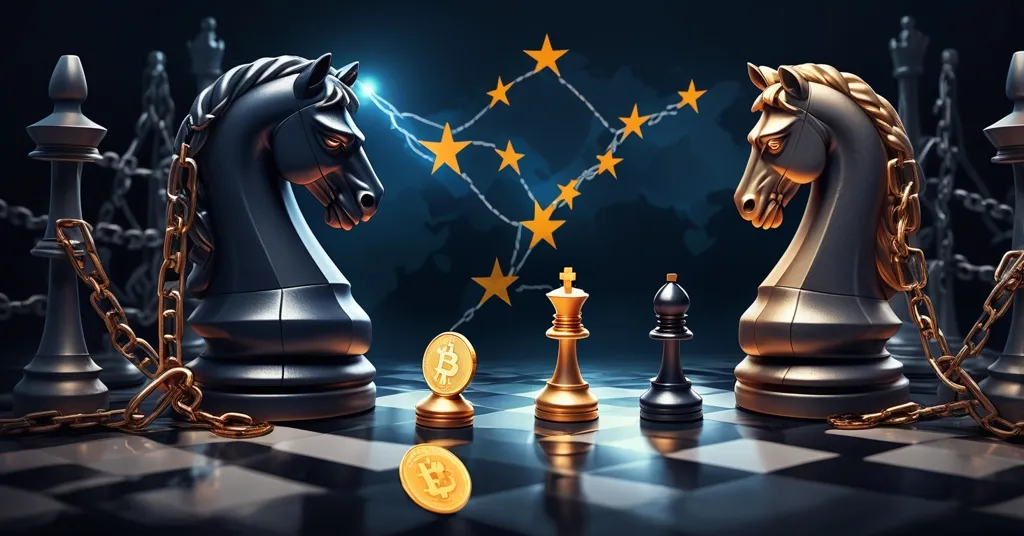
This showdown also spotlights crypto’s geopolitical weight. Blockchain is no longer just tech; it’s a chess piece in global power plays. Russia’s pivot to regulate and integrate digital assets, even as Sberbank dabbles in crypto loans, shows they’re not folding under EU pressure—they’re rewriting the rules. For Bitcoin purists, it’s a call to stay sharp; for altcoin advocates, it’s a chance to prove utility in murky waters. One certainty remains: the blockchain battlefield is getting uglier, and the soul of decentralization hangs in the balance.
Key Questions and Takeaways on the EU-Russia Crypto Clash
- What is the EU’s proposed ban on Russian crypto transactions trying to achieve?
The EU aims to halt all dealings with Russian-based crypto platforms to stop sanctions evasion, zeroing in on notorious entities like Garantex and the A7 platform, which has moved $100 billion via its A7A5 stablecoin. - Why is unanimous EU agreement a potential roadblock?
All 27 member states must greenlight the proposal, but three are already skeptical, which could delay or derail the ban on Russian crypto activity. - How is Russia countering this sanctions pressure with crypto?
Russia is crafting a regulatory framework for digital assets, enabling trading for investors, while heavyweights like Sberbank explore crypto-backed loans, showing both defiance and adaptation. - What risks does the EU ban pose to global cryptocurrency markets?
A tough ban could rattle investors, potentially tanking Bitcoin and altcoin prices due to regulatory fears, though it might also drive adoption in freer regions as users seek untraceable assets. - Does overregulation threaten blockchain’s decentralized spirit?
Damn right it does—blanket bans could strangle innovation and push activity underground, but unchecked evasion by bad actors like A7 fuels the case for tighter grips, making balanced, tech-savvy policies critical. - How does this conflict highlight crypto’s geopolitical role?
It reveals blockchain’s dual edge as a tool for freedom and evasion, placing Bitcoin and other cryptocurrencies at the heart of international power struggles and regulatory wars.