EU Bans Russian Crypto Ties as Moscow Powers Up Mining Operations
 LTB
LTB EU Slams Door on Russian Crypto Ties as Moscow Fuels Mining Surge
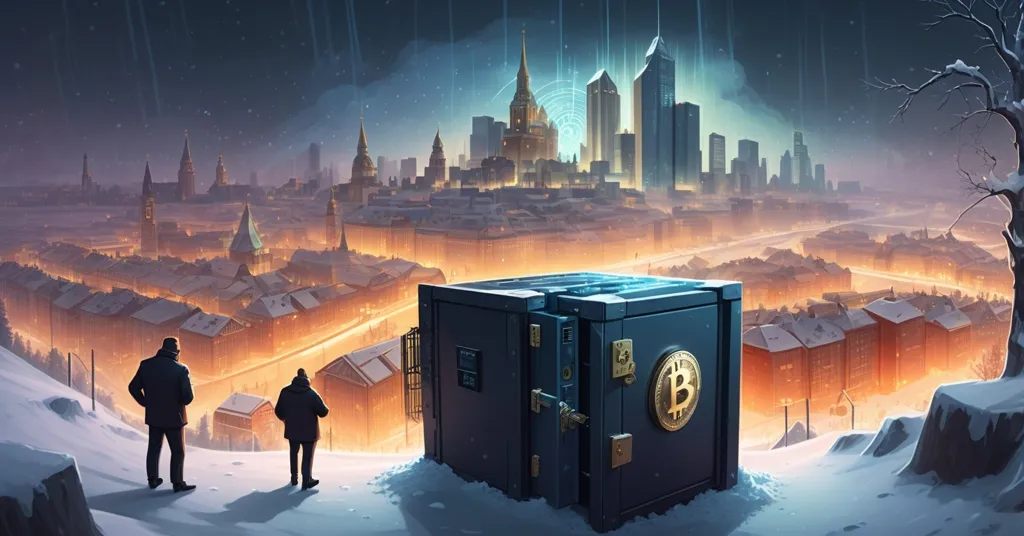
The European Union is gearing up to enforce a total ban on cryptocurrency transactions with Russian entities, tightening the financial noose in its 20th sanctions package since the Ukraine invasion. Meanwhile, Russia is countering with a bold push into regulated crypto mining, exemplified by broker Finam’s new investment fund. This clash reveals the raw power of decentralized tech in geopolitical conflicts, where blockchain is both a weapon and a shield.
- EU’s Hardline Ban: A sweeping prohibition on all crypto dealings with Russian entities to block sanctions evasion.
- Russia’s Mining Play: Regulated funds fuel industrial-scale mining, leveraging energy and climate advantages.
- Digital Battleground: Crypto emerges as a pivotal tool in financial strategy and resistance.
EU’s Iron Fist: Targeting Every Crypto Link
The European Commission has rolled out a fierce proposal to cut off all cryptocurrency transactions between EU individuals or companies and Russian crypto-asset service providers. This isn’t a selective strike like past sanctions targeting specific exchanges or wallets; it’s a complete blackout aimed at crushing every possible loophole. Since Russia’s invasion of Ukraine in 2022, the EU has unleashed 19 sanctions packages, but the borderless, decentralized nature of cryptocurrencies has allowed sanctioned Russian platforms to slip through by rebranding or rerouting operations. Blockchain tech, at its core, enables peer-to-peer value transfers without traditional banking oversight—think sending money directly to someone halfway across the world with no bank or government in the loop. The EU sees this as a glaring threat, and their latest draft pulls no punches, targeting not just Bitcoin or Ethereum transactions but also ruble-linked stablecoins and even potential central bank digital currencies (CBDCs) that Moscow might roll out. For more on this development, check out the latest update on the EU’s efforts to sever Russian crypto connections.
For those new to the space, stablecoins are cryptocurrencies pegged to assets like fiat currency to maintain a steady value—imagine a digital dollar that doesn’t fluctuate like Bitcoin. A ruble-linked stablecoin could act as a digital version of Russia’s currency, usable for payments beyond sanctioned borders. CBDCs, on the other hand, are government-issued digital currencies, often pitched as the future of state-backed money with tight control over transactions. The EU worries these tools could become backdoors for Russia to sidestep traditional financial restrictions, funneling funds without detection. But here’s the rub: enforcing a ban on a decentralized system like blockchain is like trying to ban whispers in a crowd. Transactions can be masked through anonymous wallets, and the tech doesn’t bow to geopolitical lines. The EU’s resolve is clear, but the practical hurdles are immense.
There’s also a political snag. This blanket ban needs unanimous approval from all 27 EU member states—a tough sell when national interests clash. Some countries might hesitate, fearing blowback on their own crypto sectors or worrying that pushing Russia out of regulated spaces just drives activity deeper into shadowy, untraceable networks. Let’s be real: if you think Brussels can fully outsmart a tech built by cypherpunks, you’ve never tangled with a buggy smart contract. This move sends a loud message, though—crypto isn’t a fringe experiment anymore; it’s a frontline in financial pressure through sanctions.
Russia’s Mining Gambit: Turning Energy into Power
While the EU tightens the screws, Moscow is laying out the red carpet for crypto miners with a very different vision. Russian financial broker Finam has launched a regulated investment fund focused on cryptocurrency mining, registered with the Bank of Russia. This isn’t a fly-by-night scheme but a formal vehicle funding industrial-scale mining operations, including facilities powered by natural gas in regions like Mordovia. For the uninitiated, crypto mining—especially for Bitcoin—involves validating blockchain transactions by solving complex mathematical puzzles, a process that demands massive computational power and, crucially, energy. Russia holds a trump card here: abundant, cheap energy from gas and hydroelectric sources, paired with a frigid climate that naturally cools mining rigs, slashing costs. Picture a Bitcoin mine in Siberia, where subzero temps handle your cooling for free while dirt-cheap gas keeps the lights on. It’s a miner’s paradise—and Russia’s economic ace.
Finam’s fund offers Russian investors a way to tap into crypto mining profits without directly owning digital assets, a neat sidestep aligning with Moscow’s push to formalize the sector under Western sanctions. This isn’t just about stacking Bitcoin; it’s about creating value that’s tough to freeze or seize, unlike bank accounts tied to SWIFT or other global systems. Russia’s strategy is a calculated middle finger to traditional financial controls, positioning itself as a global mining hub. The numbers speak for themselves—post-China’s 2021 mining ban, Russia reportedly climbed to one of the top spots in global Bitcoin hash rate, the total computational power securing the network. If Moscow corners even more of this hash rate, it could shift Bitcoin’s dynamics, influencing transaction validation and network security worldwide.
The Decentralization Dilemma: Risks on Both Sides
Let’s cut through the hype and look at the underbelly of these moves. The EU’s all-out ban assumes choking crypto access will cripple Russia’s sanctions evasion, but what if it just pushes activity into darker corners? Decentralized systems thrive under pressure—blockchain was born to resist censorship. A blanket ban might hammer legitimate businesses or exchanges trying to comply, while crafty players pivot to peer-to-peer trades (direct user-to-user transactions with no middleman) or mixers (tools that scramble transaction data for privacy, often exploited by illicit actors). The result? Brussels could end up with less visibility into Russian crypto flows, not more. And let’s not forget the collateral damage—EU-based blockchain startups, already navigating a maze of regulations, might get caught in the crossfire, stifling innovation on the continent. As advocates of decentralization, we see the irony: trying to control a borderless tech might just undermine the very systems the EU wants to protect.
On the flip side, Russia’s mining boom isn’t all sunshine and Satoshi vibes. State-backed mining on a massive scale risks centralizing Bitcoin’s hash rate in Moscow’s hands, a direct clash with the protocol’s core ethos of distributed, censorship-resistant power. Hash rate concentration matters—if one entity controls over 50% of it, they could theoretically manipulate transactions or launch a so-called 51% attack to double-spend coins, undermining trust in the network. Bitcoin maximalists like us cheer any embrace of the original cryptocurrency as proof of its unstoppable nature, but a state warping its decentralized spirit is a bitter pill. Historically, China’s dominance in mining pre-2021 raised similar alarms until their crackdown scattered hash rate globally. Russia stepping into that void could reignite those fears, prompting regulators worldwide to cry foul over network security or market manipulation.
Environmental Heat and Altcoin Shadows
Then there’s the environmental elephant in the room. Bitcoin mining catches endless flak for its energy hunger—think coal plants powering rigs in some regions, spewing carbon like there’s no tomorrow. Russia’s reliance on natural gas might be less dirty than coal, and those cold climates cut cooling costs, but it’s still a fossil fuel play. Environmental, social, and governance (ESG) investors and green-minded crypto advocates are already squinting hard at this expansion. Compare this to innovations elsewhere—miners in places like Iceland or Canada often tap renewables like geothermal or hydro power. Russia’s gas-heavy approach could spark backlash, especially as the global Bitcoin energy debate rages on. Could Moscow face pressure to pivot, or will economic survival trump eco-concerns? Don’t hold your breath for a green revolution in Siberia.
Altcoin ecosystems offer another lens on this mess. Ethereum, for instance, ditched energy-intensive mining with its 2022 shift to Proof-of-Stake, a consensus mechanism that slashes power use by validating transactions via staked coins instead of raw computation. Ethereum’s defenders might scoff at Russia’s old-school Bitcoin mining obsession, arguing their platform’s smart contracts and decentralized finance (DeFi) protocols offer more agile tools for dodging sanctions—think programmable money flows that don’t need rigs. Yet, they’re not immune to geopolitical games; DeFi platforms can still be targeted by regulators, and stablecoins on Ethereum could fall under the EU’s ban hammer just as easily. While we lean toward Bitcoin as the ultimate disruptor—its code is law, and no state can fully tame it—we can’t ignore altcoins’ role in filling niches Bitcoin doesn’t touch.
Human Stakes and Global Ripples
Zooming out, this isn’t just a policy spat—it’s personal. For everyday Russians, battered by ruble volatility under sanctions, Bitcoin and other cryptocurrencies offer a lifeline to store value or move funds beyond frozen banking channels. Anecdotal reports suggest a spike in crypto adoption among citizens since 2022, though hard data is scarce. In the EU, meanwhile, crypto users and firms brace for compliance headaches—imagine running a small blockchain startup in Berlin and suddenly needing to vet every wallet for Russian ties. The human cost of these chess moves often gets buried under headlines, but it’s real.
Globally, this EU-Russia showdown signals crypto’s ascent as a geopolitical force. Other sanctioned nations like Iran or Venezuela, already dabbling in mining or state-backed digital currencies, might take notes from Moscow’s playbook. If crypto proves a viable escape hatch from financial isolation, expect more countries to jump in, further straining regulatory frameworks. This isn’t just about Bitcoin or blockchain; it’s about who controls the future of money. The EU wants to strangle Russia’s access to these tools, while Moscow wields them for survival. Neither side can fully bend decentralized tech to their will, and that’s the beauty—and chaos—of it.
Key Questions on the EU-Russia Crypto Clash
- Why is the EU banning all crypto transactions with Russia?
The EU seeks to seal every gap that lets sanctioned Russian entities dodge financial restrictions using decentralized platforms, viewing crypto as a critical threat to sanctions enforcement. - How is Russia using Bitcoin mining to fight Western sanctions?
Through regulated funds like Finam’s, Russia powers industrial-scale mining with cheap energy and cold climates, generating economic value outside Western-controlled systems. - Could the EU’s crypto ban drive Russian activity underground?
Yes, it risks pushing transactions into untraceable peer-to-peer networks or privacy tools like mixers, possibly making oversight tougher for regulators. - Does Russia’s mining surge threaten Bitcoin’s decentralization?
Absolutely—state-driven mining could concentrate hash rate control in Moscow, clashing with Bitcoin’s vision of a distributed, censorship-resistant network. - Are stablecoins and CBDCs real threats for sanctions evasion?
Indeed, ruble-pegged stablecoins and potential central bank digital currencies could serve as alternative payment channels, bypassing traditional banking blockades. - What’s the environmental toll of Russia’s mining push?
Relying on natural gas, while less polluting than coal, still raises carbon concerns, drawing scrutiny from eco-conscious crypto advocates and investors. - How does this clash shape global blockchain trends?
It underscores crypto’s role as a geopolitical tool, potentially inspiring other sanctioned nations to adopt mining or DeFi, while pushing regulators to clamp down harder on decentralized tech.
So, where do we stand? The EU’s iron grip on crypto aims to choke Russia’s financial lifelines, but blockchain doesn’t play by anyone’s rules. Moscow’s mining rigs, humming with defiant energy, prove crypto isn’t just a speculative game—it’s a survival tactic. For Bitcoin purists, there’s a grudging nod to any nation betting big on the king of crypto, yet the specter of state control looms large. Altcoin fans might argue smarter, leaner systems like Ethereum point to a different future. One thing’s certain: the fight over digital money is a fight for power and freedom. Will Brussels outmaneuver a borderless tech, or will Russia’s miners keep hashing their way to resilience? Stick with us as we unravel this financial revolution, no fluff, just facts.