BlockDAG at $0.00016 Sparks Trader Shift from Hedera, Dogecoin Ahead of March 4 Launch
 LTB
LTB Shifting Sands: Traders Ditch Hedera and Dogecoin as BlockDAG’s $0.00016 Pre-Launch Window Nears March 4 Debut
Crypto markets are buzzing with a notable pivot as traders move away from established names like Hedera and Dogecoin, turning their gaze toward BlockDAG (BDAG), a newcomer priced at a mere $0.00016 in its final pre-launch Genesis phase before public trading begins on March 4. This shift reflects a broader hunger for fresh opportunities in a space still reeling from past crashes and craving the next big thing. Let’s break down the dynamics behind this trend and what it means for investors.
- Hedera’s Slow Grind: Price forecasts for 2026 sit at $0.10 to $0.23, supported by enterprise interest but lacking explosive potential.
- Dogecoin’s Stale Hype: Price trapped between $0.10–$0.12 support and $0.21–$0.22 resistance, driven by memes over merit.
- BlockDAG’s Early Buzz: At $0.00016 with over 35,000 airdrops claimed, it’s a speculative bet ahead of its trading launch.
Why Trader Sentiment Is Shifting Now
The crypto market is a fickle beast, shaped by equal parts innovation and irrational exuberance. After the brutal 2022 bear market—marked by collapses like FTX and Terra-LUNA—investors are caught between caution and desperation for the next breakout star. Bitcoin remains the unshakeable king, a beacon of decentralized freedom and store of value, but its steady dominance leaves little room for the wild gains speculators chase. Altcoins, once the darlings of 2021’s bull run, now face fatigue as projects struggle to deliver on lofty promises. Hedera’s enterprise focus feels too tame, Dogecoin’s meme-driven spikes are losing steam, and new entrants like BlockDAG are capitalizing on the early investment window. This pivot isn’t just about tech—it’s about psychology, timing, and the relentless hunt for outsized returns in a space that thrives on disruption.
Hedera: Enterprise Promise, Speculative Yawn
Hedera stands out as a blockchain alternative built for the corporate world, leveraging a technology called hashgraph. Unlike traditional blockchains, hashgraph uses a Directed Acyclic Graph (DAG) structure paired with a gossip protocol—think of it as news spreading through a small town, where each person quickly shares what they’ve heard with others—to achieve rapid consensus. It also employs virtual voting, a mechanism where nodes agree on transaction validity without a central overseer, promising high-throughput processing for thousands of transactions per second. This has attracted heavyweights like IBM and Google Cloud to its governing council, positioning Hedera for real-world use cases such as supply chain tracking or tokenized assets.
Price predictions for 2026 range from $0.10 to $0.23, a gradual uptick from today’s levels, driven by potential enterprise adoption and overall market momentum. Yet, there’s no hint of a dramatic surge. Hedera’s growth trajectory is more tortoise than hare—steady, reliable, but unlikely to get hearts racing among traders looking for quick 10x gains. Its centralized governance, while appealing to businesses, also raises eyebrows among decentralization purists who see Bitcoin’s leaderless ethos as the gold standard. And with competition from Ethereum, Polkadot, and others vying for enterprise attention, Hedera’s path isn’t guaranteed. Could a major partnership spark an unexpected rally? Possibly, but for now, it’s a safe bet that lacks sizzle.
Dogecoin: Meme Magic Losing Its Spark
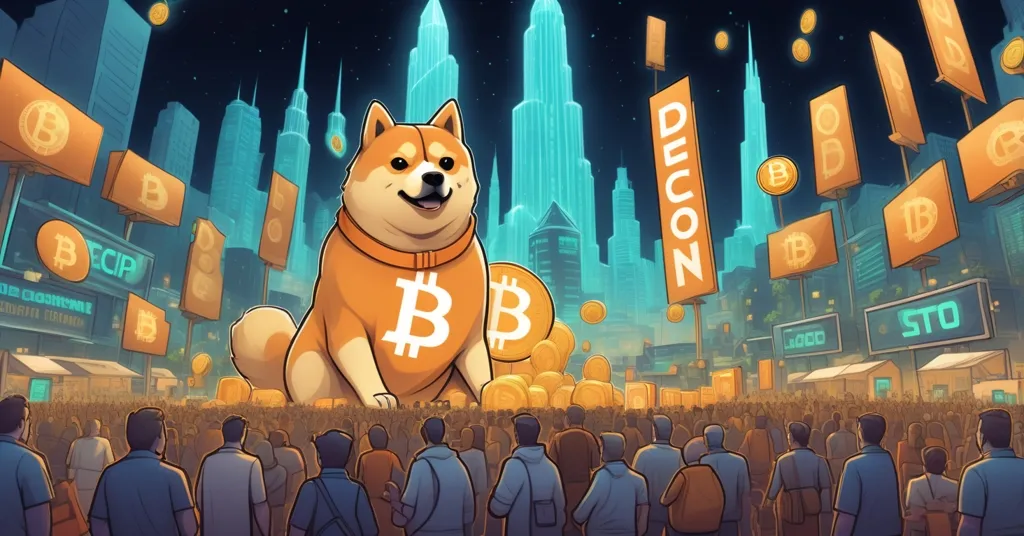
Dogecoin, the Shiba Inu-faced coin born as a 2013 joke, somehow clings to relevance despite offering little beyond nostalgia. Built on a proof-of-work model akin to Bitcoin but with faster block times and negligible fees, it’s a cheap, accessible option for microtransactions or online tipping. Its 2021 surge—propelled by Elon Musk’s tweets and Reddit’s WallStreetBets crowd—saw it briefly hit $0.73, turning pocket change into life-changing sums for early holders. Today, though, its price languishes in a predictable range, with support (a level where buyers often step in to halt declines) at $0.10–$0.12 and resistance (where selling pressure caps gains) at $0.21–$0.22.
What drives Dogecoin’s volatility? Not tech upgrades or killer apps, but raw community sentiment and macro market ripples. A Musk endorsement can send it soaring; a regulatory rumor can tank it overnight. It’s the crypto equivalent of a carnival game—entertaining, but not a serious investment. Still, let’s not write it off entirely: Dogecoin’s low barrier to entry makes it a gateway for crypto newbies, and its cultural staying power shouldn’t be underestimated. But with no meaningful development on the horizon and growing scrutiny on meme coins, traders seem to be tiring of the joke. Can its loyal DOGE army defy the odds again? Maybe, but banking on vibes over value is a risky play.
BlockDAG: Ground-Floor Gamble or Bust?
BlockDAG (BDAG) is the shiny new toy grabbing headlines, priced at a microscopic $0.00016 in its final Genesis phase before public trading launches on March 4. Like Hedera, it utilizes a DAG structure, but with a focus on parallel block processing to boost scalability and speed, potentially handling transaction volumes that dwarf traditional chains. While specifics on testnet results or exact throughput goals remain sparse, the promise is clear: a network that could rival or exceed existing solutions in efficiency. With exchange listings secured, RPC nodes active on 15 platforms, and over 35,000 airdrops already claimed, BlockDAG is drumming up serious early interest. Once the Genesis phase ends, pricing shifts to market-driven dynamics, starting with spot markets and later expanding to futures as liquidity builds.
At this entry point, it’s hard not to feel the pull of FOMO—a penny-stock bet with moonshot potential. But let’s pump the brakes on the optimism. Early-stage crypto projects are a minefield; for every Ethereum that reshapes the game, there are countless failures that vanish into obscurity or worse, rug-pull their investors. BlockDAG’s ultra-low price could signal confidence in organic growth—or desperation to attract liquidity. Key questions linger: Who’s behind the team? Are there proven use cases, or is this pure speculation? Post-launch, will early holders dump their bags, crashing the price? Compare this to past hype trains like EOS, which raised billions in 2018 only to underdeliver. BlockDAG might be a dark horse, but it’s a long shot, and anyone jumping in should brace for a bumpy ride.
Bitcoin’s Lens: Maximalism Meets Innovation
As Bitcoin maximalists, we view the world through a lens of skepticism toward anything that strays from BTC’s core principles of decentralization, security, and sovereignty. Bitcoin isn’t just a currency; it’s a rebellion against centralized control, a tool for privacy and freedom in a world of overreaching systems. Hedera’s corporate governance feels like a compromise, trading pure decentralization for enterprise appeal. Dogecoin, while fun, lacks the ideological weight to matter in the long game. BlockDAG, with its unproven tech and speculative hype, risks diluting the focus on what makes crypto revolutionary—though if it delivers on scalability, it could complement Bitcoin by filling a niche BTC doesn’t aim to serve.
We’re champions of effective accelerationism, pushing for tech that disrupts the status quo at breakneck speed, but not at the cost of principles. Altcoins and protocols like Ethereum have shown that innovation outside Bitcoin can drive the space forward—smart contracts changed everything, after all. If BlockDAG or others solve real problems like transaction throughput without sacrificing user autonomy, they deserve a seat at the table. But let’s not kid ourselves: Bitcoin is the bedrock. Stack sats first, speculate second, and never forget that most altcoin graveyards are paved with broken promises.
What’s Next for Crypto Investors?
Navigating this terrain means balancing the thrill of new tech with the harsh reality of market traps. Hedera offers a stable, if uninspiring, play for those betting on enterprise adoption. Dogecoin might still have meme-fueled spurts, but it’s a gamble with diminishing returns. BlockDAG tempts with ground-floor potential, but it’s the riskiest of the trio—think of it as a lottery ticket rather than a sure thing. For practical steps, diversify: keep a core holding in Bitcoin for resilience, allocate a smaller slice to established altcoins like Hedera for steady growth, and reserve a tiny fraction for speculative bets like BlockDAG if you can stomach the volatility. Above all, we’re here to push decentralization, not peddle pipe dreams. Verify everything—team credibility, tech claims, tokenomics—before risking a single satoshi. The crypto Wild West rewards the bold, but it chews up the reckless even faster.
Key Questions and Takeaways
- What’s the price outlook for Hedera by 2026?
Forecasts point to a range of $0.10 to $0.23, fueled by enterprise interest and market trends, though a sharp rally seems unlikely without a major catalyst. - Why are traders cooling on Dogecoin?
Its price is stuck between $0.10–$0.12 support and $0.21–$0.22 resistance, driven by hype rather than tech, leaving investors seeking more substance. - What’s the big deal with BlockDAG’s Genesis phase?
Priced at $0.00016 before its March 4 trading debut, with 35,000+ airdrops claimed, it’s a rare low-entry shot at speculative gains, albeit with high risk. - Should investors abandon Hedera and Dogecoin for BlockDAG?
Not outright—Hedera offers stability, Dogecoin has cultural pull, and BlockDAG is a wildcard; it’s about risk tolerance and portfolio balance, not blind jumps. - How does Bitcoin fit into this altcoin shuffle?
Bitcoin remains the ultimate safe haven for decentralization and value; altcoins like BlockDAG may innovate, but they’re unproven against BTC’s track record. - What risks should crypto investors prioritize?
Early projects like BlockDAG carry unknowns—team opacity, tech failures, or dumps—while even established coins like Dogecoin face sentiment swings; research is non-negotiable.