Bitcoin Whales Stir Volatility on Binance with Massive 10,000 BTC Transfers
 LTB
LTB Bitcoin Whales Drop Bombshells on Binance: Volatility Looming?
Bitcoin whales are making major moves on Binance, sending shockwaves through the crypto market as Bitcoin struggles below $70,000. These large holders, who can sway prices with a single transaction, have ramped up activity on one of the world’s biggest exchanges, leaving traders and enthusiasts on edge about what’s next for the king of digital assets.
- Whale Activity Spike: Whale inflow ratio on Binance surged from 0.4 to 0.62 between February 2 and 15.
- Massive Transfer: A wallet linked to Garrett Jin, the “Hyperunit whale,” moved nearly 10,000 BTC.
- Volatility Warning: Large inflows raise the risk of sharp price swings, though outcomes remain uncertain.
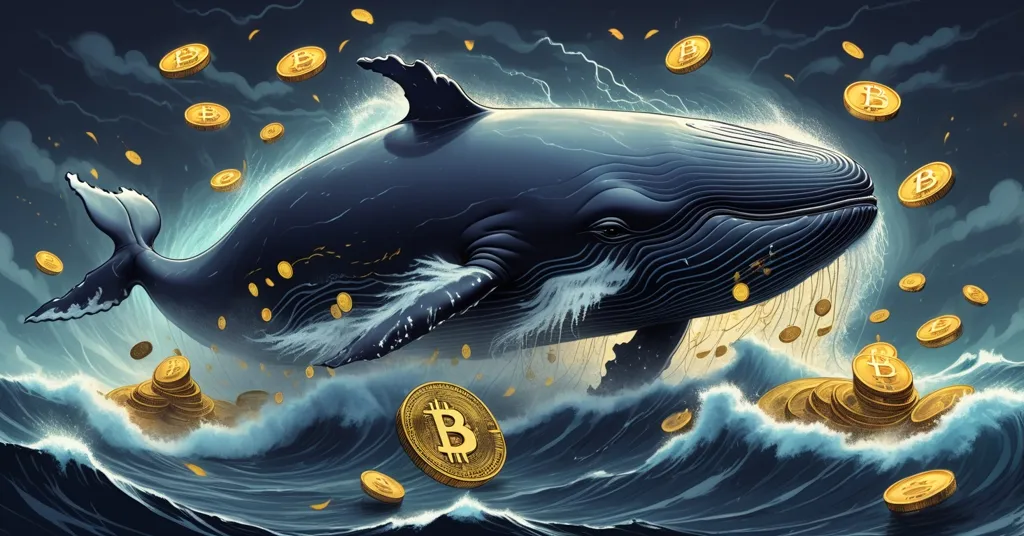
Picture this: a financial tsunami crashing onto Binance’s trading floor as Bitcoin whales—those mega-holders with wallets fat enough to dwarf most portfolios—unload massive stacks of BTC. Data from CryptoQuant paints a stark picture: between February 2 and 15, the whale inflow ratio on Binance, a metric tracking large Bitcoin deposits relative to total inflows, skyrocketed from 0.4 to 0.62. That’s a clear signal the big players are shuffling serious coin, as reported in a recent analysis of Bitcoin whale movements on Binance. As @Darkfost_Coc highlighted on Twitter, sharing insights from CryptoQuant:
“Between February 02 and 15, the ratio rose sharply from 0.4 to 0.62, signaling a significant resurgence of whale activity on Binance.”
Leading the charge is a wallet tied to Garrett Jin, dubbed the “Hyperunit whale” in crypto circles for his outsized transactions and mysterious presence. Jin’s address alone transferred a jaw-dropping 10,000 BTC to Binance during this window—an amount worth hundreds of millions at current prices. He’s not a lone actor, though. Multiple independent large wallets have also funneled hefty sums to the exchange, suggesting either a coordinated shuffle or a broader trend among Bitcoin’s elite. Whether this is strategic repositioning or a prelude to chaos, the scale of these Bitcoin whale transactions is impossible to ignore.
Breaking Down Whale Activity on Binance
For the uninitiated, whales are individuals or entities holding massive amounts of Bitcoin, often thousands of coins, giving them the power to influence market dynamics. When they move coins to an exchange like Binance, it’s tracked via the whale inflow ratio—a simple measure of how much of the total Bitcoin flowing into the platform comes from these heavyweights. A jump from 0.4 to 0.62 means their dominance in recent deposits has grown significantly, and that’s a red flag for potential Bitcoin market volatility.
Why does this matter? Exchanges are where trading happens, and large inflows often hint at big moves—whether that’s selling, swapping, or something else. The “Hyperunit whale” Garrett Jin, for instance, isn’t just a random name. Known for past high-profile transfers, his actions often spark speculation about insider plays or market timing. Are he and others preparing to offload their stacks, or is this mere housekeeping? With multiple whales in the mix, crypto forums are buzzing with theories, from panic to shrugs, as smaller traders brace for impact.
Bitcoin’s Price Under Pressure: Macro Forces at Play
Let’s zoom out. Bitcoin is currently trading below $70,000, a psychological threshold that’s become a battleground for bulls and bears. This isn’t just crypto’s internal drama—global headaches are weighing heavy. Macroeconomic uncertainty, like inflation jitters and central bank rate hikes, combined with geopolitical tensions such as ongoing conflicts and sanctions, has fueled risk aversion across financial markets. Bitcoin, once a rogue asset dancing to its own beat, now often mirrors Wall Street’s mood swings. When stocks stumble on recession fears, BTC feels the chill too.
Whale activity couldn’t come at a worse time. With Bitcoin already under pressure from these macro forces, large transfers to Binance amplify the stakes. While whales dominate crypto headlines, their moves are often magnified by the same global fears that rattle traditional markets. It’s a stark reminder that Bitcoin’s price isn’t just about hodlers and miners anymore—it’s tangled up in broader crypto market uncertainty tied to world events.
Volatility Risks: What Are Whales Up To?
Before you start panic-selling your sats, let’s unpack what these crypto whale transactions might mean. A flood of Bitcoin to Binance doesn’t automatically spell disaster. Sure, it could signal whales gearing up to dump their holdings, which might tank prices if there aren’t enough buyers—think of it as a store with too few customers to absorb a massive sell-off. But there’s more to the story. Whales might be moving coins into custody for safekeeping, using them as collateral for margin trades, or setting up hedges via options to protect against downturns.
Another angle: they could be swapping Bitcoin into altcoins or stablecoins like USDT to dodge volatility, or even diving into Ethereum for DeFi yields in a multi-chain world. Altcoins often fill niches Bitcoin doesn’t, like smart contracts or faster transactions, and whales know this. They might also opt for over-the-counter (OTC) trades—private deals off public exchanges—to avoid spooking the market, unlike on-exchange dumps that can jolt order books. An order book, by the way, is just a digital ledger of all buy and sell orders at various prices; when buy-side liquidity (the pool of ready buyers) is thin, a big sell can cause wild swings.
Still, the risk of sharp price drops is real. Clustered large orders can overwhelm thin markets, triggering cascades of stop-losses—automatic sell orders traders set to cap losses if prices plummet. We’ve seen this movie before: during the 2017 and 2021 bull runs, euphoric peaks often crashed hard, sometimes sparked by whale moves. Even earlier, in the 2013 Mt. Gox fiasco, whale-like activity contributed to brutal corrections. Could one whale’s move tank your portfolio overnight? It’s not a given, but the uncertainty has traders gripping their seats.
Decentralization Dilemma: Whale Power vs. Bitcoin’s Ethos
Let’s not dodge the elephant in the room: whale influence in crypto is a double-edged sword. Bitcoin was born to decentralize money, to rip power from banks and governments and hand it to the people. Yet here we are, sweating over a few fat wallets that can jerk the chain. Ironic, isn’t it? In a largely unregulated space, transparency around these moves is often zilch. Are these whales insiders with info us plebs lack? Are they playing 4D chess while we’re stuck on checkers? Their outsized clout clashes with Bitcoin’s promise of freedom, exposing a raw tension in this financial revolution.
But there’s a flip side. Whales aren’t always the villains. Their deep pockets can provide liquidity during sell-offs, preventing deeper crashes, or fund projects that drive adoption. Think of them as accidental market stabilizers at times, even if their motives are pure profit. Balancing this reality with our push for decentralization is tricky—it’s why we champion disruption and effective accelerationism (e/acc). Whale-driven volatility might just stress-test Bitcoin’s resilience, accelerating its growth into a battle-hardened system over the long haul.
Navigating the Noise: A Word of Caution
For traders—whether you’re a diamond-handed hodler or a newbie testing the waters—these inflows scream caution. Bitcoin trading risks are spiking, and fast. Whale activity tracked on platforms like CryptoQuant or Glassnode offers clues, but don’t fall for the FUD (fear, uncertainty, doubt) or hype on social media. Twitter’s self-proclaimed price prophets are at it again, peddling garbage like “Bitcoin to $100K by Tuesday!”—spare us the crystal ball nonsense. We’re here for facts, not fairy tales. And a quick heads-up: scammers often exploit whale news with phishing or fake alerts, so verify data with trusted sources before acting.
Could these moves signal a broader shift? Perhaps. But remember, Bitcoin’s correlation with traditional markets has tightened since institutional players piled in post-2020. Upcoming events like Federal Reserve announcements on interest rates could dwarf even a 10,000 BTC transfer in impact. Whales are a loud sideshow, but the macro stage often steals the spotlight.
Key Questions on Bitcoin Whale Activity
- What’s driving the surge in Bitcoin whale activity on Binance?
The whale inflow ratio jumped from 0.4 to 0.62 in early February, fueled by major transfers like the 10,000 BTC linked to Garrett Jin’s “Hyperunit whale” wallet, possibly for selling, hedging, or custody purposes. - Will this trigger a Bitcoin price crash?
Not guaranteed—large inflows heighten volatility risks, but they might reflect repositioning or trading into other assets rather than immediate selling pressure. - How do global factors impact Bitcoin right now?
Macroeconomic uncertainty and geopolitical tensions are driving risk aversion, keeping Bitcoin below $70,000 as it mirrors broader financial market fears. - Should traders worry about these whale moves?
Absolutely, to an extent—clustered large orders can disrupt liquidity and spark sharp price swings, so staying vigilant with solid risk management is crucial. - Do whales undermine Bitcoin’s decentralization?
Their influence can clash with Bitcoin’s ethos of distributed power, yet they also bring liquidity and momentum, creating a complex balance in the ecosystem.
What’s Next for Bitcoin?
Bitcoin remains a wild frontier of innovation and unpredictability, a bold experiment in upending the financial status quo. These whale bombshells on Binance remind us that even in a decentralized dream, a handful of players can shake the ground we stand on. As advocates for privacy, freedom, and disruption, we see Bitcoin’s potential to rewrite the rules—but we’re not blind to the jagged edges. Stay sharp, verify your info, and don’t let the big fish catch you off guard. This market doesn’t wait for anyone.