Wall Street vs. Bitcoin: Has Decentralization Been Tamed? Expert Debate Rages
 LTB
LTB Has Wall Street Tamed Bitcoin? A Bloomberg Expert’s Take Ignites Fierce Debate
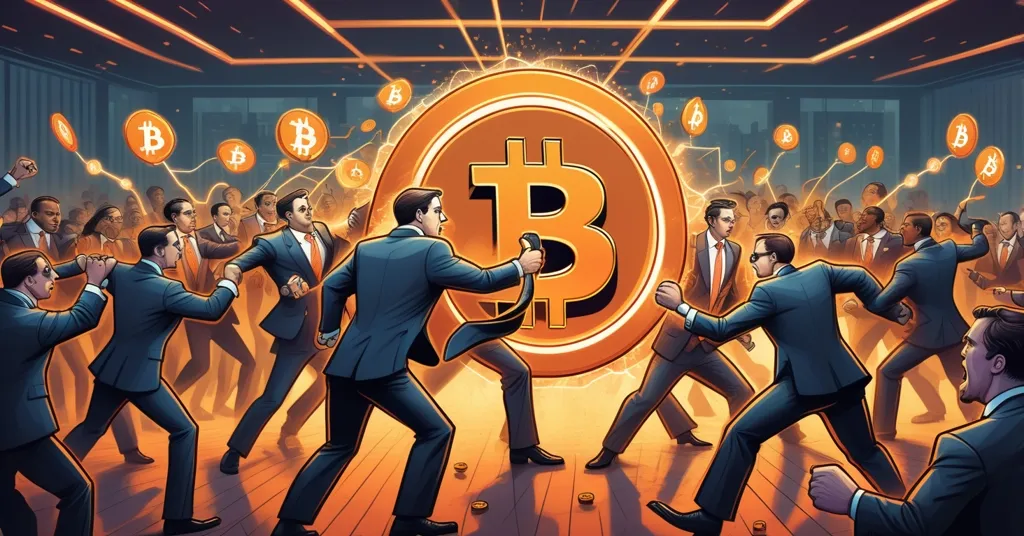
Bitcoin, the original flag-bearer of financial rebellion, finds itself under scrutiny yet again as a fiery discussion on social media platform X raises critical questions about its soul. Bloomberg ETF analyst Eric Balchunas has thrown fuel on the fire, defending Bitcoin’s core promise as a decentralized, censorship-resistant money, even as Wall Street’s influence grows through tools like ETFs. But not everyone agrees, with sharp critics pointing to Bitcoin’s wild price swings as proof it’s far from the stable currency it claims to be.
- Central Conflict: Does Wall Street’s involvement via ETFs undermine Bitcoin’s decentralized ethos?
- Volatility Question: Can Bitcoin truly be debasement-resistant with its dramatic price fluctuations?
- Identity Crisis: Is Bitcoin still the people’s money, or just another asset for institutional speculation?
This clash of ideas erupted when Cooper Turley, founder of Coop Records, took to X to challenge cryptocurrency’s real-world utility beyond mere speculation. Balchunas didn’t hold back, stepping in to champion Bitcoin’s unique value. He argues it remains a user-run form of money that no government can censor or dilute through inflation. For more on this heated exchange, check out the full discussion on whether Wall Street has co-opted Bitcoin.
“The novel value of bitcoin is that it is user-run money that is both censorship and debasement-resistant. Far as I can tell nothing has changed about that,” Balchunas stated.
Let’s break this down for those new to the space. Censorship resistance means Bitcoin transactions can’t be blocked or reversed by any central authority—think of it as a financial system where no bank or government can freeze your funds. Debasement resistance comes from Bitcoin’s hard cap of 21 million coins, preventing the kind of value erosion seen in fiat currencies when central banks print money endlessly. These principles are the bedrock of Bitcoin’s appeal, especially to those who’ve been burned by traditional finance or live under oppressive regimes.
Balchunas also tackled the elephant in the room: Wall Street’s creeping influence. With spot Bitcoin ETFs—exchange-traded funds that track BTC’s price without requiring direct ownership—launched by giants like BlackRock in early 2023, institutional adoption has skyrocketed. He sees this as a net positive, a stark improvement over the shady intermediaries of crypto’s Wild West days.
“All that really happened was the intermediaries got upgraded. You went from paying high fees to SBF only for him to ‘lose’ your money to Larry Fink et al, who do same thing (outsourced your btc) but in a way that’s much cheaper and safer,” Balchunas explained.
For clarity, SBF is Sam Bankman-Fried, the infamous ex-CEO of FTX, whose exchange collapsed in 2022 amid fraud allegations, wiping out billions in user funds. Larry Fink, BlackRock’s CEO, represents the new wave of polished, regulated players offering Bitcoin exposure without the risk of losing it all to a rogue exchange. But here’s the rub for purists: ETFs mean you don’t hold the actual Bitcoin. You’re buying a financial product tied to its price, not the private keys to your coins. As the saying goes among Bitcoiners, “not your keys, not your crypto”—a reminder that true ownership is the heart of decentralization.
The Volatility Dilemma: A Currency or a Casino?
Not everyone is singing Bitcoin’s praises alongside Balchunas. Oliver Renick, host of Chicago Future of Finance, delivered a brutal takedown of Bitcoin’s claim to debasement resistance, pointing to its stomach-churning price swings. With Bitcoin trading at $66,207 during this debate—still a hefty sum but prone to double-digit drops in mere days—Renick argues it’s more gamble than gold.
“Debasement-resistant is biggest error here IMO. If the dollar were down as much as btc can do on any given week, the world would go nuts, i.e, bitcoins volatility goes thru a debasement event like 3 times a year compared to the dollar where a 2% is a big deal. It’s rly bad money,” Renick argued.
He’s got a point. Imagine using a currency to buy groceries, only to find it’s worth 20% less by the time you hit checkout. That’s Bitcoin’s reality for now, and it’s a far cry from the stability of fiat like the US dollar, where a 2% shift is headline news. Balchunas doesn’t dodge this critique entirely. He admits Bitcoin isn’t ready to be a mainstream currency, blaming its youth—it’s only been around since 2009, a blip compared to centuries-old financial systems.
“It is debasement resistant, govt can’t dilute it—that’s true even if it is volatile,” Balchunas countered.
He backs this optimism with cold, hard stats: Bitcoin has surged 450% over 2023 and 2024, crushing gold’s 20% gain in the same span. Picture investing in a volatile startup versus a sleepy savings account—that’s the kind of disparity we’re talking about. For long-term holders, or “HODLers” (a crypto slang term for those who cling to their Bitcoin through thick and thin), such gains might justify the rollercoaster. But Renick isn’t convinced, darkly hinting at Bitcoin’s uncertain future.
“Bitcoin may not make it to its 20th birthday, who knows,” Renick mused.
Looking at Bitcoin’s history adds some weight to Balchunas’ “youth” argument. Back in 2011-2013, BTC saw crashes of 80-90% regularly, while today’s dips, though painful, are often less severe as adoption grows. The 2017 bull run to $20,000 and the 2022 bear market lows show a pattern of diminishing volatility over time, though it’s still nowhere near stable enough for everyday use. Could time truly tame this beast, or is Renick right that it’s a fatal flaw?
Wall Street’s Power Play: Upgrade or Takeover?
The rise of Bitcoin ETFs has brought undeniable benefits—legitimacy, accessibility, and massive inflows. BlackRock’s iShares Bitcoin Trust, for instance, amassed billions in assets within months of its launch, signaling institutional appetite. Roughly 20% of Bitcoin’s supply is now tied to such vehicles or custodial services, per recent estimates, compared to a tiny fraction just five years ago. This shift has made Bitcoin a household name, but at what cost?
For Bitcoin maximalists—those who see BTC as the ultimate standard of decentralized money—this smells like a hostile takeover. Wall Street’s slick marketing pushes ETFs as a “safe” way to invest, but it’s a leash on Bitcoin’s freedom. You’re not joining the revolution; you’re buying a ticket to spectate while hedge funds play. Worse, heavy institutional ownership risks market manipulation, where big players could sway prices through coordinated trades, a far cry from the peer-to-peer vision Satoshi Nakamoto laid out in 2008. And let’s not forget potential regulatory fallout—stricter KYC (know-your-customer) rules tied to ETF-linked wallets could clash with Bitcoin’s privacy ethos, turning it into just another surveilled asset.
Yet, there’s a flip side. Institutional backing has driven Bitcoin’s price and visibility to new heights, pulling in retail investors who’d never touch a hardware wallet. It’s also forced governments to take crypto seriously, potentially paving the way for clearer rules rather than outright bans. For every maximalist clutching their cold storage, there’s a pragmatist who sees this as the only path to mass adoption, even if it means cozying up to the very giants Bitcoin was built to disrupt.
Bitcoin’s Identity Crisis: Digital Gold or Niche Tool?
Peel back the layers of this debate, and you’re left with a raw question: what is Bitcoin, really? If its volatility keeps it from being a functional currency, as Renick suggests, its value might boil down to censorship resistance alone. He even floats a grim price target of $10,000 per coin if Bitcoin fails as money—a fraction of its current value. That’s a bitter pill for anyone banking on BTC as the future of finance, not just a niche escape hatch for dodging capital controls.
But let’s zoom out. In places like Venezuela or Nigeria, where hyperinflation and government overreach crush local currencies, Bitcoin’s volatility is a small price to pay for financial autonomy. A 20% drop hurts, sure, but it’s nothing compared to losing 90% of your savings overnight to a collapsing bolívar. Here, Bitcoin isn’t a speculative toy; it’s a lifeline, allowing cross-border payments or wealth preservation without a bank’s permission. This global perspective shows why censorship resistance isn’t just a buzzword—it’s a feature worth fighting for, even if Western speculators only see dollar signs.
Contrast this with other blockchains like Ethereum, which prioritize utility through smart contracts and decentralized finance (DeFi) apps. Ethereum fills niches Bitcoin doesn’t touch, like tokenized assets or programmable money, but it lacks BTC’s raw defiance of centralized power. As a Bitcoin maximalist at heart, I’d argue nothing matches its unapologetic middle finger to the status quo, though I’ll tip my hat to altcoins for experimenting where Bitcoin shouldn’t. BTC is digital gold; let others play with digital legos.
What’s Next for Bitcoin’s Soul?
Looking ahead, this tug-of-war over Bitcoin’s identity isn’t going away. Regulatory crackdowns could tighten Wall Street’s grip, with governments pushing for more oversight of ETF providers or custodial services. On the tech side, solutions like the Lightning Network—a layer on Bitcoin for faster, cheaper transactions—might chip away at volatility concerns by making BTC more usable day-to-day. Then there’s the halving cycles, roughly every four years, which cut miner rewards and historically spark price surges. The next one in 2028 could either cement Bitcoin’s “digital gold” status or expose it as overhyped if adoption stalls.
Community sentiment, from X rants to Bitcoin conference keynotes, mirrors this divide. Some OGs lament the ETF era as a betrayal; others cheer the inflows as validation. Reddit’s r/Bitcoin buzzes with both sides—hodlers mocking “paper Bitcoin” investors while newcomers ask if ETFs are their safest bet. One thing’s clear: Bitcoin remains a paradox, a financial Molotov cocktail against centralized control that’s somehow also a shiny toy for hedge funds. Whether it stays true to its rebellious roots or gets domesticated by suits, the fight for its soul rages on.
Key Takeaways and Burning Questions
- Has Wall Street co-opted Bitcoin through ETFs?
Institutional tools like ETFs have made Bitcoin more accessible and mainstream, but they haven’t changed its core resistance to censorship or debasement. Still, they risk centralizing control, clashing with its decentralized promise. - Does Bitcoin’s volatility discredit its debasement-resistant claim?
Critics equate price crashes to debasement events, undermining its reliability as money. Defenders insist true debasement resistance is its fixed supply, immune to government dilution, regardless of market swings. - Can Bitcoin become a stable currency for daily use?
Not yet—its wild fluctuations make it impractical for routine transactions. Optimists bet on maturity over time, with growing adoption and tech like the Lightning Network potentially smoothing the edges. - What’s Bitcoin’s value if it fails as money?
Its censorship resistance stands as a powerful feature, especially in unstable regions, offering financial freedom where traditional systems fail, even if its monetary role remains limited. - Should the crypto community resist or embrace institutional adoption?
It’s a tightrope. Institutional involvement boosts growth and legitimacy but threatens Bitcoin’s anti-establishment core. Each user must decide if the trade-off for mass adoption is worth the soul-searching.