Bitcoin and Crypto Markets Crash as Israel Strikes Iran in 2026 Geopolitical Crisis
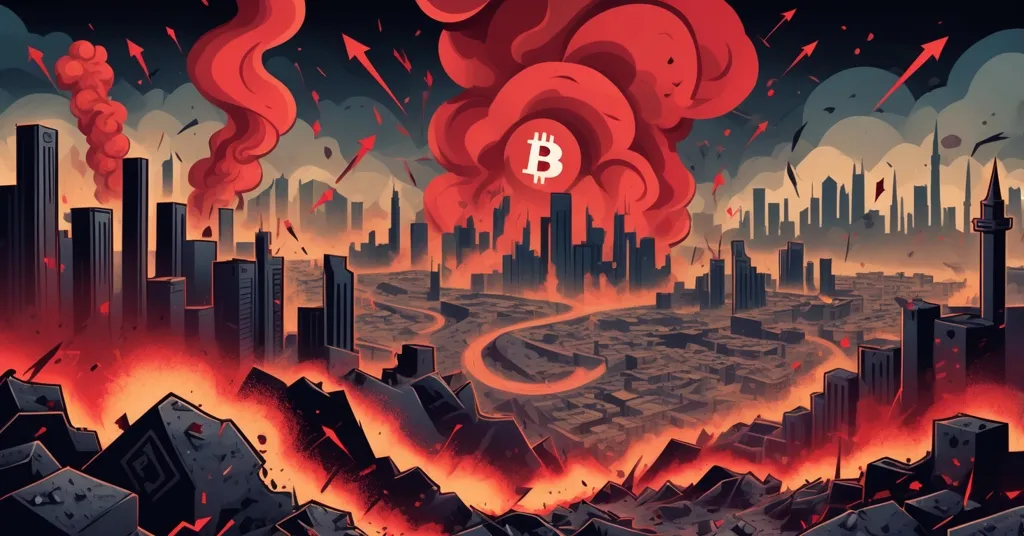
 LTB
LTB Geopolitical Chaos: Israel Strikes Iran, Bitcoin and Crypto Markets Tank Hard in 2026
On February 28, 2026, the world woke to a geopolitical bombshell as Israel launched a preemptive strike on Iran, sending shockwaves through the Middle East and beyond. With the U.S. jumping into the fray and regional tensions boiling over, global markets—especially crypto—have taken a severe beating. Bitcoin and the broader digital asset space are reeling under intense selling pressure as fear and uncertainty grip investors.
- Middle East Eruption: Israel’s strike on Iran sparks emergency and U.S. combat operations.
- Crypto Bloodbath: Bitcoin crashes to $63.6K, with $75 billion wiped out in an hour.
- Global Fallout: Oil supply risks via the Strait of Hormuz threaten economic stability.
Middle East Crisis Explodes with Global Ramifications
The conflict ignited early Saturday when Israel, citing imminent threats, executed a military operation against Iran. As reported by CNN, Israeli official Israel Katz confirmed the aggressive move, stating,
Israel carried out a ‘preemptive strike’ against Iran early Saturday.
This wasn’t just a skirmish—it plunged the region into turmoil. Israel declared a nationwide state of emergency, bracing for retaliation from Iran via drones and ballistic missiles. Things went from bad to hellish when U.S. President Donald Trump doubled down, announcing,
The United States has begun ‘major combat operations’ against Iran.
Citing missile threats and Iran’s nuclear ambitions, Trump didn’t hold back, even urging Iranian citizens to overthrow their government—a statement as bold as it is divisive. This isn’t mere saber-rattling; it’s a market-moving bombshell.
The regional dominoes are falling fast. Saudi Arabia, along with UAE, Bahrain, Qatar, Kuwait, and Jordan, has aligned with the U.S., signaling a potential widening of the conflict. Saudi Arabia’s stance was clear in its official statement:
Saudi Arabia said it is prepared to support the United States in ‘any capacity’ amid escalating tensions with Iran.
With Iranian missile strikes already reported across the region, the stakes couldn’t be higher. A major flashpoint looms over the Strait of Hormuz, a narrow waterway acting like the highway for 20% of the world’s oil supply. If conflict disrupts this chokepoint, it’s akin to shutting down a major interstate—gas prices could surge, goods could get pricier, and inflation might rear its ugly head again. Analysts estimate a 10% oil price spike per week of disruption, per recent Bloomberg data, and that’s a conservative guess. The ripple effects would hammer risk assets worldwide, from stocks to crypto. For the latest on this crisis and its impact on markets, check out the live updates on Israel’s attack on Iran and the crypto market crash.
Crypto Markets in Freefall: Bitcoin and Beyond
Now, let’s see how this warzone chaos ripped through crypto markets like a wildfire. Bitcoin, often hyped as “digital gold” by maximalists, crumbled under the weight of risk-off sentiment. If it’s supposed to be a safe haven, why is it bleeding alongside tech stocks? The answer lies in its correlation to macro fears—when panic hits, investors dump speculative assets, Bitcoin included. In just 30 minutes, a staggering $5 billion in Bitcoin was offloaded, with institutional heavyweights on exchanges like Binance, Bybit, Bitfinex, Kraken, and Coinbase driving the sell-off. Market makers Wintermute and FalconX were reportedly in the mix, amplifying the carnage. Bitcoin’s price nosedived to around $63.6K, hovering precariously above critical support at $63.1K. If that level snaps, we’re looking at a potential slide to $60K or even $53K—bad news for anyone still chanting “number go up.”
The damage wasn’t confined to Bitcoin. The entire crypto market lost a jaw-dropping $75 billion in value within 60 minutes. Bitcoin long liquidations—where traders using borrowed money get forced to sell at a loss—hit $209 million in a single hour. For the uninitiated, think of leveraged trading as borrowing cash to bet big on price moves; when the market turns, exchanges liquidate your position to cover the loan, often tanking prices further. Ethereum, the second-largest crypto by market cap, got dragged down to nearly $1.8K in the panic. Beyond raw price action, Ethereum’s utility in decentralized finance (DeFi) and non-fungible tokens (NFTs) could face headwinds—lending yields are dipping as liquidity dries up, and creators might pause NFT drops amid sky-high gas fees and sour sentiment. With Bitcoin’s open interest—a measure of total bets on its price—sitting at $20.5 billion, the risk of more cascading liquidations looms large. Think of it as a powder keg; any sudden price swing could trigger a chain reaction.
One glimmer of chaos worth watching is the Bitcoin liquidation heatmap, showing heavy short exposure above current levels—$69.85 million at $66,541 alone. Translation: if Bitcoin unexpectedly surges, those betting against it (shorts) will scramble to buy back, potentially fueling a short squeeze. That could send prices spiking fast, though right now, the bears are running the show. For historical context, let’s not forget Bitcoin’s track record in crises. During the 2022 Ukraine-Russia conflict, it initially dipped as a risk asset before rallying on narratives of decentralization and fiat weakness. Is it failing the “digital gold” test today, or are we witnessing the painful birth of a new financial order? Only time will tell.
Stablecoin Spotlight: Tether’s Milestone Amid Controversy
Even stablecoins, often seen as a refuge during market meltdowns like this, aren’t free from drama. Tether (USDT), the biggest stablecoin pegged to the U.S. dollar, crossed a circulating supply of $180 billion—a massive milestone. For newcomers, stablecoins aim to hold steady value, acting as a safe harbor or trading pair in crypto’s wild swings. But Tether’s also making waves for freezing $4.2 billion in illicit funds, including $3.5 billion since 2023. Partnering with the U.S. Department of Justice, they recently locked $61 million tied to pig-butchering scams—schemes where fraudsters charm victims into “investing” before vanishing with the cash. This shows a push for compliance, but it also lays bare crypto’s dark side, where anonymity can shield bad actors. Let me be crystal clear: we stand for decentralization, but scammers preying on the vulnerable can kick rocks. Clean up or get lost.
Looking deeper, Tether’s actions could have broader implications, especially in a crisis like this. Geopolitical unrest often accelerates regulatory scrutiny, and stablecoins are already in the crosshairs. Could this Middle East mess push global lawmakers to clamp down harder on USDT and its peers? If so, it might slow crypto adoption short-term—think stricter KYC rules or outright bans in jittery jurisdictions. Yet, it also underscores stablecoins’ growing role in mainstream finance, bridging fiat and digital worlds. Love it or hate it, Tether’s $180 billion supply proves it’s a cornerstone of this ecosystem, even if trust remains shaky for some.
Oil, Inflation, and the Bigger Picture
Zooming out, the Middle East crisis casts a long shadow over global economics. The Strait of Hormuz isn’t just a geopolitical hotspot; it’s an artery for 20% of the planet’s oil flow. Any disruption there could send crude prices rocketing faster than a memecoin on a hype train—terrible news for your gas bill and your Bitcoin stack. Higher oil costs fuel inflation, already a persistent headache for central banks, and squeeze high-beta assets—those speculative plays like crypto and growth stocks that thrive in calm times but crater under stress. Bitcoin’s “store of value” narrative gets tested hard when macro fears dominate, behaving more like a leveraged tech play than a safe harbor.
Imagine waking up to missile strike headlines, then checking your crypto wallet only to see your holdings down double digits in an hour. That’s the brutal reality for millions right now. And with leveraged traders getting wiped out left and right, the market feels like a house of cards waiting for the next gust of bad news. Beware of Telegram grifters hawking “war-proof” tokens or crisis pump-and-dumps—they’re just here to swipe your sats. We’re not peddling $100K Bitcoin fairy tales; our aim is raw, unfiltered truth to help you navigate this mess.
Decentralization’s Silver Lining Amid the Storm
As Bitcoin maximalists, we can’t help but spot opportunity in this chaos. Crises expose the cracks in centralized systems—fiat currencies ripe for inflation, governments mired in endless conflict, and financial gatekeepers who crumble under pressure. Bitcoin offers a way out, a defiant middle finger to the broken status quo, even if the path to mass adoption is a rollercoaster of volatility. Look back at past shocks: Bitcoin often emerges stronger post-crisis as distrust in traditional systems grows. Could this be another catalyst?
That said, we’re not blind fanboys. Altcoins and other blockchains play vital roles in this financial revolution. Ethereum’s smart contracts power DeFi and NFTs, filling niches Bitcoin isn’t built for. Solana’s blazing speed caters to high-throughput apps that BTC can’t touch. If a recovery kicks in, these innovations could shine—Ethereum’s staking yields or Solana’s scalability might draw capital back faster than pure store-of-value plays. This isn’t a one-coin game; pretending otherwise is just stubborn dogma. Decentralized tech as a whole is the disruptor, and every protocol has its part to play.
What’s Next for Crypto in This Crisis?
The Middle East situation remains a live wire—every headline, tweet, or missile could jolt markets further. For crypto holders, survival is the priority: ditch the leverage, keep an eye on Bitcoin’s $63.1K support, and don’t fall for shillers peddling fake price predictions. The coming days will test both global stability and the resilience of this ecosystem. Will Bitcoin hold the line or crack under pressure? Can decentralized systems prove their worth when the world’s on edge? Buckle up—this ride’s far from over.
Key Takeaways and Questions
- What caused the Bitcoin price crash in 2026?
Geopolitical turmoil from Israel’s strike on Iran and U.S. combat operations sparked mass fear, driving a risk-off wave with a $5 billion Bitcoin sell-off and $209 million in liquidations in hours. - How does the Middle East conflict hit markets beyond crypto?
Risks to the Strait of Hormuz could disrupt 20% of global oil flows, pushing oil prices and inflation higher, which hammers speculative assets like stocks and cryptocurrencies. - Why is Tether’s $4.2 billion illicit funds freeze significant?
It shows stablecoins aligning with law enforcement, like freezing $61 million for the U.S. Department of Justice, highlighting both innovation and crime-fighting efforts amid a $180 billion supply. - What Bitcoin price levels should investors monitor?
Bitcoin’s key support is at $63.1K; breaking below risks falls to $60K or $53K, while holding steady could pave the way for a rebound toward $66K. - Could a short squeeze jolt Bitcoin’s price soon?
With hefty short positions at levels like $66,541 ($69.85 million), a sudden price jump could force shorts to cover, sparking a rapid bullish surge amid the current bearish chaos.