Bitcoin’s $1 Trillion Crisis: Has the Crypto King Failed in 2026?
 LTB
LTB Has Bitcoin Failed? Unpacking the $1 Trillion Identity Crisis of 2026
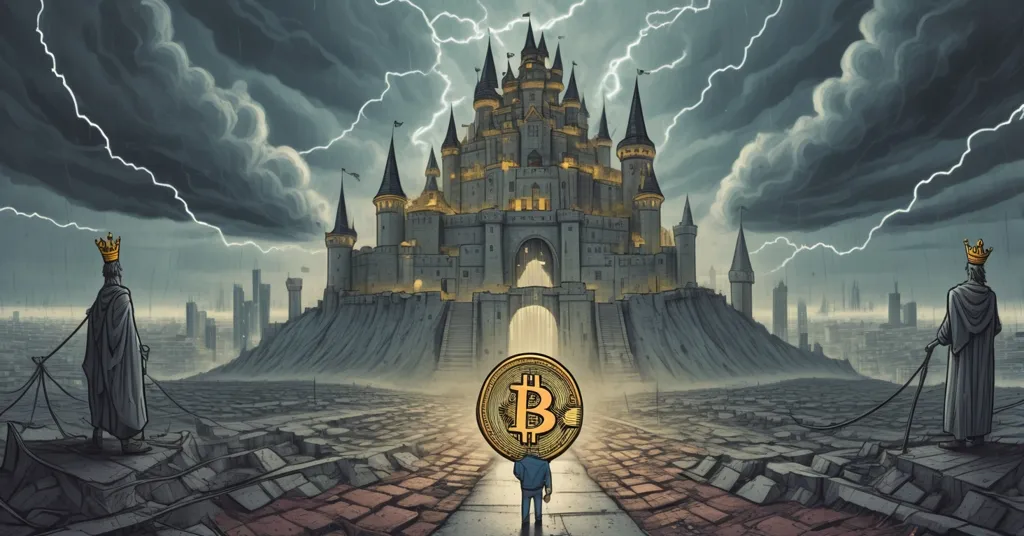
Bitcoin, the trailblazer of decentralized finance, finds itself at a brutal crossroads in 2026. After plummeting 48% from a staggering $126,500 peak in October 2025 to below $66,000, and with institutional interest drying up, a piercing question emerges: has Bitcoin failed its revolutionary mission, or is this merely a midlife crisis for the world’s first cryptocurrency?
- Price Collapse: Bitcoin’s value nosedives nearly half in less than a year.
- Institutional Exodus: Hedge funds dump exposure; ETF outflows hit hard.
- Tech Threats: Quantum computing and AI-driven economies challenge Bitcoin’s future.
Bitcoin Price Crash 2026: Symptom of a Deeper Reckoning
The numbers are grim. Bitcoin’s value has been slashed by 48%, dropping from a euphoric high of $126,500 in late 2025 to a sobering sub-$66,000 by 2026. This isn’t just a dip—it’s a full-blown gut punch. Hedge funds, once Bitcoin’s biggest cheerleaders during speculative frenzies, have reported zero exposure for the first time in years. Exchange-traded funds (ETFs), hailed as a gateway for mainstream adoption, are bleeding capital with sharply negative flows. As one harsh critic put it:
“Bitcoin has failed every single test it was supposed to pass during the downturn.”
But let’s not stop at the surface-level carnage. This price meltdown isn’t just about market cycles; it’s a reflection of shaken confidence in Bitcoin’s core promise. Often touted as “digital gold,” Bitcoin was supposed to be a safe haven during economic turmoil. Yet, in 2025’s uncertainty, it faltered while traditional gold thrived. When push comes to shove, human psychology leans toward the tangible—something you can hold, not just code on a ledger. One observer nailed this sentiment:
“In a true crisis, people run to the fool-proof methods, the ones that their grandfathers and their great-grandfathers used and that is gold, silver, and copper.”
Historically, Bitcoin has stumbled in crises before—think the 2018 crash after the 2017 bull run—yet it always clawed back. Could this 48% drop be another chapter in a cyclical story of recovery? Perhaps, but the stakes feel higher now with new players and pressures in the game. Unlike gold, Bitcoin’s intangible nature requires trust in tech and community, not just tradition. Can it carve a complementary role alongside gold as a modern store of value, or is the “digital gold” narrative dead in the water? For an in-depth look at this dilemma, check out this analysis of Bitcoin’s $1 trillion identity crisis.
Institutional Capture: Betraying Satoshi’s Vision
Beyond the price, a deeper betrayal festers. Bitcoin was born in 2009 as a rebel’s tool—a way to sidestep banks and governments, ensuring financial sovereignty with the mantra “not your keys, not your crypto.” Fast forward to 2026, and 80% of retail investors have handed that power back to institutions through ETFs. Think about that: four out of five everyday Bitcoin holders willingly surrendered the very autonomy Satoshi Nakamoto fought for. The irony cuts deep.
“The original attraction of Bitcoin was the notion that no bank could prevent you from accessing your money. Now 80% of retail buyers have handed that power back to institutions willingly.”
For the uninitiated, ETFs are financial products that let you invest in Bitcoin without directly owning it. They’re easy—buy shares through your brokerage, no wallet setup or seed phrase stress. But here’s the catch: your Bitcoin isn’t truly yours. Fund managers hold the keys, centralizing control in a way that spits in the face of decentralization. Picture an average Joe, drawn to Bitcoin’s hype in 2025, opting for an ETF because self-custody feels too daunting. He’s now at the mercy of a corporate middleman—hardly the cypherpunk dream.
Why this shift? Convenience, mostly. Self-custody scares people—lose your private key, and your wealth vanishes. Plus, ETFs fit neatly into traditional portfolios, luring in Wall Street. But if trust in these institutions crumbles—or worse, if regulators crack down—retail investors could be left holding the bag. Bitcoin maximalists will scream this is heresy, and they’re not wrong. Yet, there’s a flip side: institutional involvement signals mainstream acceptance, something early adopters once craved. Is this a necessary evil for Bitcoin’s growth, or a fatal compromise?
Adding fuel to the fire, regulatory pressures in 2026 seem to be tightening. With ETFs tying Bitcoin closer to traditional finance, governments might be eyeing stricter taxes, reporting rules, or outright restrictions. Can Bitcoin retain its rebellious spirit under this weight, or will it morph into just another Wall Street toy? The identity dilemma sharpens.
Quantum Threats: Can Bitcoin Keep Up with Tech’s Dark Side?
Shifting gears to tech, Bitcoin faces a sci-fi nightmare turned reality: quantum computing. Unlike classical computers, quantum machines exploit quantum mechanics to crunch numbers at mind-boggling speeds, potentially cracking the cryptographic shields that secure Bitcoin’s blockchain. According to the Human Rights Foundation (HRF), about 1.72 million BTC—worth roughly $188 billion at current prices—in early addresses are vulnerable to long-range quantum attacks within five years. Another 4.49 million BTC, around $495 billion, is at risk but can be moved to safer addresses. Even scarier? Short-range attacks could target transactions in real-time.
Think of quantum computing as a super-powered lockpick, capable of dismantling Bitcoin’s security in ways today’s hackers can only dream of. For newcomers, Bitcoin’s safety hinges on complex math—public and private keys—that’s nearly impossible to break with current tech. Quantum computing flips that script, threatening to expose funds if the tech matures fast enough.
There’s a lifeline, though. On February 11, 2026, Bitcoin core developer Murch published BIP 360: Pay to Merkle Root, a proposal to bolster quantum resistance. In simple terms, it’s a new method to secure Bitcoin addresses against these advanced attacks. But here’s the rub: adoption isn’t guaranteed. Getting the community—miners, developers, users—to agree on and implement such changes is a slow, messy process. Consensus in a decentralized system is both Bitcoin’s strength and its Achilles’ heel. Will this upgrade come in time, or are billions in BTC doomed to be a quantum hacker’s jackpot?
AI and the Future: Is Bitcoin Too Slow for Tomorrow’s Economy?
As if quantum risks weren’t enough, Bitcoin’s relevance is under fire in the emerging “agentic economy” powered by artificial intelligence (AI). AI agents are like digital assistants on steroids—autonomous systems executing trades, payments, or contracts in milliseconds. They demand near-instant processing, often under 500 milliseconds. Bitcoin’s settlement time? Up to 10 minutes on a good day, an eternity in AI’s world.
Experiments reveal AI agents favoring stablecoins like USDT or USDC over Bitcoin. Why? Stability and speed. Stablecoins, pegged to assets like the US dollar, avoid Bitcoin’s wild price swings and settle transactions faster, making them ideal for DeFi protocols or cross-border payments. One expert captured the mismatch perfectly:
“An AI agent for whom extra-ninety-nine point nine-nine percent reliability is the infrastructural norm cannot ground its operation on top of a payment system that ‘could’ just work. It requires a system that’s 99.999% reliable.”
Does this spell obsolescence for Bitcoin in an AI-driven future? Not necessarily. Bitcoin wasn’t built for every use case—and that’s fine. Its strength is as an unshakeable store of value, a decentralized bedrock. Faster networks like Ethereum or Solana, or even Bitcoin’s own Layer 2 solutions like the Lightning Network, could handle AI’s microtransactions. Lightning, for instance, enables near-instant payments at a fraction of the cost, though adoption remains spotty. Stablecoins fill niches too, despite their own centralization baggage. Bitcoin doesn’t need to be the jack-of-all-trades; it can be the king of sovereignty while others race for speed.
Still, let’s throw out a controversial jab: if Bitcoin can’t outrun AI’s demands, maybe stablecoins are the real cypherpunk dream—centralized flaws and all. It’s a provocative thought, not a gospel, but it forces us to question what “decentralized money” means in a hyper-fast, tech-driven world.
Bitcoin’s Evolution: A Permanent Fixture or a Faded Rebel?
Let’s play devil’s advocate and zoom out. Despite the doom, Bitcoin isn’t on its deathbed—it’s transforming. By 2026, it’s shed much of its “get rich quick” stigma, embedding itself as a permanent piece of global financial infrastructure. Think of it as the grumpy old man refusing to leave the party: not the flashiest, but undeniably still relevant.
“Bitcoin is no longer fighting for a seat at the table; it’s now a permanent fixture of the global financial infrastructure.”
That’s no small feat. Bitcoin has survived nearly two decades of bans, hacks, and relentless FUD (fear, uncertainty, doubt). A 48% drop stings, but it’s not unprecedented—recovery has followed worse crashes. Institutional capture, while disappointing, reflects a level of acceptance early hodlers could only dream of. Quantum threats loom, but the community’s response with proposals like BIP 360 shows resilience. And for AI? Bitcoin can stick to being the ultimate store of value while others handle the fast lane.
Don’t get me wrong—challenges aren’t trivial. This isn’t just a PR hiccup; it’s a fundamental crossroads. Was Bitcoin meant to rival gold, power payments, or fuel speculation? Right now, it’s struggling to nail any of those roles convincingly. And let’s be brutally honest: the endless hype of “Bitcoin to $1 million by next week!” is utter garbage peddled by charlatans looking to fleece the naive. We’re here to cut through that noise, not pump bags. Bitcoin’s worth lies in disrupting the status quo, championing privacy, freedom, and decentralization—not in moonshot fantasies.
The Bitcoin community remains a wildcard in this saga. Developers grind on open-source solutions, grassroots movements push for privacy tools, and maximalists keep the ethos alive. This decentralized spirit—messy, stubborn, brilliant—is what could steer Bitcoin back to its roots. Looking ahead to 2027 or 2030, imagine a Bitcoin hardened by quantum upgrades, a niche but unassailable store of value in a multi-chain world. That’s the effective accelerationist bet: progress through chaos, not despite it.
Key Questions and Takeaways on Bitcoin’s 2026 Dilemma
- What’s driving Bitcoin’s identity crisis in 2026?
A devastating 48% price drop from $126,500 to below $66,000, coupled with institutional withdrawal through negative ETF flows and Bitcoin’s failure to match gold as a safe haven during economic turmoil, has shattered confidence in its purpose. - Has institutional involvement undermined Bitcoin’s core ethos?
Without a doubt—80% of retail investors using ETFs have handed control back to centralized entities, a direct betrayal of Bitcoin’s promise of financial sovereignty and decentralization. - Are quantum computing risks a fatal blow to Bitcoin?
They’re a serious threat, with billions in BTC potentially vulnerable, but initiatives like BIP 360 signal the community’s fightback; it’s a tough obstacle, not a knockout punch. - Can Bitcoin remain relevant in an AI-driven economy?
It’s questionable for AI’s speed demands due to settlement times of up to 10 minutes, but Bitcoin can still anchor as a store of value while faster networks or stablecoins cater to AI transactions. - What role does Bitcoin play in global finance today?
By 2026, it’s no longer a fringe gamble but a lasting element of financial infrastructure, though its original rebellious edge feels dulled by institutional creep.
Bitcoin’s path has never been linear, and 2026 is shaping up as one of its ugliest chapters. The price collapse bites, the institutional takeover stinks, and tech threats like quantum computing and AI loom like storm clouds. Yet, writing Bitcoin off would be premature. Its knack for defying odds, rooted in a community that refuses to bend, keeps the flame alive. The real question isn’t whether Bitcoin has failed—it’s whether it can rediscover its soul amid the chaos. Its future isn’t set; it’s up to developers, users, and hodlers to decide if it reclaims its cypherpunk heart or morphs into something else. For now, we watch, we critique, and we brace for one hell of a wild ride.