Pentagon’s $200B Iran War Request Sparks Economic Crisis and Bitcoin Debate
 LTB
LTB Pentagon’s $200B Iran War Request: Economic Chaos and Bitcoin’s Potential Role
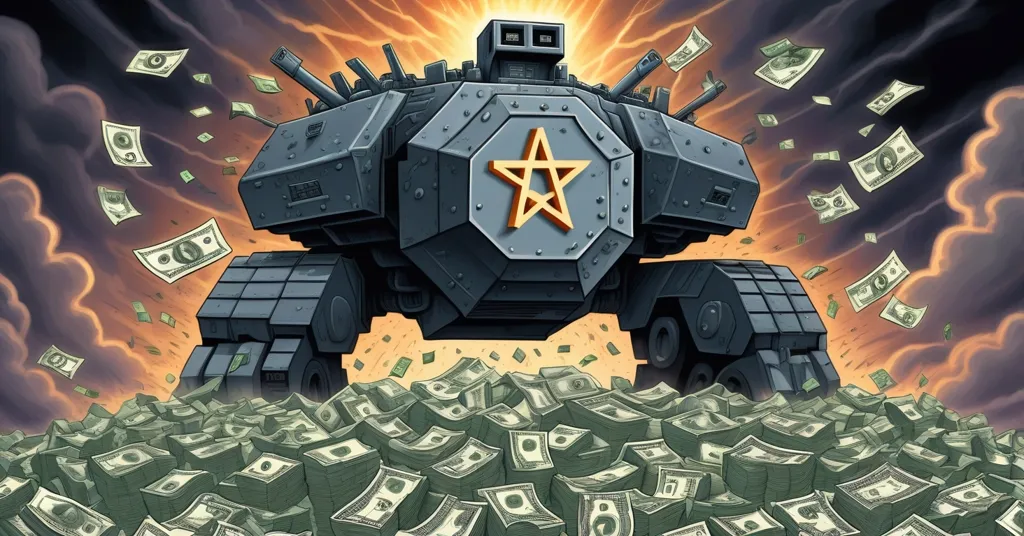
The Pentagon has sent shockwaves through Washington with a staggering request for over $200 billion to fund the ongoing war in Iran, a figure that obliterates initial budgets and threatens to saddle future generations with trillions in debt. As weapons stockpiles vanish under the weight of U.S. and Israeli airstrikes, this financial gambit sets the stage for a brutal Congressional showdown while slamming an already battered American economy—and raises serious questions about whether decentralized solutions like Bitcoin could offer a way out.
- Massive Funding Ask: Pentagon seeks $200 billion for Iran war, mainly to replenish weapons stockpiles.
- Soaring Costs: $11.3 billion spent in one week, with short-term estimates up to $250 billion and long-term debt in the trillions.
- Economic Hit: Oil prices climb to $100 per barrel, gas hits $3.84 per gallon, amid job losses and stagnant rates.
- Political Firestorm: Congress braces for a fierce battle, with Democrats opposed and public support waning.
The $200 Billion Bombshell: A War Machine Running on Empty
Let’s get straight to the meat of this fiscal nightmare. The Pentagon’s $200 billion request is a desperate attempt to keep the war in Iran grinding forward as munitions are depleted at a breakneck pace during joint airstrikes with Israel against Iranian targets. The U.S. has already burned through $11.3 billion in just the first week of conflict, with daily costs ranging from $1 billion to $2 billion. If that sounds insane, it is—imagine torching enough cash every day to buy a fleet of luxury yachts. Projections are even bleaker: a three-week conflict could cost between $60 billion and $130 billion, a five-week war might hit $175 billion, and an eight-week slog could exceed $250 billion. That’s just the upfront tab, folks.
But the real pain comes later. Harvard professor Linda Bilmes, co-author of The Three Trillion Dollar War on the Iraq conflict, has crunched the numbers and issued a dire warning. She estimates that long-term costs—think veterans’ disability claims, medical care for injured soldiers, and the interest on borrowed funds to pay for all this—could balloon into the trillions. For those new to this concept, when the government borrows money to fund wars, it pays extra over decades just for the privilege of that debt, on top of lifelong support for veterans injured in battle. We’re still shelling out billions yearly for Iraq and Afghanistan, decades after the dust settled. This isn’t a guess; it’s a repeating horror show, and Bilmes’ past predictions have been eerily on point.
Economic Pain at the Pump: War’s Ripple Effects
Now, let’s talk about how this mess is hitting everyday Americans where it hurts—right in the wallet. Iran isn’t just a geopolitical hotspot; it’s a major player in global oil markets. When conflict erupted, oil prices skyrocketed to nearly $120 per barrel before settling at around $100, up sharply from $70 before the war. That spike translates directly to pain at the gas station, with U.S. prices jumping from $2.92 to $3.84 per gallon, per AAA data. For the average family, filling up the tank now feels like bankrolling a small military operation. Layer this on top of an economy already on shaky ground—92,000 jobs lost recently, unemployment at 4.4%, and the Federal Reserve holding interest rates steady at 3.5%-3.75% with no relief in sight—and you’ve got a recipe for serious financial strain.
This war isn’t just bleeding the treasury; it’s draining household budgets. With no immediate end to the conflict and Iran’s oil production under threat, energy costs could climb even higher, squeezing consumers already grappling with inflation and stagnant wages. It’s a brutal reminder of how interconnected global markets are and how quickly military decisions can screw over the little guy thousands of miles away.
Political Powder Keg: Congress Gears Up for War Over Funding
On the political front, this $200 billion request is a ticking time bomb. Congress is poised for an all-out brawl, with Democrats ready to pounce and even some Republicans raising eyebrows at the price tag. House Minority Leader Hakeem Jeffries didn’t hold back, slamming the administration’s audacity:
“The notion that they would come up here and ask for additional money is beyond the pale at this moment.”
Mark Cancian, Senior Adviser at the Center for Strategic and International Studies, echoed the sentiment, predicting a fierce clash:
“If the administration asks for more money, there will be a big political fight because all the anti-war sentiment will focus on that request.”
Public support for the war is tepid at best, and war fatigue is setting in after decades of Middle East entanglements. Meanwhile, Senator Tom Cotton of Arkansas wants to pile on extra funding for intelligence operations, which could bloat the bill further—or splinter Republican backing if fiscal conservatives dig in their heels. This comes after President Trump’s earlier push for a $1.5 trillion defense budget, already shot down by the White House budget office as excessive. With national debt a festering issue, the timing of this request couldn’t be more politically toxic.
Weapons Woes: Can Cash Fix a Broken System?
The Pentagon’s primary justification for this eyewatering sum is weapons production. Stockpiles are dwindling faster than a gambler’s luck in Vegas, thanks to the relentless pace of airstrikes. But here’s the ugly truth: throwing $200 billion at the problem might not even move the needle. Elaine McCusker, former Pentagon Comptroller, laid it out cold and clear:
“You’re definitely not going to get it sooner if you don’t invest, but money alone is no guarantee.”
What she’s getting at is simple—production isn’t just about cash. It’s bogged down by real-world limits: not enough workers, not enough factories, and not enough raw materials to churn out missiles and bombs at the speed needed. For those unfamiliar, this is what’s called a bottleneck—a choke point where no amount of money can instantly fix the jam. Deputy Defense Secretary Steven Feinberg is reportedly hustling to align internal budgets, but the military-industrial complex is stretched to its breaking point. This isn’t a problem you solve overnight, no matter how deep the government’s pockets are.
The Counterpoint: National Security or Fiscal Suicide?
To play devil’s advocate for a moment, the Pentagon has a case for urgency. Iran poses a complex geopolitical threat, and maintaining military dominance in the region—alongside allies like Israel—could be seen as a non-negotiable for national security. Failing to replenish weapons or sustain operations might embolden adversaries or weaken U.S. credibility on the global stage. Some policymakers argue that the cost, however steep, is a necessary evil to prevent larger conflicts down the line.
But let’s not drink the Kool-Aid without a chaser. While security matters, shouldn’t we question a system that prioritizes endless war over sustainable innovation? Why are we dumping billions into bombs when the same funds could accelerate technologies like blockchain that disrupt outdated financial models? The U.S. has a track record of overextending itself in the Middle East, with little to show for it beyond debt and disillusionment. This $200 billion could be the tipping point where short-term strategy collides with long-term insolvency.
Decentralized Dollars: Could Bitcoin Be a Lifeline?
Speaking of broken systems, let’s pivot to something closer to home for us crypto enthusiasts: how does this war-driven economic quagmire tie into Bitcoin and decentralized finance? For those new to the space, Bitcoin is a digital currency that operates outside government control, secured by a decentralized network called blockchain. Unlike fiat currencies like the dollar, which can be printed endlessly to fund wars or bailouts, Bitcoin has a fixed supply of 21 million coins, making it a potential shield against inflation and currency devaluation.
Historically, geopolitical crises and massive government spending have driven interest in Bitcoin as a hedge. During the 2020 pandemic, for instance, Bitcoin’s price surged as central banks pumped trillions into economies, devaluing fiat. With the Iran war pushing oil prices up and the U.S. borrowing billions more, we could see similar dynamics. If the dollar weakens under the weight of trillion-dollar war debts, savers might turn to Bitcoin to preserve wealth. Hell, if the Pentagon could mine Bitcoin instead of missiles, maybe we’d balance the budget for once.
But let’s not get carried away with hopium. Bitcoin isn’t a magic bullet—its volatility can wipe out gains as fast as they come, and it’s not widely accepted enough to replace fiat overnight. Still, its decentralized nature offers a glimmer of hope for those sick of watching governments burn through cash while families struggle. Beyond Bitcoin, other blockchain projects fill crucial niches. Ethereum-based stablecoins, for example, provide price stability tied to assets like the dollar, offering a less volatile tool for transactions or savings during economic turmoil. Even in Iran, crypto adoption has spiked in recent years as citizens dodge sanctions with Bitcoin, a real-world case of decentralization bypassing oppressive systems.
From an effective accelerationism perspective—a belief in speeding up tech innovation to solve systemic issues—blockchain could disrupt the very funding models that enable endless wars. Imagine a world where financial sovereignty via crypto undercuts the ability to borrow trillions unchecked. It’s a long shot, but it’s a vision worth pushing for, especially when the alternative is another decade of fiscal disaster.
Key Takeaways and Burning Questions
- What’s behind the Pentagon’s $200 billion request for the Iran war?
It’s mainly to fund weapons production and operational costs as U.S. and Israeli airstrikes rapidly deplete stockpiles in the conflict with Iran. - How much could this war ultimately cost U.S. taxpayers?
Short-term costs could reach $250 billion within weeks, while long-term burdens like veterans’ care and debt interest might hit trillions, echoing past wars. - Why is Congress so split over this funding?
Democrats largely reject the war itself, and even some Republicans hesitate at the massive cost amid soaring national debt and weak public backing. - How is the Iran war affecting everyday Americans?
Gas prices have soared to $3.84 per gallon from $2.92 due to oil market chaos, while job losses and flat interest rates add to economic woes. - Can Bitcoin or decentralized tech ease these economic pressures?
Bitcoin could serve as a hedge against inflation and fiat devaluation from war spending, though its volatility is a risk. Decentralized finance (DeFi) also offers alternative tools outside government control. - Why should crypto fans care about war-driven economic policies?
Massive government spending on wars often weakens fiat currencies, underscoring the need for decentralized options like Bitcoin to protect wealth and push financial sovereignty.
Zooming out, this $200 billion request isn’t just a budget line item—it’s a glaring symptom of a system addicted to overreach. The Iran war mirrors past Middle East debacles that left deep fiscal scars, and the economic fallout—higher gas prices, squeezed households—shows how fast global crises hit home. For Bitcoin maximalists and decentralization advocates, this is yet another case for breaking free from fiat’s failures. Yet, we can’t ignore the hard truth: wars aren’t fought on blockchain, and trillion-dollar debts won’t vanish into a wallet address. The Congressional fight over this funding is a microcosm of bigger battles—about priorities, accountability, and whether the current financial order can survive another round of self-inflicted wounds. Strap in; the road ahead looks rougher than a bear market dip.