500 BTC Seized in Law Enforcement Sting: Clifton Collins’ Wallet Cracked
 LTB
LTB Seized Bitcoin Wallet Roars Back: 500 BTC Moved in Law Enforcement Sting
A long-dormant Bitcoin wallet tied to a convicted individual has jolted awake with a jaw-dropping transfer of 500 BTC, worth roughly $35.5 million at current prices. Tracked by blockchain sleuths at Arkham Intelligence, this move reveals a high-stakes law enforcement operation that punches holes in the myth of Bitcoin’s unbreakable security, raising eyebrows and questions across the crypto community.
- Huge Transfer: 500 BTC ($35.5 million) shifted from a wallet linked to Clifton Collins to a Coinbase Custody address.
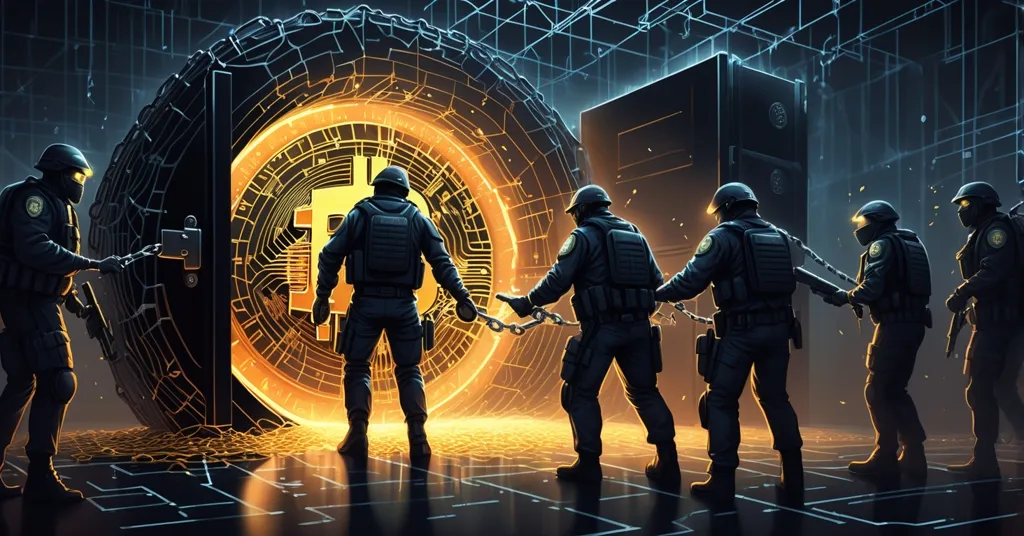
- Authorities Strike: Europol and Irish Garda orchestrated the seizure using cutting-edge decryption tech, bypassing lost private keys.
- More at Risk: 5,500 BTC across 11 other Collins wallets, valued at over $426 million, could be next in line.
The Awakening: A Digital Heist in Reverse
Picture this: a Bitcoin fortune, amassed over a decade ago, sits untouched in the blockchain’s depths, its owner behind bars, keys supposedly lost to history. Then, out of nowhere, $35.5 million in BTC moves in a single transaction. That’s the reality for Clifton Collins, an early adopter who scooped up 6,000 BTC in 2011, when a single coin was worth mere dollars. Today, his stash across 12 wallet addresses is valued at a staggering $426 million. But Collins isn’t cashing out from a beach somewhere—he’s been locked up since 2017, convicted on charges related to illicit activities, with his digital vault presumed inaccessible.
That presumption got obliterated recently when Arkham Intelligence, a blockchain analytics outfit, flagged the movement of 500 BTC from one of Collins’ dusty addresses, as detailed in this report on the seized wallet activity. The funds didn’t land in some shady mixer or anonymous wallet—they went straight to Coinbase Custody, a fortified storage service often tapped by law enforcement to lock down seized crypto. This wasn’t a lucky hacker or a ghost from Collins’ past. This was a calculated play by Europol and the Irish Garda’s Criminal Assets Bureau, who stepped up to claim credit for what they call a major win against cryptocurrency crime.
“The Criminal Assets Bureau in collaboration with Europol gained access to and seized a cryptocurrency wallet containing 500 bitcoins, which are the proceeds of crime.” — Irish Garda Statement
Clifton Collins: From Bitcoin Whale to Convict
Collins’ story reads like a cautionary tale from Bitcoin’s Wild West days. Back in 2011, he was among the early believers, mining or buying 6,000 BTC when the network was a niche experiment for cypherpunks and tech geeks. But his journey took a grim turn with his 2017 arrest in Ireland, tied to allegations of using crypto for illegal dealings—details remain murky, though reports suggest ties to drug-related proceeds. At the time, authorities hit a wall: Collins’ private keys, the cryptographic codes needed to access his Bitcoin, were reportedly hidden in a fishing rod case. Post-arrest, that case vanished—either stolen, discarded, or lost in a landfill—leaving his fortune seemingly out of reach. Until now.
This seizure isn’t just a plot twist in Collins’ saga; it’s a neon sign flashing “no one’s safe” for early Bitcoin holders. With $426 million still sitting in his remaining 11 wallets, the stakes couldn’t be higher. If authorities cracked one address, what’s stopping them from cracking the rest?
Cracking the Uncrackable: How Did They Do It?
Here’s the kicker: Europol and the Irish Garda accessed Collins’ wallet without the original private keys, boasting about “advanced decryption techniques.” What does that even mean? They’re not spilling the beans, but the crypto security crowd has plenty of theories. Let’s break it down for the uninitiated. A private key is like the PIN to your digital bank vault—lose it, and your Bitcoin is locked forever. Or so we thought. Early Bitcoin software, like Bitcoin Core, often stored these keys in a file called wallet.dat. Think of it as a little black box holding your secret codes. If that box isn’t locked tight with strong encryption, it’s like leaving your vault’s combo on a napkin.
One possibility is that authorities brute-forced their way in—imagine trying every key on a giant keyring until one clicks. With today’s computational muscle, guessing billions of combinations is doable for poorly secured files from 2011. Another theory points to weak key generation back in Bitcoin’s infancy. Unlike today’s airtight random number generators, early methods sometimes produced predictable keys, a flaw that modern tech can exploit. Back then, securing Bitcoin was like locking your door but leaving the spare key under the mat—charming, but dumb.
Whatever the method, this operation shows law enforcement isn’t just playing catch-up with crypto—they’re swinging heavy tech hammers. And for anyone holding coins from the pre-2013 era, it’s a gut check. Those old setups aren’t the Fort Knox you might think they are.
A Warning for Early Adopters: Is Your Wallet Safe?
Let’s not beat around the bush—this isn’t just Collins’ nightmare. If you’re sitting on Bitcoin from the early days, scribbled on a scrap of paper or tucked into some ancient software, you’re on notice. Bitcoin’s blockchain is immutable, sure, but your personal security setup? That’s only as strong as your weakest link. In 2011, security was a padlock; today, it’s a high-tech safe with multi-factor authentication. Modern tools like hardware wallets—think Ledger or Trezor—or multi-signature setups requiring multiple keys to spend funds, are light-years ahead. But if you’re still rocking a 2011 wallet.dat file on an old hard drive, you might as well paint a target on your back.
Here’s a quick survival guide for Bitcoin holders, straight from the Collins fallout: ditch outdated software, move your coins to a hardware wallet, and set up multi-sig if you’ve got a serious stash. Encrypt everything, and for the love of Satoshi, don’t hide your keys in a fishing rod. If Europol can crack a “lost” wallet, imagine what a determined black-hat hacker could do.
The Bigger Battle: Decentralization Under Siege
Zooming out, this seizure isn’t just a tech flex by authorities—it’s a salvo in the war between Bitcoin’s promise of financial freedom and the state’s iron grip. Bitcoin was born in 2009 from Satoshi Nakamoto’s vision of a world without middlemen, where your money is yours, untouchable by banks or governments. Yet, as Collins’ case proves, that ideal slams into reality when human error and outdated tech meet relentless law enforcement innovation. Moving the 500 BTC to Coinbase Custody—a centralized, institutional-grade storage platform—underscores the irony. A system built to defy control ends up in the hands of the very powers it sought to disrupt.
But there’s another angle worth chewing on. Could seizures like this actually help Bitcoin in the long run? By targeting illicit funds, authorities might ease regulatory boot pressure, painting crypto as less of a criminal haven and more of a legit financial tool. It’s a bitter trade-off: sacrifice some privacy to clean up the ecosystem and boost mainstream adoption. Not every maximalist will swallow that pill—I can already hear the cries of “this is an attack on decentralization!”—but face it, removing tainted coins could polish Bitcoin’s image for hesitant investors and policymakers.
On the flip side, this chips away at the narrative of Bitcoin as an unassailable fortress. If old wallets can be pried open, what’s next? Sure, modern security practices hold up for most users, but market sentiment doesn’t always grasp nuance. A headline like this could spook newcomers or trigger sell-offs among jittery holders, even if the risk is niche. Then again, Bitcoin has weathered worse storms—think Silk Road busts or Mt. Gox—and come out stronger. If anything, stories like this might push the community to double down on security, accelerating effective upgrades across the board.
History offers context. From the Silk Road takedown in 2013, where the FBI seized thousands of BTC, to more recent mixer busts like Europol’s raid on Cryptomixer, law enforcement has been sharpening its crypto toolkit for years. Collins’ wallet is just the latest trophy, a reminder that the cat-and-mouse game between decentralization and control is heating up. As a champion of disrupting the status quo, I’ll always root for Bitcoin’s ethos of freedom and privacy. But let’s not kid ourselves—state power isn’t rolling over anytime soon.
Key Takeaways: Unpacking the Collins Seizure
- How did law enforcement access a Bitcoin wallet without the private keys?
Europol and the Irish Garda likely deployed advanced decryption, possibly brute-forcing a wallet.dat file or exploiting weak key generation from 2011, though they’ve kept the exact playbook secret. - Are older Bitcoin wallets at risk after this operation?
Yes, wallets from Bitcoin’s early years (pre-2013) often used outdated encryption or predictable key generation, leaving them exposed to sophisticated attacks by entities with serious tech resources. - Could the remaining 5,500 BTC in Collins’ wallets be seized next?
Quite likely. If the other 11 wallets share similar flaws or storage methods, over $426 million in Bitcoin could be vulnerable to the same decryption tactics. - Why do authorities trust Coinbase Custody for seized Bitcoin?
Coinbase Custody offers top-tier security and compliance features, making it a go-to for law enforcement to store seized crypto while legal proceedings play out, despite its centralized nature clashing with Bitcoin’s ethos. - Does this seizure tarnish Bitcoin’s privacy and security reputation?
To a degree, it exposes cracks in outdated storage methods, denting the “unbreakable” aura for early adopters, though modern practices like hardware wallets remain solid for most users. - What can Bitcoin holders do to protect their funds?
Upgrade security now—move coins to hardware wallets, use multi-signature setups, encrypt backups, and ditch old software or unsecure storage to avoid becoming the next cautionary tale.
As we keep tabs on the remaining $426 million in Collins’ wallets, one truth stands out: the fight for decentralization is a gritty, ongoing slog. Bitcoin’s promise of financial sovereignty is as compelling as ever, but it’s not a free pass from real-world battles. Whether this seizure spooks the market or spurs smarter security, it’s a wake-up call for the community. Stick with us at Let’s Talk, Bitcoin as we track this unfolding chess match—because if there’s one thing certain in crypto, it’s that the next move is always a surprise.