Bitcoin Whales Grab 61,568 BTC in Price Dip—Why Isn’t the Market Budging?
 LTB
LTB Bitcoin Whales Snag 61,568 BTC During Price Slump—Why Isn’t It Moving the Needle?
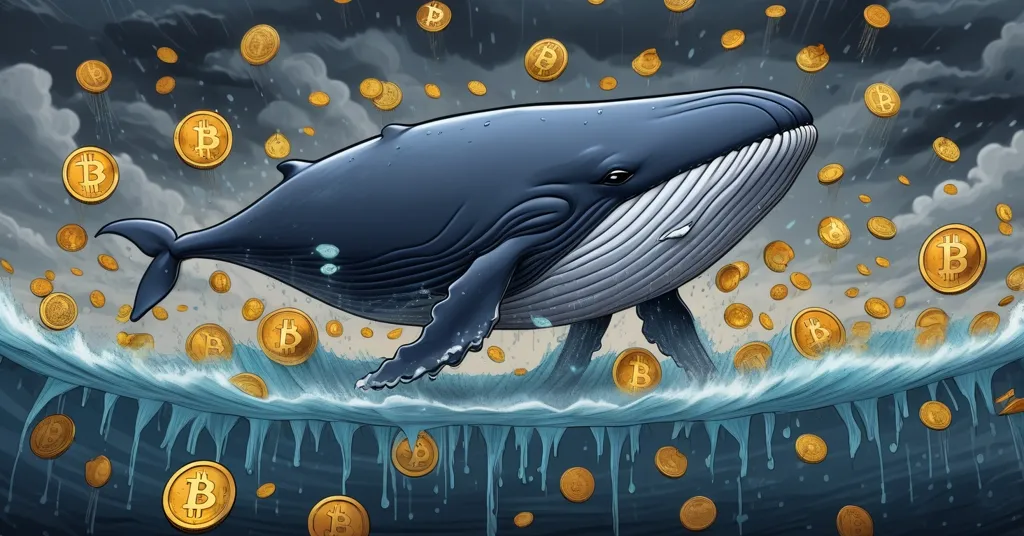
Bitcoin’s price stumbled nearly 5% to $66,349 recently, yet the market’s biggest players—known as whales—aren’t blinking. Over the past month, these heavyweights added a staggering 61,568 BTC to their holdings, a clear sign of confidence amid turbulence, as reported by recent market analysis on whale activity. But with geopolitical unrest, unexpected sell-offs from a tiny Himalayan nation, and mixed signals from retail buyers, the anticipated price surge remains elusive.
- Whale Moves: Wallets with 10 to 10,000 BTC increased holdings by 61,568 BTC, a 0.45% rise.
- Retail Echo: Small holders (less than 0.01 BTC) boosted their stash by 0.42%, shadowing whale behavior.
- Price Woes: Bitcoin fell to $66,349 from an intraday high of $69,789, missing the $72,000 mark seen earlier this week.
Whale Accumulation: A Bullish Bet Against the Odds
Let’s break down the on-chain action. According to data from Santiment, Bitcoin whales—large holders with wallets containing between 10 and 10,000 BTC, often capable of swaying market trends due to their sheer volume—have been on a quiet rampage. Their accumulation of 61,568 BTC over the last 30 days represents a 0.45% uptick in their collective holdings. For the uninitiated, this kind of buying often signals that these deep-pocketed investors are betting on Bitcoin’s long-term value, viewing current price weakness as a bargain. Historically, when whales hoard BTC, it’s a precursor to upward momentum, as their purchases can tighten supply and push prices higher when demand kicks in.
But why are they so confident now? It’s likely a mix of factors. Some might be hedging against inflation, expecting Bitcoin to act as digital gold in uncertain economic times. Others could be positioning for potential catalysts like upcoming ETF approvals or regulatory clarity that could drive mainstream adoption. There’s also the chance they’re exploiting market inefficiencies—buying low during fear-driven dips to sell high later. On-chain metrics, while not fully conclusive, show reduced exchange inflows recently, hinting that these whales are holding rather than preparing to dump. Still, their bullish bet hasn’t translated to a price jump yet, and there’s a reason for that.
Retail Buyers: Mirroring Whales, Muddying Signals
Here’s where it gets messy. Retail investors—those smaller players with wallets holding less than 0.01 BTC—aren’t sitting on the sidelines either. They’ve increased their holdings by 0.42% over the same period, nearly matching the pace of whale accumulation. For newcomers, retail investors are everyday folks dabbling in Bitcoin, often with tiny fractions of a coin, hoping to ride the wave to financial freedom. Normally, a clear price signal emerges when whales buy while retail sells, creating a scarcity effect as supply dwindles. Think of it as a tug-of-war: when one side pulls harder, the direction becomes obvious. Right now, though, both sides are pulling with equal force, leaving Bitcoin stuck in a frustrating sideways grind.
Santiment points out that a stronger upward move typically requires divergence—whales amassing coins while retail steps back. Without that, the market lacks the spark for a breakout. Imagine a crowded Bitcoin party where everyone’s dancing to the same beat—no one’s leading, so the energy fizzles. This parallel buying pattern keeps Bitcoin’s price hovering around $66,349, down from an intraday peak of $69,789 and well shy of the $72,000 high earlier this week. That $72,000 level, by the way, acts as a key milestone for traders—a mental hurdle where hesitation or hype often kicks in. Failing to reclaim it has left many bulls grumbling, wondering what’s holding BTC back despite whale conviction.
External Shocks: Geopolitical Heat and a Himalayan Surprise
Beyond on-chain dynamics, the world outside crypto is throwing punches at Bitcoin’s momentum. First up, geopolitical tensions in the Middle East are spooking markets. Reuters reports that the Pentagon is considering deploying up to 10,000 additional US troops to the region amid escalating friction with Iran. For those new to market dynamics, Bitcoin often gets lumped in with “risk-on” investments—assets like stocks that thrive when optimism reigns but get dumped when uncertainty spikes. If military escalation looms, or even if saber-rattling intensifies, traders tend to flock to safer bets like gold or the US dollar, leaving cryptocurrencies vulnerable. Even murmurs of President Donald Trump pushing for peace talks with Tehran haven’t soothed nerves. The shadow of conflict keeps risk assets like BTC on shaky ground.
Historically, Bitcoin has weathered such storms with mixed results. During the 2022 Ukraine-Russia conflict, for instance, BTC initially dipped as investors fled risk, only to rebound as its narrative as a borderless, censorship-resistant asset gained traction. Today, with no clear resolution in sight for Middle East tensions, caution dominates. Add to that the strength of the US dollar index (DXY) in recent weeks, often a safe-haven indicator, and it’s no shock that Bitcoin’s price reflects this jittery sentiment.
Then there’s an even weirder curveball: Bhutan. Yes, the tiny Himalayan kingdom better known for its “Gross National Happiness” index than crypto clout. Arkham Intelligence data reveals that wallets tied to the Royal Government of Bhutan moved 519.707 BTC—worth roughly $36.75 million—recently, likely to exchanges for sale. This isn’t a one-off; their outflows in 2026 alone exceed $150 million. For context, that’s a drop in the ocean compared to Bitcoin’s daily trading volume of $20-30 billion, but it’s still a notable drag, especially in a skittish market. Why the sell-off? Speculation points to profit-taking or funding state initiatives, possibly linked to Bhutan’s rumored Bitcoin mining operations powered by cheap hydroelectric energy. Who knew a mountain nation could ripple the crypto pond? These sales add measurable selling pressure, countering the bullish vibes from whale accumulation.
Price Stagnation: Why No Breakout Yet?
So, we’ve got whales and retail investors buying, yet Bitcoin’s price refuses to budge past key levels. Why? It’s a perfect storm of bullish intent clashing with bearish forces. The lack of divergence between whale and retail behavior dilutes the supply scarcity effect that often sparks rallies. Meanwhile, external risks—geopolitical uncertainty and Bhutan’s unexpected dumps—keep downward pressure alive. A 5% drop to $66,349 might be Bitcoin’s version of a rough Tuesday, but it’s enough to stall momentum when traders are already on edge.
Let’s not sugarcoat it: Bitcoin’s current consolidation phase is a high-stakes waiting game. For Bitcoin maximalists like myself, who see BTC as the ultimate middle finger to centralized financial control, this dip is just noise—an opportunity to HODL (a crypto slang term for “hold on for dear life”) until the inevitable climb. Bitcoin’s promise of financial sovereignty, privacy, and disruption of broken systems remains unshaken. Yet, even I’ll admit the short-term picture is murky. If Middle East tensions boil over, or more niche players like Bhutan cash out, we could see more pain before gain. On-chain signals are mixed, and anyone claiming a $100K Bitcoin by next month is peddling pure nonsense—beware of such baseless hype in this space.
What’s Next for Bitcoin? Catalysts and Counterpoints
Looking ahead, a few potential triggers could break Bitcoin out of this rut. The next halving event, expected in 2024, will slash mining rewards and historically tightens supply, often igniting bull runs. Regulatory developments, like clearer US guidelines on crypto or broader ETF approvals, could draw institutional money back into BTC. Even macro shifts, such as Federal Reserve rate cuts easing economic pressure, might lift risk assets across the board. If whales keep hoarding while retail eases off, that longed-for supply squeeze could finally materialize.
But let’s play devil’s advocate. What if external shocks persist? A full-blown Middle East conflict could tank Bitcoin further as risk aversion spikes. And while I’m a Bitcoin cheerleader, it’s worth noting that other blockchains like Ethereum might weather such storms differently, thanks to their focus on decentralized finance (DeFi) or staking yields that attract a different investor base. Altcoins often fill niches Bitcoin doesn’t—think smart contracts or scalable transactions—and their resilience could remind us that this financial revolution isn’t a one-coin show. Still, Bitcoin’s network security and first-mover advantage keep it king in my book.
Ultimately, this moment underscores Bitcoin’s dual nature: a beacon of decentralization that empowers individuals to escape fiat tyranny, yet an asset still tethered to global chaos. Whales stacking 61,568 BTC signal faith in a future where money answers to no central authority. But immediate hurdles remind us that even a borderless currency feels the heat of contested borders. Whether you’re a whale, a small-time HODLer, or just dipping your toes into crypto, the next few weeks could be make-or-break. Keep tabs on on-chain flows, Middle East headlines, and hell, maybe even Bhutan’s next chess move. Stranger things have tipped this market before.
Key Takeaways and Burning Questions
- Why are Bitcoin whales buying 61,568 BTC during a price slump?
They likely see the drop to $66,349 as a discount, betting on Bitcoin’s long-term potential as a store of value or hedge against economic uncertainty. - Why hasn’t Bitcoin’s price surged with whale accumulation?
Retail investors buying at a similar pace (0.42% increase) dilutes the bullish signal, as a breakout often needs whales to hoard while retail pulls back. - How do geopolitical tensions impact Bitcoin’s market?
Potential US troop deployments in the Middle East and tensions with Iran fuel caution, driving investors away from risk assets like BTC toward safer options. - What’s behind Bhutan’s $36.75 million Bitcoin sell-off?
Tied to the Royal Government, these sales—exceeding $150 million in 2026—may involve profit-taking or strategic funding, possibly from hydroelectric-powered mining. - Should Bitcoin holders worry about this consolidation phase?
Not overly—it’s a normal market cycle, but mixed on-chain signals and external risks mean staying alert is crucial for both traders and long-term believers.