US Commodity Giants Lose $10B in Oil Crisis: Bitcoin’s Role in Crypto & Blockchain | Let’s Talk Bitcoin
 LTB
LTB US Commodity Titans Bleed: $10 Billion Lost in Oil Amid Iran Conflict—Why Bitcoin Matters
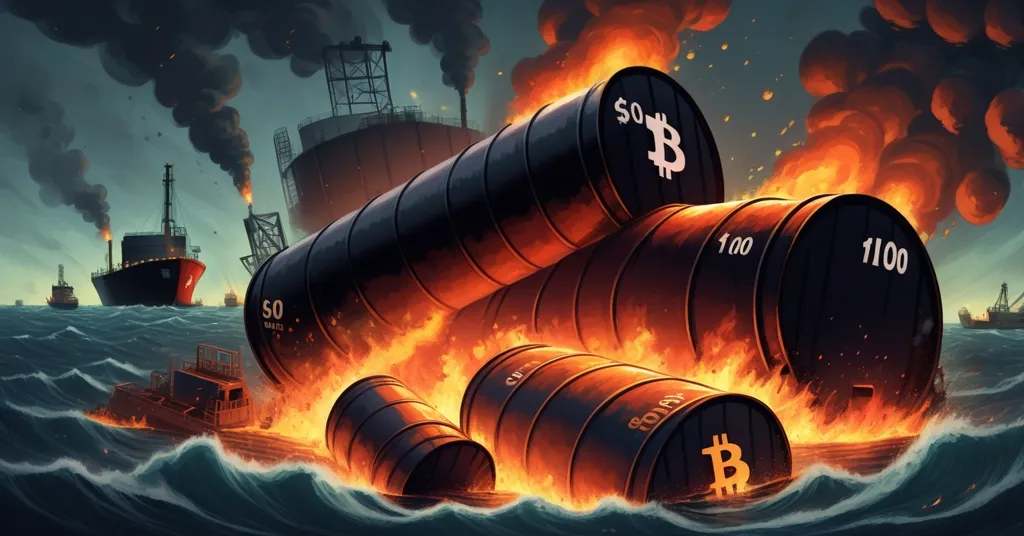
Major US commodity trading houses have been gut-punched by the US-Israel-Iran conflict, hemorrhaging over $10 billion in the oil market as geopolitical mayhem flips every prediction on its head. A sudden oil price surge, fueled by military escalations and shipping nightmares in the Gulf, has exposed the fragility of centralized markets, leaving traders scrambling and reminding us why decentralized systems like Bitcoin are gaining traction as a potential safe haven.
- Staggering Losses: US commodity giants lost over $10 billion betting on falling oil prices as war erupted.
- Shipping Paralysis: Over 100 fuel tankers stranded in the Gulf, with the Strait of Hormuz nearly shut down.
- Price Explosion: Oil soared past $100 per barrel amid a US Navy blockade and diplomatic collapse.
- Crypto Relevance: Centralized market failures highlight Bitcoin’s appeal as a hedge against geopolitical chaos.
The Oil Market Meltdown
Picture this: you’re a high-rolling trader, sitting on a mountain of contracts betting oil prices will tank. Then, boom—the US-Israel-Iran conflict ignites, and your crystal ball shatters into a billion-dollar mess. That’s exactly what happened to major US commodity houses, who, according to a hard-hitting study by Oliver Wyman, misjudged the market so badly they lost over $10 billion out of the gate, as detailed in a recent report on massive losses from the Iran war. Alexander Franke, Head of Risk and Trading at Oliver Wyman, didn’t sugarcoat the fiasco:
“For most participants, the situation was a surprise. Before the war started, there was a strong conviction in the market that prices would fall, and because of the war, they spiked.”
The numbers tell a brutal tale. US crude for May delivery skyrocketed 8% to $104.40 per barrel, while Brent crude for June delivery—think of it as the global benchmark that often dictates what you pay at the pump—jumped over 7% to $102.51 per barrel. This wasn’t just a blip on a trading screen; it was a full-on crisis. Traders who expected a sleepy market got a grenade instead, and the fallout rippled through every corner of the commodity world. But here’s the kicker: this isn’t just about oil. It’s about a centralized system so brittle that a single spark in the Middle East can torch billions overnight. For those of us eyeing Bitcoin and blockchain, it’s a neon sign flashing “decentralization or bust.”
Geopolitical Tinderbox: Iran and the Strait of Hormuz
At the heart of this disaster lies the Strait of Hormuz, a narrow waterway between Iran and Oman that’s basically the jugular vein for 20% of the world’s oil supply. When tensions flared, the US Navy, under CENTCOM, slapped a blockade on Iranian ports, effectively strangling maritime traffic. Their statement was as cold as it gets:
“The blockade will be enforced impartially against vessels of all nations entering or departing Iranian ports and coastal areas, including all Iranian ports on the Arabian Gulf and Gulf of Oman.”
The result? Over 100 fuel tankers are stuck in the Gulf, unable to move without risking a missile or a military intercept. Traffic through the Strait collapsed—down from over 100 vessels daily to just three supertankers on a recent Saturday. Iran, naturally, pushed back hard. Ali Akbar Velayati, senior adviser to Supreme Leader Mojtaba Khamenei, threw down the gauntlet:
“The key to the Strait of Hormuz remained in the hands of the Islamic Republic.”
Meanwhile, President Donald Trump’s threats of a broader blockade on the Strait itself turned the heat up to eleven. For anyone not steeped in geopolitics, here’s why this matters: when the Strait chokes, global oil supply does too. That means higher gas prices, inflation spikes, and economic ripples that hit your wallet—hard. It’s another middle finger from geopolitics to centralized markets, and a stark reminder of why we need systems no navy can blockade.
Commodity Giants Reeling
The biggest names in the game—Vitol, Trafigura, and Mercuria—took a beating in the early days of this conflict. These aren’t small fry; they’re titans of commodity trading, yet even they couldn’t dodge the chaos. With shipments stranded, they had to scramble for replacement cargoes at absurdly inflated prices. Worse, a spike in Brent crude futures triggered massive margin calls—basically, a broker’s demand for extra cash to cover potential losses on leveraged bets. If you’re new to this, think of it as a high-stakes poker game where the house suddenly demands you double your chips mid-hand. For these firms, it meant coughing up cash they didn’t have lying around, deepening the financial wound.
Zooming out, the commodity trading sector was already on thin ice. Gross margins plummeted to $92 billion last year, the lowest since 2021, compared to a peak of $145 billion in 2022. Oil desk profits specifically dropped 15%, while operational costs—known as “seat costs,” or the price of keeping a trading operation running, like salaries and tech—have surged over 30% since 2021. Metals trading did better with a 20% profit bump, but it’s a drop in the bucket against oil’s slump. Oliver Wyman estimates baseline earnings for the industry at $90 billion to $110 billion annually, assuming no more geopolitical disasters. Yeah, good luck with that.
This isn’t just a balance sheet problem; it’s a human one. Firms are tightening belts, which could mean layoffs or slashed bonuses for traders already under pressure. And for the rest of us, it’s a signal: centralized markets are a house of cards when war breaks out. Economic uncertainty like this often drives interest in alternatives—cue Bitcoin and crypto, waiting in the wings.
Diplomatic Dead End: No Peace in Sight
If you were hoping for a quick fix, don’t hold your breath. Peace talks in Pakistan imploded, with US Vice President JD Vance pointing fingers at Iran’s refusal to back off nuclear weapon development. His frustration was palpable:
“The simple question is, do we see a fundamental commitment of will for the Iranians not to develop a nuclear weapon. We have not seen that yet, we hope that we will.”
Iranian officials, predictably, weren’t buying what the US was selling. Parliamentary Speaker Mohammad-Bagher Ghalibaf laid it bare:
“The US failed to gain the trust of the Iranian delegation in this round of negotiations.”
With mutual distrust this deep and Iran’s nuclear ambitions still a lightning rod, de-escalation feels like a pipe dream. The Strait of Hormuz remains a geopolitical landmine, and every failed talk or military maneuver keeps oil markets—and global economies—on edge. For commodity traders, it’s a nightmare with no end date. For the rest of us, it’s a glaring example of how centralized control over critical resources can collapse under pressure, leaving chaos in its wake.
Why This Matters for Bitcoin and Crypto
Let’s cut through the noise: this oil market trainwreck is a case study in why centralized systems keep failing spectacularly. Oil price spikes historically fuel inflation and fiat currency devaluation—look at the 1970s oil crisis or even 2020’s COVID chaos, when uncertainty sent Bitcoin soaring as a store of value. Right now, with oil above $100 a barrel and supply chains in tatters, fiat currencies are wobbling under the threat of runaway inflation. Enter Bitcoin: with its fixed supply of 21 million coins, it’s immune to the whims of central banks printing money to patch up crises. It’s no coincidence that during past geopolitical messes—like the 2013 Cyprus banking collapse—Bitcoin saw surges as people fled crumbling traditional systems.
But let’s not get carried away with the hype. Bitcoin isn’t a magic bullet. Sure, it sidesteps blockades and border disputes—good luck blockading a decentralized ledger—but it’s got its own demons. The 2022 FTX collapse proved that crypto markets aren’t immune to human greed or stupidity, and volatility is still a rollercoaster. Plus, geopolitical crises often bring regulatory hawks circling, with governments cracking down on alternative assets when they feel control slipping. So, while Bitcoin might dodge this oil bullet, it’s not a guaranteed lifeboat.
Beyond Bitcoin, blockchain technology itself offers glimmers of hope for fixing systemic messes like this. Projects like VeChain or IBM’s blockchain supply chain tools could track oil shipments transparently, reducing reliance on choke points like the Strait of Hormuz by providing real-time, tamper-proof data. Ethereum-based platforms are also experimenting with tokenized energy assets, potentially decentralizing how energy markets operate. Even altcoins, often dismissed by Bitcoin maximalists, are carving niches in solving real-world problems—something Bitcoin itself isn’t always built to do. As much as I lean toward Bitcoin’s purity, I’ll give props to these innovations for pushing the financial revolution forward.
Still, the core lesson here is about fragility. When a single waterway or government policy can tank $10 billion in value, it’s time to question why we keep betting on the old guard’s playbook. Decentralization isn’t just a buzzword; it’s a survival tactic. And while crypto has its warts, crises like this remind us why we’re fighting to disrupt the status quo in the first place.
Key Takeaways and Burning Questions
- What caused the $10 billion loss for US commodity houses?
Traders bet big on falling oil prices, only to get blindsided by the US-Israel-Iran conflict, which spiked prices and stranded shipments, leaving balance sheets in ruins. - How has the war crippled oil shipping routes?
Over 100 fuel tankers are stuck in the Gulf, and traffic through the Strait of Hormuz—a lifeline for 20% of global oil—has plummeted, driving up costs and supply fears. - Why did oil prices blast past $100 per barrel?
A lethal combo of geopolitical tensions, a US Navy blockade on Iranian ports, and collapsed peace talks throttled supply, sending prices through the roof. - What makes the Strait of Hormuz so critical?
It’s the gateway for a massive chunk of global oil; Iran’s control claims and US blockade threats have slashed traffic, risking sustained shortages. - Why might Bitcoin thrive amid this oil chaos?
As fiat currencies stagger under inflation fears from oil spikes, Bitcoin’s fixed supply offers a potential shield—though its own volatility remains a gamble. - Could blockchain tech prevent supply chain crises like this?
Absolutely—projects like VeChain enable transparent tracking of shipments, potentially bypassing centralized choke points and geopolitical gridlock with decentralized data.
So, where does this leave us? Commodity traders are still nursing their wounds, oil markets are a wild ride, and the geopolitical chessboard is a dumpster fire. For Bitcoin and crypto enthusiasts, this mess is a brutal reminder of why we champion decentralization. Centralized markets can implode with a single flare-up, while blockchain-based systems—at least in theory—don’t bend to borders or blockades. Sure, crypto’s not perfect, and I’m not here to shill fairy tales. But if governments and Wall Street can’t keep oil flowing without losing billions, maybe it’s time they stop pretending they can control money too. Bitcoin’s ledger doesn’t care about the Strait of Hormuz—and that’s exactly why it’s worth watching as this chaos unfolds.