CLARITY Act in Jeopardy: Will U.S. Politics Stifle Crypto’s Future?
 LTB
LTB CLARITY Act on the Brink: Will Washington Fumble Crypto’s Future?
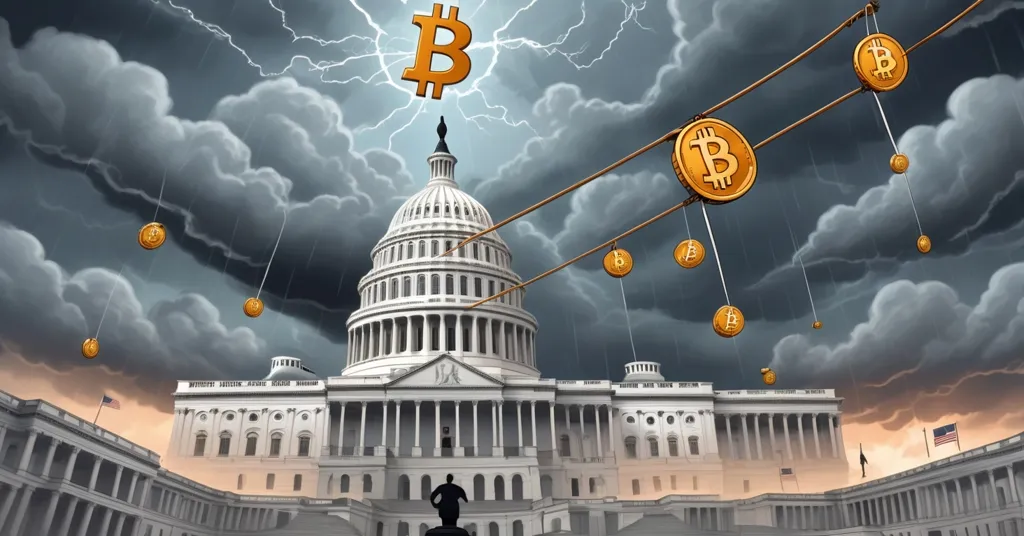
The future of finance hangs by a thread as the CLARITY Act, a lifeline for the cryptocurrency industry, risks drowning in a sea of Republican drama. With only weeks to act, this pivotal bill—designed to untangle the regulatory mess around digital assets in the U.S.—is being sidelined by unrelated political battles over surveillance laws and budget disputes. The clock is ticking, and the stakes for Bitcoin, altcoins, and blockchain innovation couldn’t be higher.
- Political Chaos: Republican infighting over FISA surveillance and ICE/CBP funding delays the CLARITY Act.
- Narrow Window: Just 14 working days remain post-Easter before midterms clog the Senate schedule.
- High Stakes: Regulatory clarity could unlock institutional crypto adoption—or leave the industry in limbo until 2030.
What is the CLARITY Act, and Why Does It Matter?
For those new to the regulatory maze, the CLARITY Act is a proposed U.S. bill aiming to settle a long-standing turf war between two federal agencies: the Securities and Exchange Commission (SEC) and the Commodity Futures Trading Commission (CFTC). Think of it like two referees arguing over who calls the shots in a game—except the game is crypto, and the players (projects, investors, exchanges) are stuck in confusion. The SEC regulates securities like stocks, while the CFTC oversees commodities like gold or oil futures. But digital assets? They’re often caught in a gray zone. Is Bitcoin a commodity? Are Ethereum-based tokens securities? No one agrees, and that ambiguity has led to inconsistent enforcement, scaring off big institutional money.
The CLARITY Act seeks to draw clear lines—potentially classifying Bitcoin and similar assets as commodities under CFTC oversight, while certain tokenized projects might fall under the SEC as securities. This isn’t just bureaucratic nitpicking; it’s the key to building safe highways for Wall Street to pour billions into crypto without fearing legal ambushes. JPMorgan analysts have called a midyear passage a major positive trigger for the sector, signaling that clarity could catalyze mainstream adoption. Without it, startups hesitate, exchanges tiptoe, and innovation stalls. For an industry built on disruption, that’s a bitter pill to swallow.
Political Circus: Unrelated Battles Derail Crypto Progress
So why isn’t this bill sailing through Congress? Because Washington is too busy with its own petty games. House Republicans are deadlocked over reauthorizing FISA Section 702, a surveillance program expiring on April 19, with some insisting on tacking on unrelated voting reforms via the SAVE America Act. At the same time, budget debates over funding for Immigration and Customs Enforcement (ICE) and Customs and Border Protection (CBP) are hogging the spotlight. House Speaker Mike Johnson is pushing for a clean FISA renewal, but resistance within his party is eating up precious legislative hours. Let’s call it what it is: a damn circus, and crypto is the unlucky sideshow. For more on the political gridlock stalling progress, check out this detailed report on Republican disputes over FISA and budget issues.
Here’s the ugly truth—digital assets aren’t a voter priority for most lawmakers. Unlike border security or government spying, crypto doesn’t ignite town halls or swing elections. Playing devil’s advocate, why should politicians care about a niche tech when their base is screaming about immigration or privacy? Traditional finance lobbyists probably aren’t losing sleep over blockchain either; if anything, they’d rather see it stifled. Still, this short-sightedness is infuriating. The CLARITY Act isn’t just about coins—it’s about positioning the U.S. as a leader in the next financial revolution. Ignoring it now is like passing on the internet in the ‘90s.
Tight Timelines: A Bureaucratic Slog Against the Clock
Over in the Senate, the situation is a nail-biter. Post-Easter recess, there are roughly 14 working days before midterm politics dominate the calendar, with long breaks looming in late summer and fall. The Senate Banking Committee, led by Tim Scott, needs to review and tweak the bill—known as a markup—by late April if it’s got any shot at advancing. As of mid-April, no date’s been set, and the silence is deafening. Even if it clears that hurdle, the road ahead is a slog: a committee vote, a Senate floor vote needing 60 Senators to say yes, reconciliation between Senate committees, alignment with the House version, and finally, a presidential signature. Justin Slaughter from Paradigm, a crypto policy group, estimates floor debates alone could chew up two to three weeks. In short, it’s a bureaucratic marathon with a sprint deadline.
Polymarket, a prediction platform, pegs the odds of passage at 55%, but that’s slipping as delays pile up. Miss this window, and the November midterms could bury the bill under election noise. Worse, a House flip to a new majority might shelve crypto reform for years. Senator Cynthia Lummis, a fierce crypto advocate, didn’t mince words on the risk:
“This is our last chance to pass the Clarity Act until at least 2030.”
Her warning, echoed by analysts at TD Cowen, paints a bleak picture. A decade-long delay isn’t just a setback—it’s a death knell for U.S.-based innovation while other nations race ahead.
Historical Failures and Global Competition
This isn’t the first time crypto’s been kicked to the curb. Remember the 2021 infrastructure bill debacle, where last-minute amendments nearly taxed developers into oblivion? Or the endless delays on stablecoin rules, leaving issuers in legal purgatory? Washington has a track record of fumbling blockchain policy, often treating it as a sideshow to bigger fish like tax reform or healthcare. Each miss pushes the industry into uncertainty, forcing projects to dodge regulators like landmines.
Meanwhile, the rest of the world isn’t waiting. The European Union is rolling out MiCA, a comprehensive crypto framework set for 2024, offering clarity on everything from stablecoins to exchanges. Singapore has carved out a pro-innovation sandbox, attracting blockchain talent. The U.S. risks a brain drain if it keeps dithering—startups and devs aren’t tethered to borders; they’ll pack up for friendlier shores. If the CLARITY Act flops, we’re not just stalling progress; we’re handing the podium to competitors. How’s that for American exceptionalism?
What’s at Stake for the Crypto Ecosystem?
Let’s zoom in on the impact. For institutional players, clarity between the SEC and CFTC means the green light to build infrastructure—think custody solutions, regulated exchanges, and ETF approvals. That’s billions in capital waiting to flood in, turbocharging adoption. But it’s not just Wall Street feeling the pinch. Smaller players—developers, retail investors, even decentralized autonomous organizations (DAOs)—are choking on uncertainty. Imagine coding a DeFi protocol only to have the SEC slap you with a securities violation, or minting NFTs without knowing if you’re breaking some obscure rule. Regulatory limbo isn’t just annoying; it’s a creativity killer.
Now, a Bitcoin maximalist might shrug and say, “Screw the rules—Bitcoin doesn’t need permission.” And they’ve got a point. Bitcoin thrived after the 2013 Silk Road bust, proving it can outlast government meddling. Its decentralized ethos laughs at red tape. But for the broader ecosystem—think Ethereum’s smart contracts, layer-2 scaling solutions, or niche altcoins filling gaps Bitcoin doesn’t touch—clarity is a game-changer. DeFi could explode with legal guardrails; NFT markets could stabilize with defined boundaries. It’s not about begging for approval; it’s about removing roadblocks to scale. So, are we supposed to just keep building in the shadows, or demand a seat at the table?
The No-BS Bottom Line
Washington’s gridlock is the biggest rug pull crypto’s faced in years. The CLARITY Act isn’t some pie-in-the-sky dream—it’s a tangible step to legitimize and accelerate the future of finance. Passing it signals the U.S. is serious about leading blockchain innovation. Failing means years of limbo, offshore exodus, and stifled potential. We’re not here to shill empty hype or peddle fake price predictions. The reality is stark: as the blockchain keeps ticking, D.C. keeps dicking around. Will the U.S. step up and own this revolution, or get left eating digital dust?
Key Questions for Crypto Enthusiasts
- What is the CLARITY Act, and why should crypto fans care?
It’s a U.S. bill to clarify whether the SEC or CFTC regulates digital assets, vital for cutting uncertainty and bringing big money into Bitcoin and altcoins. - Why is time running out for the CLARITY Act?
The Senate has a mere 14 working days post-Easter to act before midterm chaos and long breaks derail the schedule, risking a post-election stall. - How are unrelated political fights blocking crypto regulation?
Republican clashes over FISA surveillance laws and budget funding for border agencies are stealing focus, leaving the CLARITY Act on the back burner. - What happens if this bill doesn’t pass in 2023?
A delay past November midterms, especially with a House flip, could push clarity off until 2030, trapping the industry in a regulatory gray zone. - Can crypto thrive without D.C.’s blessing, or is clarity essential?
Bitcoin can survive on its own decentralized grit, but for altcoins, DeFi, and institutional adoption, regulatory rules could be the rocket fuel needed to soar.