Bitcoin Miners Pivot to AI: Threat to BTC Price and Network Security?
 LTB
LTB Bitcoin Miners Shift to AI: Impacts on BTC Price and Network Security
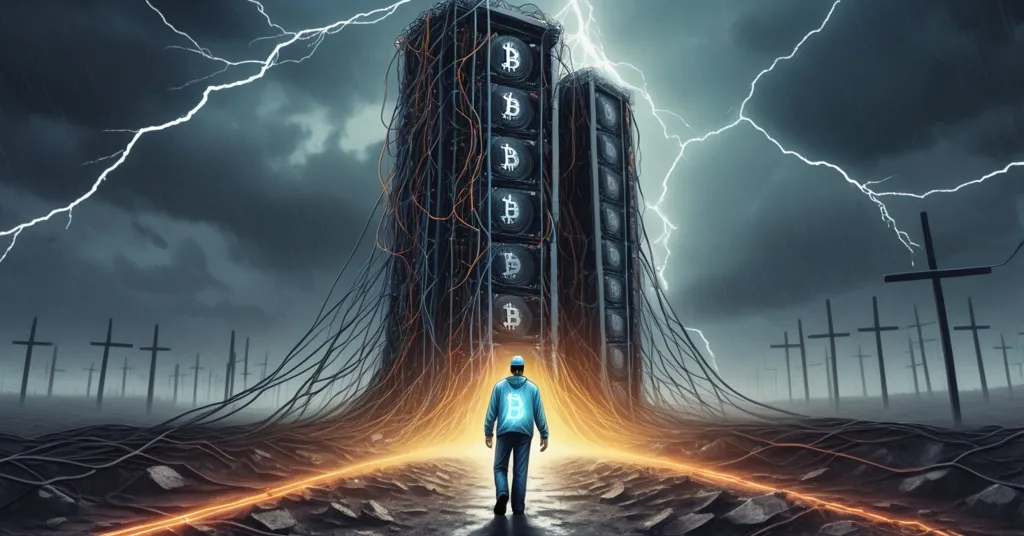
Bitcoin, the cornerstone of decentralized finance, is facing a profound challenge as major public mining companies pivot toward artificial intelligence (AI) services, sparking concerns over BTC price stability and the integrity of its blockchain. Charles Edward, founder of Capriole Investments, has issued a stark warning about this trend, highlighting potential risks that could reshape the cryptocurrency’s future.
- Industry Pivot: Bitcoin miners aim to cut BTC revenue from 90% to 30% within 2-3 years, chasing AI opportunities.
- Price Concerns: Over 32,000 BTC sold by miners in a single quarter signals heavy downward pressure on market value.
- Security Threat: Reduced investment in mining hardware could jeopardize Bitcoin’s network defenses.
The Economics Driving the AI Pivot
Bitcoin mining, the process of validating transactions on the blockchain using specialized hardware like ASICs (Application-Specific Integrated Circuits), has long been the heartbeat of the network. Miners are rewarded with newly minted BTC for their efforts, but the financial landscape is shifting dramatically. Major public mining firms, collectively valued at over $100 billion, are redirecting their focus to AI infrastructure—think building massive data centers to power machine learning models for tech giants. The lure? Eye-popping stock market gains. Companies targeting over 80% of their revenue from AI have seen share price surges of more than 500% in the past two years, while those clinging to Bitcoin with less than 60% AI focus have lagged with flat or negative returns.
This isn’t a random pivot; it’s a cold, hard response to crumbling Bitcoin mining profitability. The 2024 Bitcoin halving—a programmed event that slashes block rewards by half every four years to curb inflation—has gutted miners’ primary income. Add to that a hashprice, which measures revenue per unit of computing power (think of it as earnings per horsepower in an engine), dropping to near-record lows of $33 per petahash per second (PH/s), and stubbornly high network difficulty—how tough it is to mine a block compared to easier days in 2021. The result? Many miners aren’t even bothering to buy new rigs. Instead, they’re running their current machines until they burn out and funneling capital into AI setups. When the numbers don’t add up, businesses don’t mess around, even if it means abandoning the very network they helped build. For more insights on this shift, check out this analysis on Bitcoin miners moving to AI.
Price Pressure from Massive Miner Sell-Offs
Beyond the strategic shift, there’s an immediate sting for Bitcoin’s market dynamics. Public miners like MARA, Riot, CleanSpark, and Bitdeer unloaded over 32,000 BTC in just the first quarter of a recent speculative timeframe, according to a report by TheEnergyMag. That’s more than the entire net sales for the previous year combined. This isn’t a petty cash-out; it’s a fire sale to fund their AI ventures, and it’s stripping away buy-side support in the market. When miners—who historically hold BTC as a long-term bet—start dumping at this scale, it’s a glaring sign of shaken confidence in Bitcoin’s near-term price growth.
For the uninitiated, Bitcoin’s price is a delicate dance of supply and demand. With new issuance already throttled post-halving, miner sell-offs flood the market with coins, potentially dragging values down if demand doesn’t keep pace. Charles Edward of Capriole Investments argues this trend isn’t just a blip—it’s a systemic shift reflecting deeper doubts among industry leaders. And let’s be real: when the folks who literally mine the stuff start bailing, it’s not exactly a vote of confidence for HODLers expecting moonshot gains. Could this be the start of a slow bleed for BTC’s market cap? It’s not hard to imagine.
Network Security Under Threat
Price woes are bad enough, but there’s a darker cloud looming: Bitcoin’s network security. The strength of Bitcoin lies in its decentralized army of miners, whose combined computational power—known as hashrate—shields the blockchain from malicious attacks. If a bad actor controls over 51% of the hashrate, they could theoretically rewrite transactions or double-spend coins, undermining trust in the system. Historically, Bitcoin’s sheer scale has made such a “51% attack” impractical, but reduced investment in mining hardware could change that.
With major firms stepping back from buying new ASICs and focusing on AI instead, the network’s hashrate could stagnate or decline. Fewer miners mean less defense, plain and simple. Edward warns this isn’t a minor issue—if the trend persists, Bitcoin might face vulnerabilities unseen in past bear markets. Unlike typical miner capitulation events, where maybe 20-30% of players exit temporarily during price dips, this is a structural exodus by heavyweights. It’s like watching the town’s strongest guards pack up and leave the gates unmanned. Sure, Bitcoin has weathered storms before, but a thinned-out defense in an era of growing cyber threats is a gamble we can’t ignore.
Emerging Threats: Quantum Computing and Beyond
As if miner defections weren’t enough, Bitcoin faces futuristic risks that sound like something out of a sci-fi flick. Quantum computing, a next-generation technology capable of processing data at speeds unthinkable by today’s standards, could one day crack the cryptographic algorithms securing BTC transactions. Bitcoin relies on digital signatures to prove ownership of coins, and a sufficiently advanced quantum machine might decode these protections if the network’s code isn’t upgraded to resist such attacks. While major players like Google and IBM are still years away from practical quantum breakthroughs, the threat is real enough that the crypto community is already exploring post-quantum cryptography solutions.
This adds another layer of urgency to the miner pivot. A weakened network with lower hashrate is already a concern, but pair that with delayed or inadequate updates to combat quantum risks, and you’ve got a potential Achilles’ heel. Edward points out that miners moving to AI aren’t just abandoning ship—they’re leaving Bitcoin exposed at a critical juncture. It’s a harsh reality check for a protocol often touted as unbreakable. Will the community step up to future-proof the code, or are we too distracted by shiny new tech like AI to notice the cracks forming?
A Counterview: Evolution or Crisis?
Now, let’s flip the script and play devil’s advocate. Is this miner shift to AI truly a death knell for Bitcoin, or just a natural evolution of a cutthroat industry? Mining companies aren’t charities—they’re businesses chasing profit. If AI data centers offer better returns than grinding out BTC at razor-thin margins, shouldn’t they adapt? After all, Bitcoin’s network has survived worse. Remember the 2021 China mining ban, when over half the global hashrate vanished overnight? Smaller players and new entrants stepped in, relocating to places like Texas and Kazakhstan, and the network didn’t skip a beat. Hashrate eventually rebounded stronger than ever.
There’s an argument that this pivot could even be a net positive. As big miners exit, smaller, Bitcoin-maximalist outfits might fill the gap, further decentralizing the network and reducing reliance on a handful of corporate giants. Plus, this shakeup could force long-overdue innovation—think more energy-efficient mining tech or community-driven efforts to make mining accessible to the little guy. Maybe it’s the kick in the pants Bitcoin needs to address lingering issues like quantum-proofing or unsustainable power consumption. Critics might even argue that AI data centers aren’t much better on the energy front—swapping one environmental burden for another—but at least it diversifies the risk away from Bitcoin alone.
Still, with $100 billion in industry muscle walking away, it’s tough to shrug this off as a mere hiccup. Unlike past recoveries, this feels less like a cyclical dip and more like a vote of no confidence from the very backbone of the ecosystem. Sure, Bitcoin’s resilience is legendary, but legends can fade if the foundation crumbles.
Lessons from Altcoins and the Path Forward
Bitcoin’s miner-centric design is both its strength and its Achilles’ heel. Compare that to Ethereum, which shifted to a Proof-of-Stake (PoS) model in 2022, eliminating the need for energy-hungry mining altogether. Validators in Ethereum stake ETH to secure the network, sidestepping the hardware arms race and associated risks of miner exits. While I’m a Bitcoin advocate through and through—BTC remains the ultimate middle finger to centralized finance—there’s a lesson here. Bitcoin’s niche as a peer-to-peer cash and store of value doesn’t offer the same flexibility as Ethereum’s smart contract playground, but could a hybrid approach or community incentives for miners help stabilize the ship?
Looking ahead, the Bitcoin community isn’t helpless. Decentralization is our mantra, so why not double down on it? Open-source mining tech could lower entry barriers for new players. Advocacy for sustainable energy policies might attract environmentally conscious miners back into the fold. And on the quantum front, accelerating research into post-quantum cryptography isn’t just a nice-to-have—it’s a must. As champions of effective accelerationism (e/acc), we should push for progress, not panic. Bitcoin was born to disrupt, to champion freedom and privacy against the status quo. If miners are jumping ship for AI, let’s use this as fuel to build a stronger, more resilient protocol. Ignoring the warning signs, though, would be a betrayal of the very revolution we’re fighting for.
Key Takeaways and Burning Questions
- Why are Bitcoin miners shifting to AI?
Plummeting profitability after the 2024 halving, a hashprice at near-lows of $33 per PH/s, and stock market gains exceeding 500% for AI-focused firms are pushing miners away from Bitcoin toward more lucrative tech ventures. - How does this affect Bitcoin’s price?
Massive sell-offs, like over 32,000 BTC dumped in a single quarter, reduce market support and increase downward pressure on BTC’s value as miners liquidate holdings to fund AI projects. - What are the risks to Bitcoin’s network security?
Less investment in mining hardware means a potential drop in hashrate, weakening the network’s defenses against attacks like a 51% takeover, where a single entity could manipulate transactions. - How is this different from past miner challenges?
Unlike temporary exits in bear markets affecting 20-30% of miners, this is a structural shift by firms worth over $100 billion, signaling deeper skepticism about Bitcoin’s long-term price growth. - What other threats loom for Bitcoin?
Quantum computing could eventually break Bitcoin’s cryptographic protections if the network isn’t updated, adding urgency to a situation already strained by miner exits. - Can Bitcoin adapt to this pivot?
Potentially, through community-driven solutions like decentralizing mining further, incentivizing new entrants, and fast-tracking quantum-resistant upgrades to ensure long-term resilience.
Bitcoin stands at a crossroads. The miner migration to AI isn’t just a headline—it’s a stress test for a system built on defiance of the old financial order. As enthusiasts, whether you’re a fresh-faced newbie or a battle-scarred OG, we must grapple with the harsh realities while holding fast to the vision of decentralization. Bitcoin has always been a fighter, a beacon of freedom in a world choking on centralized control. But fighters get knocked down, and survival isn’t guaranteed. Will this be the spark that reignites innovation, or the first crack in a crumbling fortress? Only time will tell, but one thing is certain: pretending all is well would be the biggest disservice to the revolution we’ve staked our future on.