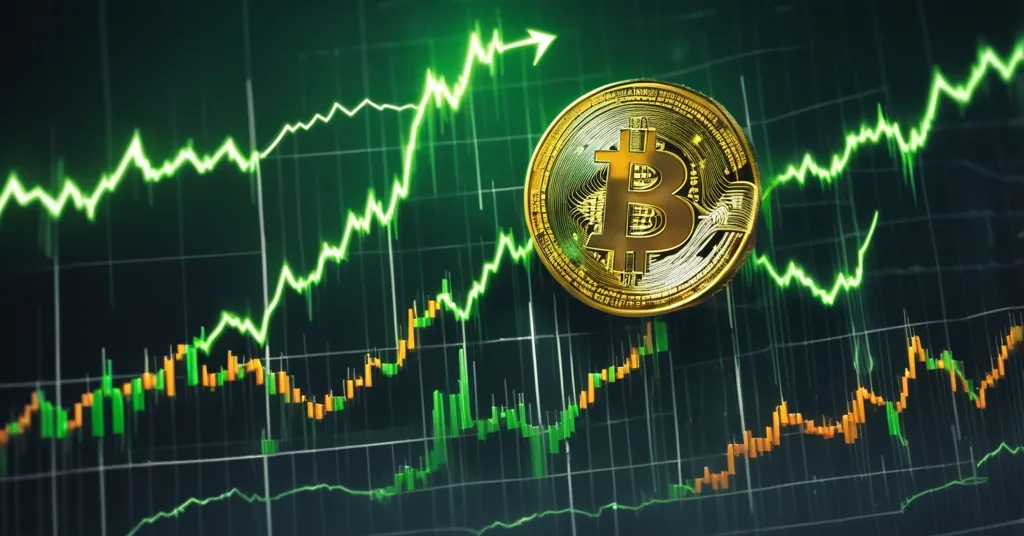
Bitcoin Rallies Past $79K as Geopolitical Tensions Cool
 LTB
LTB Bitcoin surged past $79,000 as geopolitical tensions cooled, giving traders fresh oxygen and sending risk assets higher across the board. The move was a blunt reminder that even the hardest money in crypto still reacts fast to macro fear — and the fear trade can unwind just as fast.
- Bitcoin crossed $79,000 as investors shrugged off some geopolitical stress.
- Risk appetite returned, lifting crypto and other speculative assets.
- Volatility is still the rule — a single headline can reverse the mood in minutes.
The latest Bitcoin price breakout came after a stretch of market jitters tied to geopolitical uncertainty. When that pressure eases, even temporarily, capital tends to rotate back into assets that were hammered during the panic. Bitcoin often sits right at the front of that queue because it remains the largest, most liquid, and most watched asset in crypto.
For newer readers, geopolitical tensions means the kind of real-world mess that rattles investors: war risk, sanctions, diplomatic breakdowns, trade shocks, or any escalation that makes people reach for cash and safety. When those tensions cool, traders typically feel more comfortable taking risk again. That doesn’t just help stocks and commodities — it can also send crypto markets higher, especially when sentiment had already been fragile.
The surge above $79,000 also cuts through one of crypto’s favorite fairy tales: that Bitcoin is always marching to its own drummer and somehow immune to the rest of the financial world. Not quite. In the long run, Bitcoin’s case is still powerful — fixed supply, censorship resistance, and a monetary network that doesn’t need permission from bankers or governments. But in the short run, it often behaves like a high-volatility risk asset, meaning it tends to rise harder when investors are greedy and fall harder when they get spooked.
That short-term behavior is not a bug. It’s the reality of an asset still being priced by a market that is part ideological, part speculative, and part macro-driven. Bitcoin is both digital money and a trader magnet. Those two identities can coexist, even if the maxis occasionally need a cold towel when price action looks less like Austrian economics and more like a caffeine-fueled casino.
Easing geopolitical tensions usually reduces what traders call the fear premium — the extra caution built into asset prices when uncertainty is high. Less fear means less demand for defensive positioning in cash, Treasuries, or other low-risk assets, and more willingness to chase upside elsewhere. Bitcoin doesn’t need magical narratives to move; sometimes it just needs the market to stop bracing for a catastrophe.
That said, nobody should mistake a clean breakout for a victory lap. Bitcoin can rip higher in a hurry, but it can also give that back in a heartbeat. If geopolitical stress flares again, or if broader liquidity tightens, the same market that cheered the move through $79,000 can turn around and sell into the weakness like nothing happened. Welcome to the glorious instability of an asset that trades 24/7 and has the attention span of a caffeinated squirrel.
There’s also a deeper counterpoint worth keeping in mind. Every time Bitcoin reacts to macro stress, critics dust off the tired “digital gold” debates and ask whether it really acts like a safe haven. Fair question. If Bitcoin were already a mature safe-haven asset, it would probably show a lot less sensitivity to fear-on, fear-off swings. On the other hand, the fact that it still responds so strongly to macro shifts may simply reflect where it is in adoption: still early, still liquid, still heavily traded by short-term speculators, and still being discovered by a global market that hasn’t fully priced its monetary role.
That tension is exactly why Bitcoin matters. It is not just a chart. It is a live test of whether decentralized money can coexist with — and eventually compete against — a financial system built on debt, leverage, and central bank intervention. When risk appetite improves, Bitcoin tends to catch a bid. When confidence cracks, it gets hit. That doesn’t invalidate the thesis. It just means the road to monetary disruption is messy, noisy, and full of people trying to scalp the move for a quick buck.
The broader crypto market often follows Bitcoin’s lead, though not always in a clean line. Ethereum and other major digital assets can benefit when sentiment improves, but Bitcoin usually remains the first beneficiary of a macro-driven rebound because it is still the benchmark asset. Traders use it as the gateway trade, the reserve currency of crypto if you want to put a shiny label on it. Whether that’s flattering or exhausting depends on how much you enjoy watching price action dominate the discourse.
Key takeaways and questions:
-
Why did Bitcoin rise above $79,000?
Because easing geopolitical tensions improved investor sentiment and pushed money back into risk assets, including Bitcoin.
-
Does this mean Bitcoin is decoupling from traditional markets?
No. In the short term, Bitcoin still reacts to broader macro conditions, especially shifts in risk appetite and liquidity.
-
Is Bitcoin acting like a safe haven right now?
Not consistently. It still behaves more like a volatile speculative asset during periods of stress, even if its long-term monetary case remains strong.
-
Could the rally reverse quickly?
Absolutely. A new geopolitical shock, a liquidity squeeze, or a broad market sell-off could knock Bitcoin back down fast.
-
What does this mean for crypto traders?
Momentum is back for now, but traders should treat the move with respect. Bitcoin can move hard in both directions, and chasing candles without a plan is a fast way to become exit liquidity.
Bitcoin’s climb past $79,000 is another sign that the asset remains tied to the pulse of global markets, not floating above them in some pristine monetary vacuum. It’s still the most important experiment in decentralized money, but it’s also still very much a trader’s playground. That duality is messy. It’s also what makes Bitcoin one of the most important financial assets on the planet.