CLARITY Act Stalls as Stablecoin, DeFi and Trump Ethics Fight Intensify
 LTB
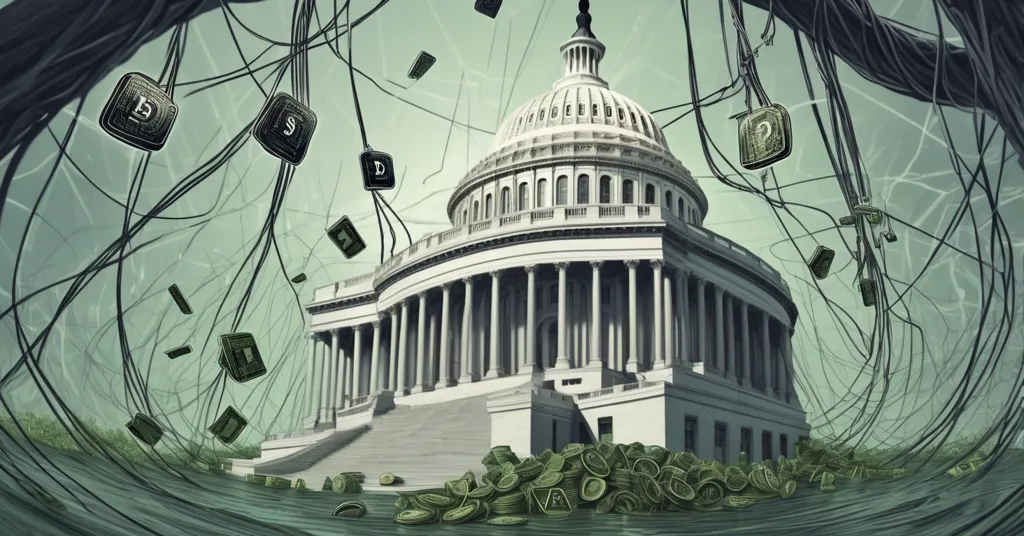
LTB The CLARITY Act was supposed to give the U.S. a cleaner rulebook for crypto, defining who regulates digital assets and where stablecoins, DeFi, and exchanges fit in. Instead, it’s getting stuck in the usual Washington swamp: banking lobby fights, Trump-linked ethics drama, and a legal knife fight over whether software developers should be treated like criminals for writing code.
- Stablecoin rewards are the first major roadblock
- Trump crypto ethics concerns are poisoning the politics
- DeFi developer protections are colliding with law enforcement fears
- Crypto PACs are already flooding the battlefield with cash
The Senate Banking Committee still hasn’t scheduled a markup for the CLARITY Act. For readers not deep in Capitol Hill jargon, a markup is the committee’s formal review and amendment session — basically the part where lawmakers start hacking the bill up, massaging it, or burying it if they don’t like what they see. Sen. Thom Tillis says May looks more realistic than April for action, which means the bill is already bleeding time before the real trench warfare even begins.
That matters because the CLARITY Act is meant to do something the U.S. crypto sector has wanted for years: establish market structure rules for digital assets. In plain English, it tries to sort out whether a token should be treated like a security, a commodity, or something else entirely, and which regulator gets the steering wheel. Without that clarity, the industry stays trapped in legal limbo while agencies and courts keep freelancing. And when Washington freelances, the result is usually confusion with a side of lobbying.
Stablecoin rewards are the first wall
The biggest immediate fight centers on stablecoin rewards. The question is whether platforms like Coinbase should be allowed to offer interest-like or yield-like payouts tied to stablecoin balances. Stablecoins are crypto assets designed to hold a steady value, usually pegged to the U.S. dollar. Rewards on those balances can look a lot like bank interest, which is exactly why the banking lobby is losing its mind over them.
The North Carolina Bankers Association urged Tillis to support an “airtight prohibition” on those rewards. The American Banking Association has been running Politico ads telling senators to “close the stablecoin loophole”. The Consumer Bankers Association also pushed back on a White House report arguing stablecoin rewards would not hurt bank lending. Their argument is obvious: if consumers can park money in stablecoins and earn something back, why would they leave funds sitting in low-yield bank accounts that do the banks all the favor and the customer none?
From the crypto side, this looks like old-school protectionism wearing a consumer-protection costume. The Digital Chamber, Blockchain Association, and Crypto Council for Innovation have all pushed for quick committee action, and one of those letters reportedly had support from more than 120 crypto stakeholders. Their message is simple: stablecoin rewards are part of the competition, and banks shouldn’t get to choke off a rival just because the rival is newer, uglier to them, and built on blockchain rails.
White House crypto adviser Patrick Witt didn’t bother with diplomatic seasoning. He said it was:
“hard to explain any further lobbying by banks on [the yield v reward] issue as motivated by anything other than greed or ignorance. Move on.”
That’s blunt, but the underlying point is hard to dismiss. The banking sector says it’s defending deposit funding and lending capacity. Crypto advocates say banks are just trying to keep their moat intact. Both can be true to a degree. Banks do rely on deposits to fund loans. But that doesn’t magically make every anti-stablecoin argument principled; sometimes it’s just incumbents trying to slap a “safety” label on self-interest and call it a day.
Delay is turning into a real problem
The schedule is slipping, and the clock is not on crypto’s side. The earliest Senate Banking Committee action may now land in the week of May 11, and every delay makes it harder to build momentum for a broader Senate vote. Galaxy Digital’s head of research, Alex Thorn, didn’t sugarcoat the odds:
“The odds of CLARITY being signed into law in 2026 are roughly 50-50, and possibly lower.”
Polymarket traders seem to agree. Odds of the bill becoming law in 2026 have dropped to 46% from 65% on April 17. Prediction markets are not gospel, but they are often a decent sniff test for political momentum. And right now the smell is less “reform is coming” and more “everyone’s still arguing about whose ox gets gored.”
Ethics language is turning the bill radioactive
If stablecoins are the economic fight, ethics is the political poison. Sen. Tillis has said the bill needs ethics language before it leaves the Senate. He made it brutally clear:
“there has to be ethics language in the bill before it leaves the Senate, or I’ll go from one of the people working on negotiating it to voting against it.”
That’s not a subtle hint. That’s a negotiation red line.
The issue here is simple and ugly: Trump’s crypto activity has become impossible to separate from the legislative debate. His $TRUMP memecoin drew scrutiny after he hosted top holders at Mar-a-Lago. The $TRUMP Coin Club is also offering luxury suites, private dinners, and “elite experiences” based on token holdings. That kind of setup doesn’t just smell bad; it gives opponents an easy argument that crypto regulation could become a playground for people with money, connections, and a willingness to buy access.
Moonrock Capital founder Simon Dedic called Trump’s crypto activity:
“the biggest obstacle to crypto regulation right now.”
That may sound dramatic, but there’s a reason it lands. Lawmakers can argue endlessly about market structure, custody rules, and token classification. What they can’t easily ignore is the optics of a sitting president or his orbit profiting from crypto ventures while helping shape the rules. That’s the sort of mess that turns a technical bill into a political grenade.
Tillis is not saying the bill should be stripped down into mush. He is saying lawmakers should not pretend ethics concerns don’t matter just because they’re inconvenient. And to be fair, he’s right. If the U.S. is going to write lasting crypto rules, it probably shouldn’t start by blessing a system where political power and token profits are casually mixed together like a bad cocktail at a lobbying reception.
DeFi protections are the legal minefield
The third major fight is over DeFi developer liability. DeFi, or decentralized finance, refers to financial services run by smart contracts and open-source code instead of a single bank or broker sitting in the middle. Developers want safe harbor language from the earlier Blockchain Regulatory Certainty Act folded into the CLARITY Act so they are not punished just for publishing code.
Safe harbor is legal shorthand for conditional protection from liability. In this context, it means lawmakers would create a zone where developers are not automatically treated as criminals simply because their software can be misused by bad actors. That idea has support from crypto builders who argue that writing open-source code is not the same thing as running a criminal enterprise.
Law enforcement groups disagree, or at least they’re not willing to hand out blanket immunity. The Fraternal Order of Police has pushed back hard, warning that broad protections would make it harder to prosecute financial crimes involving crypto. The FOP put it bluntly:
“Make no mistake, stripping law enforcement of its ability to track blockchain financial transactions would impede the work of our members”
That concern is not nonsense. DeFi tools can be used for legitimate financial activity, but they can also be abused for laundering, sanctions evasion, or moving criminal proceeds around the blockchain jungle with a lot less friction than traditional finance allows. Anyone pretending otherwise is either naive or selling something.
Tillis has said lawmakers need to address law enforcement concerns and avoid acting like all developers are angels. Fair enough. Open-source coders are not automatically mobsters, but “I just wrote the code” is not a magical incantation that wipes away every possible abuse case. The legal question is where development ends and active criminal facilitation begins.
That question is getting sharper as the Department of Justice appears set to retry Tornado Cash co-founder Roman Storm on more serious charges. Judge Katherine Polk Failla set the retrial date for October 26. Acting Attorney General Todd Blanche said the basic principle is that developers who are not knowingly helping criminals should not be charged:
“The basic principle is that if you are developing software … you are not going to be investigated and not going to be charged.”
He also said:
“you are not going to be investigated and not going to be charged”
But Coin Center’s Peter Van Valkenburgh nailed the real problem:
“enforcement posture is not legal clarity.”
Exactly. Prosecutorial vibes are not a substitute for statute text. If lawmakers want developers, investors, and users to know where the line is, they need to actually draw the line. Otherwise, you get the usual American legal tradition: hope for the best, assume the worst, and keep a lawyer on speed dial.
The money is already moving
While lawmakers bicker, crypto-funded PACs are already shaping the political ground beneath their feet. This is where the industry’s growing influence gets real. It’s one thing to complain about regulators; it’s another to pour millions into the races that decide who writes the rules.
Sentinel Action Fund plans to spend more than $8 million backing Jon Husted against Sherrod Brown in Ohio. Sentinel has received $750,000 from the Solana Policy Institute and $250,000 from Multicoin Capital. That’s not pocket change. That’s a serious election war chest with a very specific target in mind.
Fellowship PAC, tied to Tether, has endorsed multiple Republican candidates and has already received $1 million from an affiliate of Anchorage Digital and $10 million from Cantor Fitzgerald. It has spent $3 million so far and reportedly still has just under $8 million left. Its endorsements include Lindsey Graham and Barry Moore, and it has also been considered for support of Ken Paxton. The political web around that group stretches into the orbit of Howard Lutnick, Cantor Fitzgerald, and Tether’s broader stablecoin influence. That’s what happens when crypto, politics, and money stop pretending they live in separate neighborhoods.
Then there’s Fairshake, the heavyweight. It still has more than $193 million left to spend, with backers including Coinbase, Ripple Labs, and Andreessen Horowitz. Its affiliates, Protect Progress and Defend American Jobs, have already spent $8.8 million and $5.8 million, respectively. Fairshake is no longer just a PAC. It’s a political machine with a balance sheet.
This level of spending can help pro-crypto candidates and legislation. It can also drag the whole industry deeper into the same influence game it was supposedly built to escape. That’s the ugly irony: a movement born around decentralization can still end up playing the oldest centralized game in Washington — who can fund the louder megaphone and buy the better aisle seat.
What happens next
The CLARITY Act still has a path, but it’s getting narrower. Stablecoin rewards need a compromise. Ethics language needs to be inserted without blowing up support from the left or the right. DeFi protections need to avoid becoming a giant loophole for bad actors. And the whole package needs to move before the political calendar and election spending swallow what little legislative patience remains.
If the bill stalls, the losers are pretty obvious: startups stuck in regulatory fog, developers unsure where liability begins, and users left with a patchwork system that rewards lawyers more than builders. The winners are also obvious: incumbents who like the fog just fine, because confusion is a great business model when you already own the roads.
The larger takeaway is that U.S. crypto regulation is no longer just a technical policy fight. It’s a contest over competition, ethics, enforcement, and political leverage. Stablecoins threaten bank margins, DeFi threatens legal assumptions, and crypto PACs are now strong enough to shape who gets to negotiate the next round. The only thing everyone seems to agree on is that nobody trusts anybody else — which, in Washington, is basically the first sign of progress.
- What is blocking the CLARITY Act?
Stablecoin rewards, ethics language tied to crypto-linked political interests, and DeFi developer liability protections are the main roadblocks. - Why are banks fighting stablecoin rewards?
They argue yield-like payouts could pull deposits away from traditional banks and weaken lending, while crypto advocates call that protectionism dressed up as prudence. - Why does Trump’s crypto activity matter here?
It creates ethics concerns and bad optics, making it harder for lawmakers to sell a clean regulatory framework without looking compromised. - What does “safe harbor” mean for DeFi developers?
It means legal protection under certain conditions, so developers are not automatically treated like criminals just for writing open-source software. - Are law enforcement groups opposed to DeFi protections?
Yes. Groups like the Fraternal Order of Police say broad protections could make financial crime harder to investigate and prosecute. - Is DOJ softening its approach to software developers?
Not really. A softer enforcement posture is not the same as legal clarity, and developers still want actual statutory protection. - Are crypto PACs shaping the 2026 political fight?
Absolutely. Fairshake, Fellowship PAC, and Sentinel Action Fund are already spending serious money to influence races and legislation. - What’s the biggest risk if the bill keeps stalling?
The U.S. stays stuck with legal uncertainty while other jurisdictions move ahead, and the market keeps operating in a fog that helps lawyers more than innovators.