Senate CLARITY Act Faces Ethics Fight, Bank Backlash and Narrow 60-Vote Path
 LTB
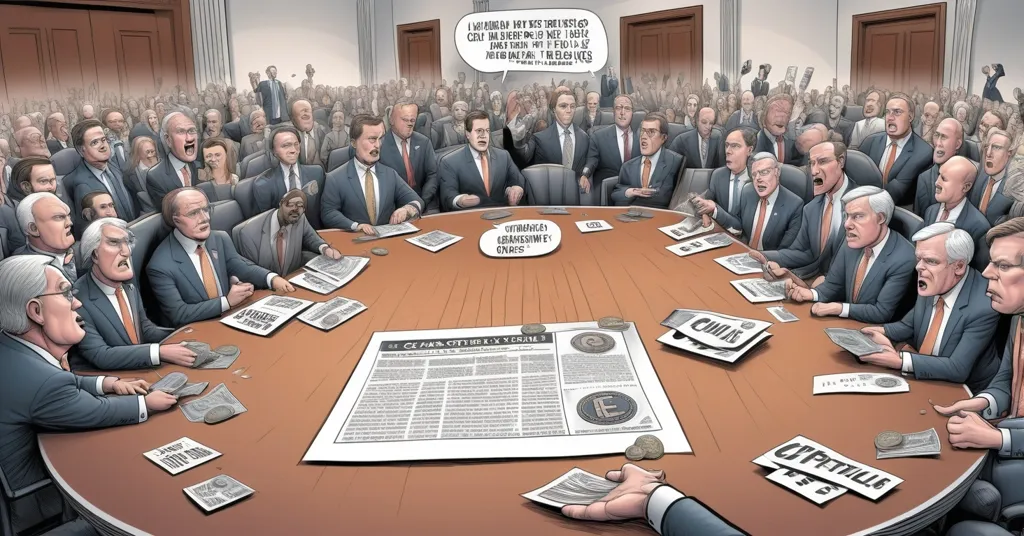
LTB The Senate’s push to pass the CLARITY Act, a major crypto market structure bill, has hit a politically ugly stretch. The plan is simple enough on paper: finally define how the SEC and CFTC split oversight of digital assets. The reality is Washington doing what Washington does best — turning a policy question into an ethics brawl, a banking lobby food fight, and a clock-watching exercise in legislative futility.
- CLARITY Act: Senate framework for U.S. crypto market structure
- SEC vs CFTC: who regulates which digital assets
- Ethics fight: Trump-linked crypto ventures are complicating support
- Stablecoin yield: banks want it dead, crypto wants it alive
- 60 votes: brutal math, narrow window, shrinking patience
For readers new to the jargon, market structure is just the rulebook for how crypto assets are classified, traded, and supervised in the U.S. Right now, that rulebook is a mess. The Securities and Exchange Commission (SEC) usually deals with securities like stocks, while the Commodity Futures Trading Commission (CFTC) handles commodities and derivatives. Crypto has spent years stuck in the gap between those two agencies, with one often acting like everything is a security and the other waving from the sidelines. That ambiguity has been great for lawyers, terrible for builders, and downright absurd for anyone trying to launch a legit business without stepping on a regulatory landmine.
The Senate Banking Committee, led by Tim Scott, still wants a bipartisan committee vote in May. That’s the official target. The unofficial target appears to be “before the whole thing gets swallowed by politics, elections, and committee-room chaos.” Multiple markups have already been delayed, and the latest 278-page draft was released in January 2026. The House already passed its version in July 2025 by a 294–134 vote, including 78 Democrats, so there is clearly some appetite for crypto regulation in the U.S. But the Senate is where legislation goes to get sandblasted by ego, special interests, and procedural math. For more context on the latest pressure points, see the crypto bill’s critical junction.
The biggest political drag on the bill right now is ethics. Republican Sen. Thom Tillis has drawn a line in the sand, saying:
“I would oppose final passage without ethics provisions included.”
That matters because Democrats are not going to let Trump’s crypto ties quietly slide by. They say the former president’s business interests create a conflict-of-interest cloud around the whole process. Reports say Donald Trump has earned at least $1.4 billion from crypto-related ventures, including World Liberty Financial, a DeFi and stablecoin project. His family also reportedly has a stake in American Bitcoin, a bitcoin mining company. In plain English: when a politician has skin in the game, every debate about crypto regulation starts looking a lot less like policymaking and a lot more like a rigged poker table.
Sen. Angela Alsobrooks has said bipartisan support depends on fixing ethics and illicit finance concerns. That phrase — illicit finance — usually covers money laundering, sanctions evasion, terrorist financing, and other fun uses of bad financial plumbing. In crypto, those concerns are always lurking in the background, and fair enough: permissionless systems can be abused just as easily as they can be used for freedom. The point isn’t to pretend risk doesn’t exist. The point is to stop using “risk” as a blanket excuse for a regulatory free-for-all or for protectionism dressed up as consumer safety.
Then there’s the bank fight, which is really a fight over who gets to own the next layer of money. One of the hottest flashpoints is whether crypto firms should be allowed to offer yield on stablecoin deposits. That’s basically interest-like rewards on stablecoins, similar to how a savings account pays interest. Banks hate this because they see deposit flight coming. If customers can park money in stablecoins and earn a return, why keep cash in a low-yield traditional account?
Standard Chartered has estimated that stablecoins could pull up to $500 billion from U.S. bank deposits by 2028. That is the kind of number that makes bank lobbyists clutch their pearls and call everyone a threat to financial stability. But the White House Council of Economic Advisers pushed back, saying stablecoin yield would displace only about 0.02% of total bank loans, or roughly $2.1 billion. That gap tells you this fight is as much about narrative control as it is about economics. One side sees a systemic bleed; the other sees a much smaller competitive nuisance and a whole lot of alarmist posturing.
There is a legitimate devil’s-advocate case here on both sides. Banks are right that deposits are the fuel of the traditional lending system. Pull too much of that fuel away, and credit gets more expensive, especially for smaller institutions. But crypto firms are also right that the traditional banking system has spent decades enjoying a cozy moat, with little competition and plenty of rent-seeking. If stablecoins can offer faster settlement, better portability, and yield, that is not automatically a bug. Sometimes it’s just what competition looks like when the old guard finally has to deal with a challenger that doesn’t need a branch office on every corner.
The Senate vote math is the part that should make everyone stop pretending this is easy. The bill needs 60 Senate votes. That means all Republicans plus seven Democrats if every GOP senator votes yes. But Sen. John Kennedy has said he will not support it, which reduces the effective Republican count and makes the Democratic lift even heavier. As one report put it bluntly: “The 60-vote math says it has not widened by enough.” That’s the problem in one sentence. You can have a committee draft, a House vote, and a stack of talking points; without the votes, you have nothing but expensive paper.
Prediction markets are treating the bill like a coin toss with better odds than before. Polymarket moved from 38% to 46% over the past week, while estimates cited by The Block have ranged from 15% to 50%. That’s not certainty. It’s sentiment. Prediction markets are useful, but they are not crystal balls — just a live snapshot of how traders think the political winds are blowing. And in Washington, those winds change faster than a lobbyist’s principles after lunch.
Paul Atkins, the SEC Chair, described the agency’s March guidance as “an important bridge” while Congress works on permanent rules. That’s bureaucratic language for “we know this system is broken, so please stop forcing the agency to patch every hole with enforcement actions and vibes.” The whole reason crypto market structure legislation matters is because it could finally answer basic questions: Which assets are securities? Which fall under commodity rules? What do exchanges need to do? How do custody standards work? What disclosures are required? Without those answers, U.S. crypto firms are stuck guessing while regulators and plaintiffs’ lawyers take turns swinging bats.
Bitcoin itself sits in a somewhat different category than many other digital assets, but it is not immune to the outcome. A clearer framework would still affect exchanges, custody providers, institutional access, derivatives, and the overall health of the U.S. crypto market. If the legislation is sensible, it could make the U.S. a better place to build around Bitcoin and broader decentralized finance. If it is clumsy, it could entrench the incumbents, give banks a regulatory moat, and smother innovation under layers of compliance theater. “Clarity” is only useful if it actually creates competition instead of freezing the system in place.
That’s why Cynthia Lummis has warned that failure this Congress could delay comprehensive crypto regulation for years. Bernie Moreno says the bill needs to clear Congress by end of May. Analyst Adrian Wall put the timing pressure in blunt terms:
“If this doesn’t get passed and put in front of the President’s desk by July, I think everyone feels that window will have been closed because of the mid-terms.”
That warning is not dramatic for effect. It’s how Congress actually works. Once midterm politics takes over, everything else gets shoved into the back seat. Crypto can wait. Banking lobbyists will keep filing memos. Ethics accusations will keep flying. And the bill that was supposed to bring “clarity” will sit in the same place as a thousand other dead-or-delayed reforms: a draft, a deadline, and a Senate calendar full of excuses.
If the CLARITY Act does survive, the upside is real. A credible crypto market structure law could give builders a reason to stay in the U.S., reduce the SEC vs CFTC confusion, and finally give legitimate businesses some legal footing. That would be a win for adoption, investment, and probably Bitcoin infrastructure too. But there is also a darker possibility: the bill gets watered down into something that looks like reform while mainly protecting the old financial order. That would be the usual Washington trick — slap “innovation” on the label, then hand the keys back to the same institutions that broke the system in the first place.
Key takeaways and questions:
What is the CLARITY Act?
It is a Senate crypto market structure bill designed to create federal rules for digital assets and define how the SEC and CFTC divide oversight.
Why does the SEC vs CFTC split matter?
Because it determines whether crypto assets are treated more like securities, commodities, or something in between. That affects exchanges, custody, trading, compliance, and enforcement.
Why is bipartisan support getting harder?
Ethics concerns over Trump-linked crypto ventures, plus fights over illicit finance and stablecoin yield, are making support politically fragile.
Why are banks opposed to stablecoin yield?
They fear crypto firms could pull deposits away from traditional accounts and challenge the old banking model where banks control the payment rails and the yield.
Are the deposit-fear claims exaggerated?
Maybe. Standard Chartered sees up to $500 billion in deposit outflows by 2028, while the White House Council of Economic Advisers says the impact may be far smaller at around $2.1 billion in loan displacement.
How serious are Trump’s crypto ties?
Politically, very serious. Reports say he has earned at least $1.4 billion from crypto ventures, including World Liberty Financial, while his family also has a stake in American Bitcoin.
Does the bill still have a path forward?
Yes, but the path is narrow. It needs 60 Senate votes, the calendar is tight, and at least one Republican senator has already signaled opposition.
What happens if Congress misses this window?
Comprehensive crypto regulation could be delayed for years, especially once the midterm election cycle takes over and the legislative agenda gets buried.
The CLARITY Act is now exactly where big crypto legislation usually ends up in Washington: caught between genuine reform and the usual swamp of power, money, and bad timing. The crypto industry wants rules. Banks want protection. Democrats want ethics safeguards. Republicans want the bill to survive contact with reality. And the market — especially Bitcoin — is left waiting to see whether the U.S. can finally write a sane rulebook, or whether it will keep fumbling the bag while the rest of the world moves ahead.