Colombia’s Petro Eyes Renewable Bitcoin Mining Hub on Caribbean Coast
 LTB
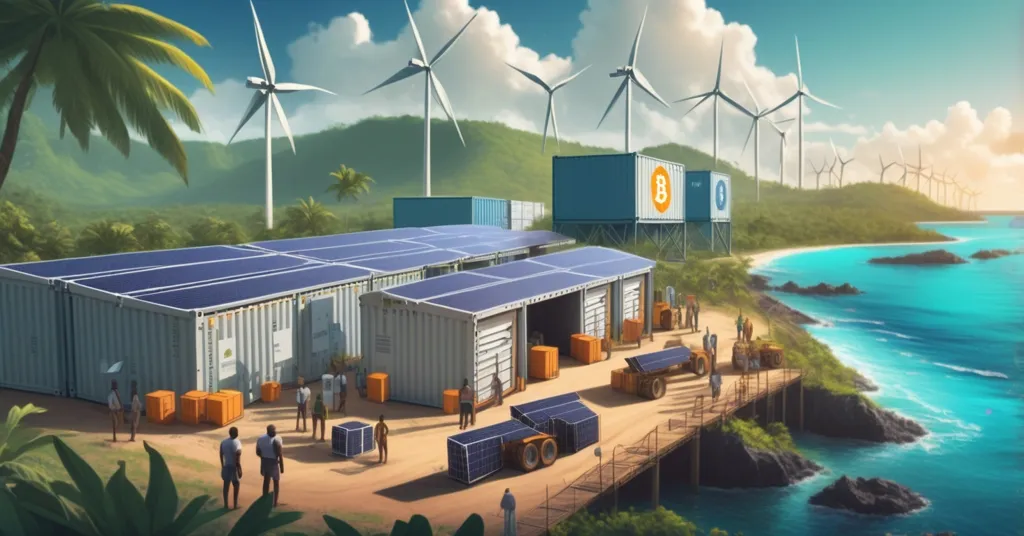
LTB Colombian President Gustavo Petro is floating a plan to turn the country’s Caribbean coast into a Bitcoin mining hub powered by renewable energy, with the Wayúu Indigenous community potentially in on the ownership. It’s a bold pitch with real potential — and a few very familiar political caveats attached.
- Barranquilla, Santa Marta, and Riohacha were named as possible mining locations
- Renewable energy and Wayúu co-ownership sit at the center of the proposal
- No mining partner, no timeline, and no formal rollout yet
- Colombia’s election cycle may decide whether anything actually happens
Petro said the Caribbean coast could receive “an immense boost” if Bitcoin mining is tied to clean energy and local participation. He named Barranquilla, Santa Marta, and Riohacha as possible sites, and suggested talks with the Wayúu community, saying they should be involved as possible co-owners rather than left on the sidelines. For more context on the proposal, see Petro’s Bitcoin mining pitch for Colombia’s Caribbean coast.
For readers less familiar with the mechanics, Bitcoin mining is the process of using specialized computers to secure the Bitcoin network and validate transactions. Miners are paid in BTC for doing that work, which is why they chase the cheapest reliable electricity they can find. Power is the real boss in this business. Everything else is just corporate PowerPoint garnish.
That matters in Colombia because the Caribbean coast, especially La Guajira, has strong wind and solar potential. La Guajira is also home to many Wayúu people, making the region both energetically attractive and politically sensitive. If a mining project is going to be built there, the local community can’t just be treated like background scenery while outside investors collect the upside.
Petro’s pitch is clearly trying to avoid the usual criticism that Bitcoin mining is a filthy energy sink. He has been openly critical of fossil-fuel-powered mining, and on that point he’s not wrong. If mining is going to happen, using surplus renewable energy is far easier to defend than burning through coal or gas just to feed rows of machines that hum like an industrial hive with an internet connection.
Why Petro is looking at Bitcoin mining
The basic logic is straightforward. Bitcoin miners go where electricity is cheap, reliable, and ideally underused. That is why countries with abundant hydro, wind, or solar can become attractive destinations for crypto mining. Petro pointed to Paraguay and Venezuela as examples of this dynamic.
Paraguay is the cleaner comparison. The country has benefited from surplus hydroelectric power, especially near the Itaipu dam, one of the world’s biggest hydroelectric facilities. That excess energy has helped pull in mining investment. HIVE Digital recently bought Bitfarms’ 200 MW hydro-powered Yguazú site in Paraguay for $56 million, and said the deal expanded its planned Paraguay infrastructure to 300 MW.
That’s a useful reminder that mining is not some abstract “crypto thing.” It’s an energy business with a Bitcoin wrapper. Miners are basically professional electricity scavengers. They follow the watts, then worry about the narrative later.
Colombia also has a stronger renewable base than many countries. The World Bank says the country generates up to 75% of its electricity from renewable sources, more than twice the global average. That doesn’t automatically make Colombia a mining paradise, but it does make Petro’s pitch more plausible than a fossil-heavy mining scheme would be.
Why the Wayúu angle matters
The most interesting part of Petro’s pitch is not the mining itself. It’s the suggestion that the Wayúu community should be involved as co-owners.
That phrase can mean a lot of things, and not all of them are equal. In the best-case scenario, it could mean equity participation, revenue sharing, or real governance rights. In the worst case, it could mean “community inclusion” in the same way a landfill says it supports “local engagement.” A photo op, a few promises, and then the real money walks away with the checksum.
For local residents, the distinction is everything. Infrastructure projects in resource-rich regions often arrive with a shiny development narrative and then leave communities holding the cost of land use, environmental stress, and broken political promises. If Petro wants this idea to survive beyond a press soundbite, meaningful local ownership would have to be more than branding. It would need actual legal and financial structure.
La Guajira is a particularly sensitive place to test that idea. The region has enormous renewable potential, but also serious infrastructure and social challenges. Wind and solar resources are only part of the equation. Transmission lines, grid stability, legal clarity, water access, and long-term maintenance all matter too. Bitcoin miners may be allergic to bureaucracy, but electricity still needs poles, cables, transformers, and somebody to keep the lights on.
Paraguay shows the upside — and the limits
Petro’s reference to Paraguay is smart political shorthand. It shows that cheap, surplus clean energy can attract mining investment and create a new source of demand for power that might otherwise go unused.
But there’s a catch: the Paraguay model depends on infrastructure that already exists and a power system capable of handling large industrial loads. Colombia’s Caribbean coast may have renewable potential, but potential is not the same thing as ready-to-operate capacity. There’s a big difference between “this region could support mining” and “this region is already set up to host hundreds of megawatts of industrial load without headaches.”
That gap is where many grand energy ideas go to die.
And then there’s market risk. Bitcoin mining profitability is tied to BTC price, network difficulty, hardware efficiency, and power costs. Even if Colombia can offer cheap renewable electricity, miners still have to survive crypto’s usual circus of volatility. A project that looks brilliant when BTC is flying can look like a very expensive toaster farm when the market turns south.
Politics may decide whether this goes anywhere
Petro’s term ends in August, and he cannot run again because of term limits. Colombia’s presidential election is set for May 31. That timing matters a lot. A president can float an idea, but the next government may be the one that has to decide whether it becomes policy or gets dumped in the nearest bureaucratic ditch.
At the moment, no major candidate has laid out a clear Bitcoin mining or digital asset policy. That means Petro’s pitch is still mostly a political vision, not a confirmed national project. It may still shape debate, especially if renewable energy and regional development become campaign issues. But without a partner, a framework, and serious commitment from the next administration, this could end up as another headline that burns bright and then evaporates.
Reuters recently reported that Colombia’s state oil company Ecopetrol bought the Windpeshi wind project in La Guajira, with operations expected by 2028. That is relevant because it shows the region’s renewable energy buildout is at least moving in a serious industrial direction. But a wind project slated for 2028 is not the same thing as a functioning Bitcoin mining campus today. The wheels of energy infrastructure grind slowly. Political speeches do not.
Could renewable-powered Bitcoin mining work in Colombia?
Yes, in theory. If Colombia can combine clean energy, stable regulation, and genuine local participation, the Caribbean coast could become a viable site for mining operations. That would not be some magical crypto utopia, but it could be a practical use of surplus renewable power and a potential source of investment in a region that needs it.
Still, there are real tradeoffs.
The upside:
- Monetizes renewable energy that may otherwise be underused
- Can attract foreign capital and technical infrastructure
- May create local jobs and tax revenue
- Could support grid development in a resource-rich region
The downside:
- Can turn into a speculative vanity project if poorly structured
- May deliver little value if locals are not genuinely included
- Depends on Bitcoin’s price and mining economics
- Requires infrastructure and regulation that may lag behind the hype
That’s the core tension here. Bitcoin mining can be a serious industrial use case for stranded or excess energy. It can also become a convenient excuse for rent-seeking, greenwashing, and political theater. Same machinery, very different outcomes.
Key questions and takeaways
What is Gustavo Petro proposing?
He is suggesting that Colombia’s Caribbean coast could host Bitcoin mining operations powered by renewable energy.
Why did he name Barranquilla, Santa Marta, and Riohacha?
Those cities are possible locations for a mining hub on the Caribbean coast, with Riohacha especially tied to La Guajira’s renewable potential.
Why does the Wayúu community matter here?
Petro says the Wayúu should be included as possible co-owners, which could make the project more locally grounded and less extractive.
Why is La Guajira important?
The region has strong wind and solar resources, making it a natural candidate for renewable-powered energy projects.
Why is Paraguay being mentioned?
Paraguay is a real-world example of how surplus hydroelectric power can attract Bitcoin mining investment.
Is this a real project yet?
No. There is no confirmed mining partner, no timeline, and no formal rollout announced.
What could stop it?
Political turnover, unclear regulation, infrastructure gaps, and the simple fact that clean energy potential does not equal operational readiness.
Why does this matter for Bitcoin and crypto?
It shows how Bitcoin mining can intersect with renewable energy, regional development, and political strategy — for better or worse.
Petro’s idea has one thing going for it: it at least tries to align Bitcoin mining with clean power and local benefit instead of the usual carbon-heavy nonsense. That’s the right direction. But until there’s a real partner, a concrete plan, and a government willing to turn rhetoric into infrastructure, this remains more promise than project. Bitcoin mining follows economics, not speeches. The grid doesn’t care about slogans, and neither does hash rate.