US Senate Advances CLARITY Act as Korea Crypto Market Exposes Transparency Gaps
 LTB
LTB US Senate Advances CLARITY Act as Korea Crypto Market Faces Transparency Gaps
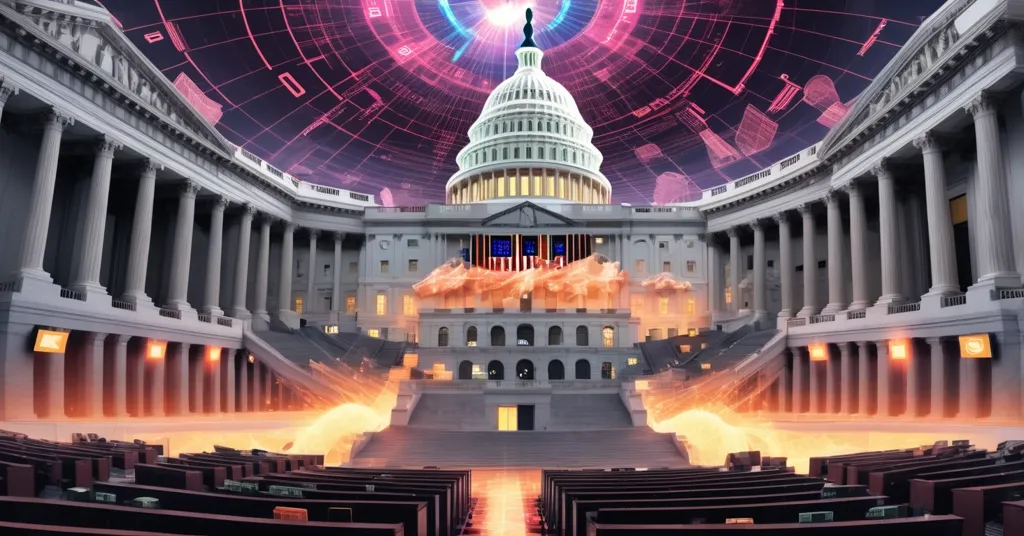
The U.S. Senate is moving toward a clearer crypto rulebook while South Korea’s massive retail market is exposing what happens when trading volume outruns transparency, accountability, and common sense.
- CLARITY Act advances: Senate Banking Committee vote of 15–9
- U.S. shift: clearer rules for securities, commodities, and market oversight
- Korea’s problem: heavy altcoin speculation, weak issuer transparency, and rising delisting pressure
The U.S. Senate Banking Committee advanced the CLARITY Act in a 15–9 vote, marking another step away from the usual crypto policy mud wrestling and toward an actual digital asset market structure. The bill won unified Republican backing and support from Democratic senators Ruben Gallego and Angela Alsobrooks, while Elizabeth Warren and other hawkish lawmakers voted against it. That split says a lot: one camp wants a usable framework, while the other still seems comfortable treating crypto like a permanent enforcement campaign with a side of political theater.
For readers less steeped in Washington jargon, the CLARITY Act is a proposed U.S. law meant to decide which digital assets should be treated like securities and which should be treated like commodities. That distinction matters because it determines whether the SEC (the U.S. Securities and Exchange Commission) or the CFTC (the U.S. Commodity Futures Trading Commission) gets the main say over a token. It also seeks to define obligations for exchanges, brokers, custodians, and parts of DeFi — short for decentralized finance, the umbrella term for on-chain financial apps that often claim to remove intermediaries but usually still have very human operators behind the curtain.
In plain English, the bill is trying to stop the industry from operating in a legal fog where nobody can confidently say what rules apply. That fog has been useful for bad actors, opportunists, and every half-baked token project with a slick website and a prayer. As one line from the piece puts it:
“Clarity” is not a concession to the industry; it is the starting point for accountability.
That framing matters well beyond the U.S. South Korea offers a sharp example of why. It has one of the most active retail crypto markets anywhere, but also some of the clearest signs that trading activity alone does not equal market health. South Korea’s Virtual Asset User Protection Act took effect in July 2024, yet the country still faces serious transparency gaps around token listings, issuer accountability, and exchange discipline.
By the end of 2025, South Korea had 11.13 million domestic exchange-eligible user accounts, with users holding about 8.1 trillion won in fiat deposits. Average daily trading volume fell to around 5.4 trillion won, and exchange operating profit declined 38% to roughly 380.7 billion won. Total crypto market capitalization in the country stood near 87.2 trillion won.
The headline takeaway is uncomfortable: user counts are still rising, but market stamina looks weaker. Lots of people are showing up. Fewer are finding a market that actually looks healthy underneath the noise.
TokenPost’s TOKEN KOREA WATCH reviewed listings across South Korea’s five major won-based exchanges and found 637 listed tokens. Only 32 tokens were listed on all five exchanges, which suggests that broad consensus on quality is pretty thin. Even more damning, only 51 projects responded to contact attempts — about 8% — and more than 140 projects reportedly did not even provide an email address.
In traditional finance, a market where investors cannot reliably contact an issuer would be considered structurally broken. In crypto, that kind of nonsense still gets dressed up as “community” or “decentralization” as if bad governance becomes noble just because it uses a blockchain. It does not. If anything, it becomes worse when the opacity is packaged with memes and momentum.
That is the core problem: a market cannot demand trust without enforceable transparency.
South Korea’s retail market is also heavily skewed toward speculation, especially outside Bitcoin. Weekly crypto trading volume is estimated at $26 billion, about 30% of global volume. Yet the domestic retail mix is roughly 85% altcoins, 9% Bitcoin, and 6% Ethereum. That imbalance matters. Bitcoin may be the most durable asset in the space, but an altcoin-heavy retail market tends to attract more churn, more hype cycles, and more pain when reality shows up late to the party.
The problem is not just that people are speculating. Speculation is part of crypto’s DNA and, frankly, one of its ugliest but most honest traits. The real issue is that too many tokens are being listed, traded, and promoted with too little accountability. Around 40% of altcoins are trading near all-time lows, and won-market trading suspensions in the second half of 2025 totaled 54 cases, up 50% from the previous half-year. The most common delisting reason was “project risk.”
That phrase can hide a lot, but usually it means one of a few things: the team is missing in action, the product is weak, the tokenomics are garbage, the supply schedule is opaque, or the entire operation looks like it was built to extract liquidity rather than build utility. In other words, the token had a future only in the marketing deck.
This is why the call for a Korean digital asset market structure law is not just regulatory hand-wringing. It is a direct response to a market that has grown fast without enough enforceable discipline. The proposed framework would add clearer token classification, mandatory issuer disclosures, communication requirements, supply and lockup transparency, and stronger exchange responsibilities. That would push exchanges to do more than collect fees and pretend listing is a neutral act.
Listing is not neutral. It is a commercial decision that signals credibility to retail investors. If an exchange lists a token, it is effectively telling users that the thing deserves attention, liquidity, and a measure of trust. If that signal is meaningless, the exchange is not serving the market — it is renting out a slot machine.
There is also a broader competitive angle. Without stronger standards, South Korea risks losing higher-quality projects to the U.S., Singapore, Hong Kong, and Japan, where compliance may be stricter but the rulebook is clearer. That is the ugly tradeoff many jurisdictions face: too little regulation invites scams and deadweight; too much can push innovation offshore. The sweet spot is not easy, but pretending the problem will solve itself is how you end up with a market full of abandoned tickers and angry retail bagholders.
Stablecoins are another pressure point. They are framed here as both a stability issue and a sovereignty issue. Stablecoins are crypto assets designed to track a stable value, usually the U.S. dollar. That makes them useful for payments, trading, and settlement — but only if reserves, redemption rights, and audits are credible. Without that, they become shadow banking with a nicer logo. At the same time, if local regulators overreach, they may hand even more payment power to foreign dollar-based stablecoin issuers. So the question is not only safety. It is also who controls the rails.
DeFi needs a similar reality check. The proposed direction is to distinguish between open-source software and the actors who actually control user funds or collect fees. That distinction matters because “decentralized” is often used as a legal force field by projects that are very much not decentralized in practice. If a team is controlling custody, setting rules, steering incentives, or extracting fees, then it should not be allowed to hide behind the poetry of code and the fiction of no responsibility.
The deeper point is blunt: if crypto cannot be eliminated, it must be governed. That is not anti-innovation. It is the minimum bar for a market that wants to be taken seriously by users, builders, and the institutions still lurking at the edge like nervous cats.
The U.S. move matters because it shows a path out of endless regulatory limbo. South Korea matters because it shows what happens when trading activity is huge but disclosure standards remain patchy and project accountability is weak. Put the two together and the message is hard to ignore: crypto markets do not become trustworthy by vibes, slogans, or another round of “number go up” nonsense. They become credible when rules are clear, issuers can be reached, exchanges carry responsibility, and retail users are no longer asked to trust smoke and a mascot.
- What is the CLARITY Act?
The CLARITY Act is a proposed U.S. digital asset market structure bill that would define whether crypto assets fall under securities law or commodities law, and which regulators oversee them. - Why does the CLARITY Act matter?
It could replace years of legal uncertainty with a clearer rulebook for exchanges, custodians, brokers, issuers, and parts of DeFi. - What is wrong with South Korea’s crypto market?
South Korea has huge trading activity, but many listed projects lack basic transparency, contactability, and accountability. - How large is South Korea’s crypto market?
It is enormous: 11.13 million exchange-eligible accounts, 8.1 trillion won in deposits, and an estimated 30% of global weekly trading volume. - Why are altcoins such a big problem in Korea?
Because the retail market is heavily altcoin-driven, which increases volatility, delisting risk, and exposure to weak or dead projects. - What does “project risk” usually mean?
It often means poor development, missing teams, weak communication, unclear supply mechanics, or tokens that never had real substance in the first place. - Why do exchanges matter so much?
Exchanges are not neutral pipes; they signal credibility. If they list weak assets without proper scrutiny, they help spread retail losses. - Why are stablecoins getting so much attention?
Because they can be useful payment tools, but without reserve and redemption standards they can also create systemic risk and threaten monetary sovereignty. - What is the DeFi regulation debate really about?
It is about separating actual decentralized software from teams or entities that still control funds, fees, or protocol direction. - What happens if South Korea does nothing?
Higher-quality projects may leave for clearer jurisdictions, while the domestic market becomes even more speculative and less trustworthy.