Bitcoin Lightning and Kenya’s M-Pesa Could Bridge Crypto Payments and Mobile Money
 LTB
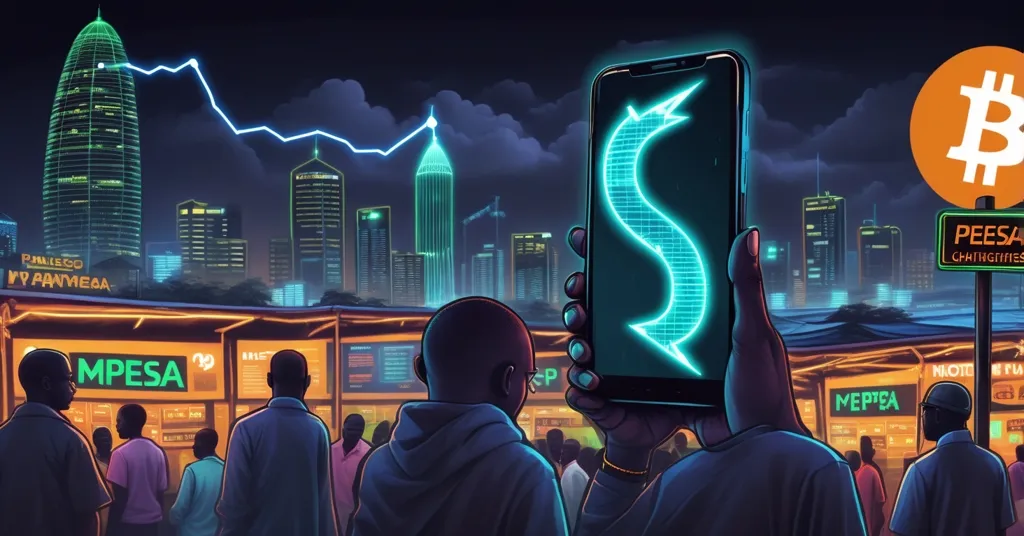
LTB Bitcoin’s Lightning Network is reportedly linking up with Kenya’s M-Pesa mobile money system, a move that could bring fast, cheap Bitcoin payments closer to everyday use in one of Africa’s most important financial markets.
- Bitcoin Lightning Network meets M-Pesa
- Potential bridge between Bitcoin and mobile money
- Could improve remittances, merchant payments, and everyday spending
- Big promise, but liquidity, UX, and regulation still matter
If this integration works beyond the demo stage, it could be a genuinely useful step for Bitcoin adoption in Kenya and across Africa. Not because it makes Bitcoin “cool” for speculators, but because it could make Bitcoin useful for actual payments — the part of the story that tends to get drowned out by chart addicts and price-pump prophets.
M-Pesa is already one of the most widely used mobile money systems in the world, especially in Kenya, where it has long been a lifeline for sending, receiving, and storing value through a phone. Bitcoin’s Lightning Network, meanwhile, is designed to move BTC quickly and with very low fees, while still anchored to Bitcoin’s base-layer security. Put the two together and you get a potentially powerful combination: mobile payments people already understand on one side, and instant Bitcoin settlement on the other.
For readers who don’t live and breathe crypto plumbing, the basics are simple. The Lightning Network is a second-layer system built on top of Bitcoin that allows payments to be sent outside the main blockchain, making them faster and cheaper. M-Pesa is a mobile money rail that lets users move cash without needing a traditional bank account. In plain English: one system helps Bitcoin move like a useful currency, and the other already has the trust and reach to get money moving by phone.
That matters because most Bitcoin talk still gets trapped in the “digital gold” box. Yes, Bitcoin is an asset, a savings technology, and a censorship-resistant monetary network. But it’s also supposed to be money. Not just something people hoard and argue about on social media while pretending to be macro geniuses. If Lightning can slot into a payment rail like M-Pesa, it gives Bitcoin a shot at being spent in the real world, not merely held on a spreadsheet or pawned off as a “long-term conviction play.”
The practical upside is obvious. A tighter Lightning-M-Pesa bridge could make it easier for users to send small payments, settle remittances, pay merchants, or move value across borders without getting eaten alive by delays and fees. That’s especially relevant in regions where traditional banking is expensive, slow, or simply unavailable to a large chunk of the population. Bitcoin’s core strength is borderless settlement; M-Pesa’s strength is local usability. That’s a strong match if the integration is built well.
There’s also a broader lesson here for Bitcoin adoption in Africa. Too much crypto “inclusion” talk assumes people need to be taught a brand-new financial religion from scratch. That’s nonsense. People already use payment tools that work for them. If Bitcoin wants real traction, it should connect to existing habits instead of demanding everyone bend their lives around crypto-native ritualism. Adoption usually comes from convenience, not ideological purity.
That said, the gap between a promising integration and meaningful usage is where plenty of crypto projects go to die.
Liquidity has to be available when users need it. Fees must stay low. Wallets and user interfaces need to be dead simple, because most people do not want to babysit channels, manage routing issues, or read a tutorial written by a terminally online engineer who thinks “self-sovereignty” means six different menus and a seed phrase tattoo.
Regulation is another obvious hurdle. Authorities tend to get twitchy when money moves in ways that are harder to monitor, especially if the system looks like it could be used to dodge controls, move capital, or frustrate compliance rules. That does not automatically kill the idea — many of the most useful financial tools start out looking suspicious to the gatekeepers — but it does mean this kind of integration has to survive the usual anti-innovation nonsense. KYC, AML, licensing requirements, and mobile-money rules can all turn a sleek idea into a bureaucratic swamp if handled badly.
There’s also the question of whether this is a direct integration, a pilot program, or a third-party bridge sitting between Bitcoin and M-Pesa. That distinction matters. A live rollout with real users is far more significant than a flashy proof of concept. In crypto, a working demo is often treated like adoption has already arrived. It hasn’t. Plenty of projects have taken a victory lap before the first real customer ever sent a meaningful transaction.
Still, Kenya is a smart place to test this kind of payment connection. M-Pesa has already shown that mobile-first money can outperform legacy banking in places where infrastructure is patchy and financial access is uneven. That makes it a natural environment for Bitcoin Lightning experimentation. If Bitcoin can plug into a payment system people already trust, the conversation changes. It stops being about ideology and starts being about utility.
The larger significance here is not that Bitcoin and M-Pesa are both “innovative.” That word is thrown around so much it’s basically wallpaper. The real point is that this could reduce friction in how people move money. That is where Bitcoin can win: not by trying to replace every payment system overnight, but by becoming a better rail underneath, alongside, or between them.
Of course, there’s a flip side. Bitcoin’s Lightning Network is fast, but it is not magic. It still depends on good wallet design, liquidity management, and a user experience that doesn’t make normal people want to throw their phone into a river. And even if the tech works beautifully, real-world adoption depends on trust. People need to believe the system will be there tomorrow, not just today when the marketing is hot and the roadmap slides are shiny.
Key questions and takeaways:
-
Why does the Bitcoin Lightning Network and M-Pesa connection matter?
Because it could combine Bitcoin’s fast, low-fee payments with one of the most widely used mobile money systems in Africa, making crypto more practical for everyday use.
-
What is Lightning Network in simple terms?
It is a Bitcoin layer that lets payments move quickly and cheaply outside the main blockchain, while still tied to Bitcoin’s security model.
-
What is M-Pesa and why is Kenya important?
M-Pesa is a mobile money system used through phones to send and receive value without a bank account. Kenya is important because mobile money is already deeply embedded in daily life there.
-
Could this help Bitcoin adoption in Africa?
Yes, if the integration is simple, reliable, and affordable. Bitcoin adoption usually grows when it fits existing habits instead of forcing people into awkward new workflows.
-
What could go wrong?
Liquidity problems, poor user experience, regulatory pressure, and overly complex systems could turn a promising bridge into another half-baked crypto experiment.
-
Is this proof that Bitcoin is becoming mainstream in Kenya?
Not yet. A real integration or pilot is a start, but mainstream use depends on whether ordinary people actually find it useful and whether the system survives regulatory scrutiny.
The most interesting thing about this development is not the buzzword appeal. It’s the possibility that Bitcoin can stop acting like a self-congratulatory asset class and start behaving like money people can actually spend. Kenya’s M-Pesa network already proved that practical payment infrastructure beats old banking inertia when it’s built for real users. If Lightning can plug into that reality, Bitcoin may gain something far more valuable than hype: genuine utility.