Rising Treasury Yields Revive Bitcoin’s Digital Gold Narrative Amid Market Stress
 LTB
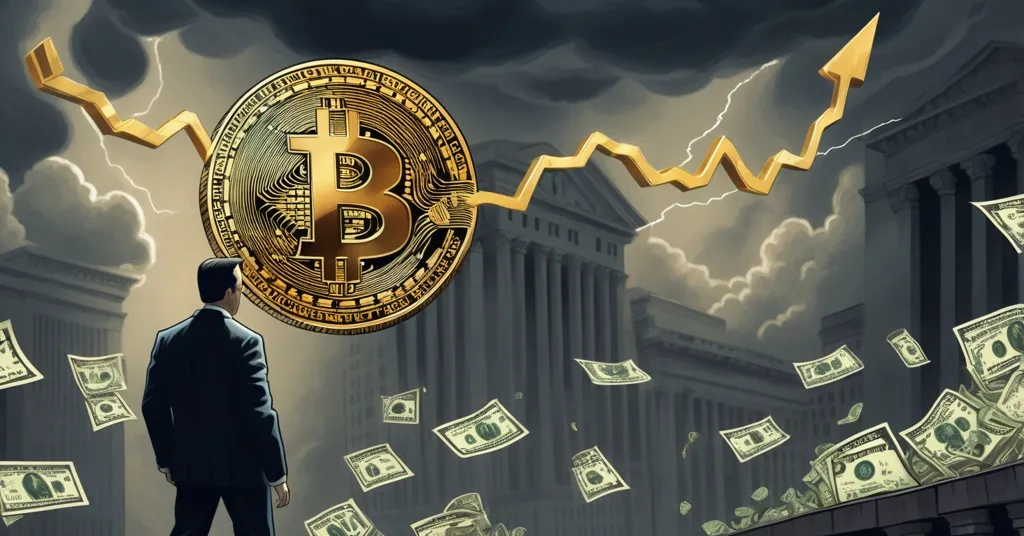
LTB Rising U.S. Treasury yields are not just a bond nerd problem. They are a global stress signal, and they have thrown Bitcoin’s “digital gold” narrative back into the spotlight, as explored in Rising US Treasury Yields Signal Market Stress, Revive Bitcoin Digital Gold Narrative.
- 10-year Treasury yields are the key pressure point
- Bond market stress can force policy shifts fast
- Bitcoin could benefit if financial repression returns
- Stablecoins are becoming relevant to Treasury demand
- South Korea faces spillover from U.S. rate pressure
The U.S. 10-year Treasury yield is one of the most important numbers in finance. It feeds into mortgage rates, commercial real estate pricing, private equity models, corporate bond issuance, equity valuations, venture capital discount rates, and the U.S. government’s own borrowing costs. When that yield climbs, the pain spreads through the system fast.
That is why bond market stress is getting so much attention. As one blunt line puts it, “Wars may be negotiated by diplomats, but they are ultimately constrained by bond traders.” Another goes even further: “The most intolerable crisis for Washington is not diplomatic embarrassment abroad but disorder in the Treasury market.” Harsh? Yes. Wrong? Not really.
The U.S. is already running deficits near $2 trillion annually, and interest costs are now one of the biggest items in the federal budget. Higher yields make that problem worse in a hurry. Every extra bit of yield means more money spent servicing debt and less room for anything else. That is the ugly arithmetic policymakers cannot wish away with a press conference and a confident jawline.
Higher yields also tighten financial conditions across the economy. Borrowing gets more expensive. Asset valuations get squeezed. Risk appetite fades. That is the kind of environment where markets stop pretending everything is fine and start pricing reality. The note calls this policy compression — fewer viable choices, faster. In plain English: the room to maneuver is shrinking.
If yields keep rising, policymakers end up with a short list of bad options. One path is faster de-escalation in geopolitical conflicts, because energy shocks and war risks can feed inflation and push yields even higher. Another is renewed monetary support, meaning more central bank intervention to keep markets from unraveling. The third is tighter Federal Reserve policy, which would aim to cool inflation but could also deepen the slowdown. Pick your poison.
The geopolitical link matters because oil and inflation expectations can hit yields from both sides. A conflict involving Iran, for example, can lift energy prices, which then stirs inflation fears and puts more pressure on Treasuries. Bond traders do not need to love geopolitics to hate what it does to duration risk. They just need a spreadsheet and a pulse.
The nastiest outcome is stagflation: weak growth, stubborn inflation, and higher borrowing costs all at once. That is a brutal mix for households, companies, and asset prices. It is also exactly the kind of setup that exposes the “everything bubble” built on cheap money and endless liquidity.
When yields rise, valuations across risk assets tend to compress. Equities, private credit, commercial real estate, speculative tech, and venture capital all get repriced. Cheap money was the fuel; higher yields are the invoice. And the bill usually lands with the least bargaining power.
That is the darker side of the story. Ordinary families tend to get hit twice. First by inflation. Then by the policy response meant to contain it. “Ordinary families are hit twice—first by inflation, then by the subsequent policy measures designed to restore price stability.” Meanwhile, the largest institutions are often protected by the familiar “too big to fail” logic that keeps getting dragged out like a rusted fire extinguisher every time the system catches smoke.
If the pressure becomes severe enough, the response could shift toward outright yield suppression. That is where terms like quantitative easing (QE) and yield curve control (YCC) come in. QE is when a central bank buys bonds to push yields lower and inject liquidity into the system. YCC is more direct: the central bank effectively caps yields at a certain level. Both are forms of financial repression, which means holding real interest rates below inflation or otherwise steering savers into government debt whether they like it or not.
That is where the bond market starts dictating the terms of the political game. History suggests that when governments are cornered by debt and rising rates, they often protect the bond market first and let the currency absorb the strain. That may be politically ugly, but it is a time-tested move. Nothing says “free market” like quietly forcing savers to subsidize the state.
“If the Fed chooses to suppress yields in an environment of structurally elevated inflation, precious metals have historically been among the clearest beneficiaries.”
That same logic extends to Bitcoin (BTC). Whenever people start worrying about currency debasement, negative real yields, or financial repression, the digital gold narrative comes roaring back. BTC does not need to behave like gold every day to benefit from that framing. It just needs enough investors to conclude that scarce, non-sovereign assets may be a better long-term refuge than paper promises backed by a mountain of debt.
Bitcoin is still a volatile asset, and nobody should pretend it is immune to short-term liquidity shocks. In a risk-off panic, BTC can get sold alongside tech stocks and other high-beta assets. That is the part of the story the permabulls conveniently forget when the charts are red. But the broader case is different: if the system moves deeper into financial repression, Bitcoin’s scarcity becomes more valuable, not less.
That is the real meaning behind the “digital gold” idea. It is not saying Bitcoin copies gold tick-for-tick. It means BTC can function as a store of value when trust in fiat purchasing power gets strained. When the state leans harder on debt, dilution, and rate suppression, a fixed-supply asset starts looking a lot less like internet funny money and a lot more like an escape hatch.
The spillover does not stop at U.S. borders. South Korea is a good example of how U.S. Treasury stress ripples outward. The U.S.–Korea rate gap can put pressure on the won, while moves in the U.S. 10-year often spill into Korea’s sovereign bond market. With household debt above 1,900 trillion won, the Bank of Korea has limited room to play hero if external financing conditions worsen.
For Korea, this is not just an abstract macro headache. A weaker won raises imported inflation pressures and can tighten financial conditions at home. In other words, U.S. yield stress can become a local pain problem very quickly. That is what global dollar dominance looks like in practice: one country’s bond market can reach into another country’s household balance sheet and rearrange the furniture.
Stablecoins are the other piece many people still underestimate. Reserve-backed stablecoin issuers hold large amounts of U.S. Treasuries, which means crypto infrastructure is now entangled with sovereign debt demand. If foreign buyers pull back, stablecoins could become a meaningful marginal buyer of U.S. government debt. Ten years ago, that would have sounded like a fever dream. Now it is just part of the plumbing.
That also explains why regulation matters so much here. The GENIUS Act and CLARITY Act are not only about crypto market structure and consumer protection. They also intersect with Treasury demand, dollar dominance, and the broader financial system. Stablecoin regulation is no longer some side quest for policymakers. It is part of debt-market strategy, whether they admit it or not.
Key questions and takeaways
What is the most important market signal right now?
The U.S. 10-year Treasury yield. It affects borrowing costs, valuations, fiscal math, and global risk appetite.
Why does the 10-year Treasury yield matter so much?
It acts like a benchmark for the whole system. Higher yields raise mortgage rates, corporate borrowing costs, and the U.S. government’s interest bill.
What is stagflation?
Stagflation is weak growth combined with stubborn inflation and rising borrowing costs. It is one of the worst setups for markets and households.
Why is Bitcoin being mentioned here?
If the system moves toward financial repression and real yields are suppressed, Bitcoin’s scarcity can make it more attractive as a store of value.
Does rising Treasury stress automatically mean BTC goes up?
No. Bitcoin can still sell off in the short term if liquidity tightens. The bullish case is more about the longer-term response to fiat stress.
Why do stablecoins matter to Treasury demand?
Stablecoin issuers hold Treasuries as reserves, so they can become an important source of demand for U.S. debt if traditional buyers weaken.
Why is South Korea part of this conversation?
U.S. rate pressure can spill into Korea’s bond market and weaken the won, which matters more when household debt is already extremely high.
What is financial repression?
It is a policy setup where real returns are kept low or negative, often by suppressing yields and channeling savings into government debt.
The uncomfortable truth is that the bond market still has more power than most politicians want to admit. If yields keep rising, the choices narrow fast: support the bond market, squeeze the currency, or risk a deeper financial rupture. That is not just a macro problem. It is a system-level stress test.
And that is exactly why Bitcoin keeps coming back into the frame. The more the old machinery leans on debt, suppression, and inflationary patch jobs, the more a scarce asset like BTC starts to look less like a speculative side bet and more like a necessary antidote.