$8M in Bitcoin Reportedly Burned, Exposing BTC Scarcity and Self-Custody Risks
 LTB
LTB Bitcoin got a little scarcer after an unexplained transaction reportedly burned about $8 million worth of BTC, permanently removing coins from circulation and hammering home a brutal truth: Bitcoin does not care if you meant to do that.
- About $8 million in BTC was reportedly burned
- The coins appear to be permanently unspendable
- No clear explanation has been confirmed
- The incident highlights Bitcoin’s immutability and self-custody risks
The move has sparked fresh debate over Bitcoin’s design, its fixed supply, and the harsh reality that a protocol built on freedom also comes with zero babysitting. If coins are sent to an unspendable address or locked in a way that no one can ever spend them again, they are effectively gone from the circulating supply forever. That is both the beauty and the menace of Bitcoin: the network enforces the rules exactly as written, not as later wished into existence by a regretful whale.
What does a Bitcoin burn actually mean?
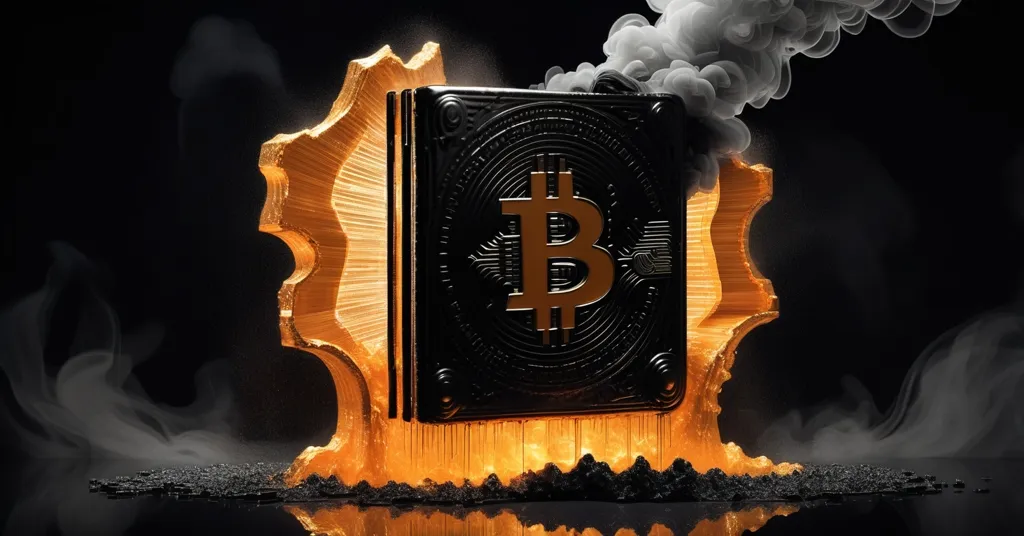
In crypto, a “burn” usually means coins have been moved to a place where they cannot be spent again. That can happen in a few ways: a transaction could send BTC to a wallet with no accessible private key, to an address format that cannot be recovered, or into a script that intentionally prevents spending. In plain English, the coins are still visible on-chain, but functionally they are dead weight.
This is not a furnace-and-ashes situation. Nothing gets physically destroyed. But on Bitcoin’s ledger, inaccessible BTC is as good as erased for practical purposes. The blockchain is transparent, but intent is often anything but. Was this a mistake? A technical blunder? A deliberate burn? A wallet cleanup gone sideways? Right now, nobody seems to know for sure.
That uncertainty is part of why the transaction drew so much attention. A whale — meaning a large holder with enough BTC to move markets or at least shake sentiment — can make waves with a single transfer. Usually that means custody reshuffling, exchange deposits, or some other market-related maneuver. This time, it appears to have ended with a permanent reduction in usable Bitcoin supply.
Why the $8 million BTC burn matters
At first glance, losing a few million dollars’ worth of BTC may sound like a rich person’s headache. And to be fair, that’s not exactly a tragedy for the average stacker. But it does matter for Bitcoin’s monetary narrative.
Bitcoin’s value proposition rests on hard money, fixed supply, and predictable issuance. There will only ever be 21 million BTC, and every coin that becomes permanently inaccessible makes the remaining usable supply a little tighter. That is why lost coins are often discussed as a reduction in circulating supply — the amount of BTC that is actually available to be spent, traded, or held by real owners.
From a scarcity standpoint, that is arguably bullish over the long run. Fewer spendable coins means a slightly smaller float, and Bitcoin already leans hard on scarcity as a core feature. A burn does not change the protocol’s 21 million cap, but it can reduce the amount of BTC that is realistically in play. In a market obsessed with squeeze dynamics, even a small reduction in liquid supply tends to get attention.
Still, let’s not pretend this is some elegant monetary ceremony. If this was an accident, then it is a very expensive reminder that self-custody is serious business. Bitcoin gives you sovereignty, but it also gives you the full consequences of your own operational mistakes. No chargebacks. No fraud department. No “sorry, can you reverse that?”
Bitcoin immutability cuts both ways
The reason Bitcoin survives as sound money is the same reason mistakes can become permanent. The protocol is immutable, meaning valid transactions are final and cannot be undone by a central authority. That is a huge part of Bitcoin’s credibility. No politician, banker, or corporate admin can swoop in and reissue lost coins because someone fat-fingered a transfer.
Of course, the flip side is obvious: if you lose access, you are out of luck. Lose your private keys, send BTC to the wrong address, or mess up a transfer to an unspendable script, and the network will not rescue you. That’s freedom with teeth. Great when you know what you’re doing. Absolutely savage when you don’t.
This is also why Bitcoin’s self-custody culture exists in the first place. Your keys, your coins — but also your mistakes, your responsibility, and your migraine if you treat security like an afterthought. The whole point is to remove trusted intermediaries. The catch is that you are now the intermediary. Hope you brought your A-game.
Not every lost coin is the same thing
It’s worth separating a few terms that often get mashed together:
Burned BTC usually means coins were sent somewhere they can no longer be spent.
Lost BTC often refers to coins that are inaccessible because private keys were lost or destroyed.
Locked BTC may mean coins are held in a way that prevents spending until certain conditions are met, or forever if those conditions can never be satisfied.
From the market’s point of view, all three can reduce effective supply. But the cause matters. Intentional burns can be symbolic or strategic. Accidental losses are just plain painful. And coins locked by design may never have been intended to circulate freely in the first place.
That distinction matters because crypto loves to blur the line between economic meaning and blockchain theater. Sometimes a whale is sending a signal. Sometimes they are just making a very expensive typo. The chain records the transaction, but not the story behind it.
The bullish case and the reality check
Bitcoin maximalists can look at this and see a parable: the protocol still works, supply remains constrained, and nobody can claw the coins back from the void. Lost BTC makes the remaining stack marginally more scarce, which is exactly the sort of mechanical scarcity Bitcoin was built to deliver.
That is the clean, bullish narrative, and it is not wrong.
But the darker side matters just as much. Every burned coin is also a reminder that Bitcoin is unforgiving infrastructure. The same properties that make it resistant to censorship and monetary manipulation also make it merciless when users or custodians screw up. There is no central help desk, no emergency reversal, and no magical bailout for sloppy wallet hygiene.
For new users, that is the lesson worth taking seriously. Bitcoin is not a toy app. It is not a bank account with an “undo” button. It is an open monetary system where finality is a feature, not a bug. If you want the upside of hard money, you have to respect the operational risk that comes with it.
For veterans, the incident is less a shock than a familiar gut punch. Lost coins have been part of Bitcoin’s history since the early days. The network has always had a quiet cemetery of forgotten keys and dead wallets. What makes this case notable is the size and the mystery.
Key questions and answers
What happened to the BTC?
Roughly $8 million worth of bitcoin was reportedly sent to a state where it can no longer be spent, effectively removing it from circulation.
Why does this matter?
Permanently inaccessible BTC makes the effective supply slightly scarcer, reinforcing Bitcoin’s fixed-supply thesis.
Was it intentional?
There is no confirmed explanation yet, so it could have been a mistake, a technical error, or a deliberate burn.
Can burned BTC be recovered?
No. If the coins are truly unspendable, they are gone for good.
Does this change Bitcoin’s total supply?
No. Bitcoin’s maximum supply stays capped at 21 million, but the amount actually usable in the market can shrink when coins are lost or burned.
What does this mean for self-custody?
It is a blunt reminder that controlling your own Bitcoin means controlling your own security, backups, and transaction discipline.
Is this good or bad for Bitcoin?
Both. It strengthens the scarcity narrative, but it also highlights how punishing mistakes can be in a system that offers no recovery net.
Bitcoin remains the most uncompromising monetary system ever built. That is exactly why people trust it — and exactly why careless users can get wrecked by it. Scarcity is the point, but so is responsibility. In Bitcoin, the code does not care about your feelings, your excuses, or your expensive typo.