US House Unveils 7 Crypto Tax Draft Bills Targeting Mining, Staking and Stablecoins
 LTB
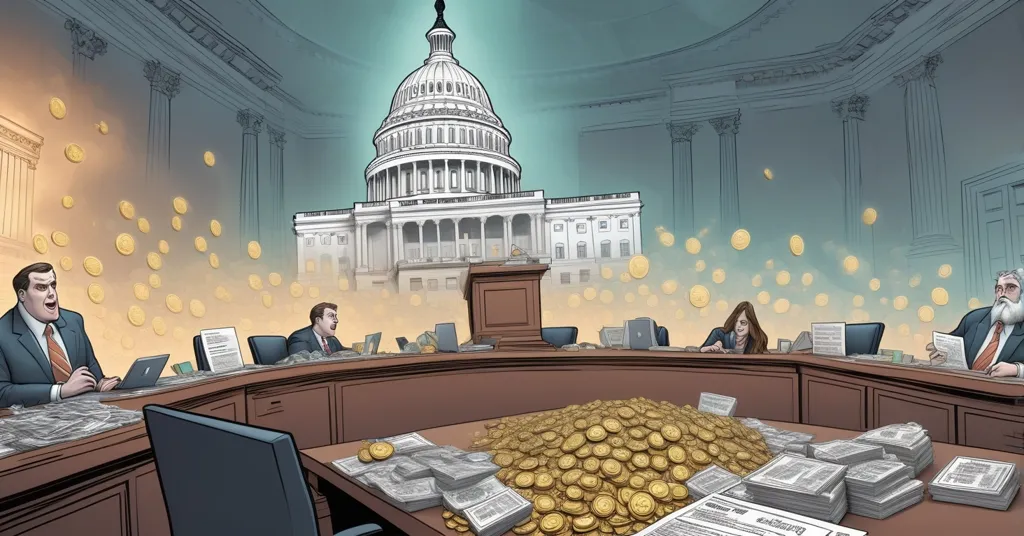
LTB The House Ways and Means Committee has released seven crypto tax draft bills that could finally drag US crypto taxes out of the fog and into something resembling a workable framework.
- Seven crypto tax drafts are now on the table
- Mining, staking, stablecoins, and wash sales are all in play
- Jason Smith is pushing digital asset tax clarity as a top priority
- Treasury, Commerce, the White House, and the Senate are all circling the issue
For years, the US has tried to tax digital assets using rules built for stocks, securities, and other traditional instruments that often don’t fit the way crypto actually works. That has left Bitcoin miners, stakers, exchanges, and everyday users dealing with confusion, compliance headaches, and a tax code that looks like it was assembled by a committee with a blindfold and a hammer. Which, to be fair, is not exactly out of character for Washington.
What the seven drafts are trying to fix
The proposed bills are meant to create a clearer tax framework for digital assets. In plain English, that means lawmakers are trying to answer some basic but long-ignored questions: When is crypto income actually taxable? What counts as a sale? And should stablecoin payments be taxed like someone is flipping an investment every time they buy coffee?
The drafts address:
- When Bitcoin mining rewards should be taxed
- When staking rewards should be taxed
- How stablecoin transactions should be treated
- Whether some stablecoin transactions should be exempt from capital gains tax
- Whether digital assets should be subject to wash sale rules
That list may sound dry, but it hits nearly every major pain point in digital asset taxation. The real fight here is not just about rates. It’s about classification, timing, and whether the IRS and Congress can stop treating crypto like a weird hobby that wandered into the tax code by accident.
Why mining and staking keep causing problems
House Ways and Means Chairman Jason Smith has made a clearer framework for digital assets “among the committee’s top priorities,” and that matters because this is the first committee-leadership-backed effort from a House or Senate tax-writing committee.
Jason Smith has made establishing a clearer tax framework for digital assets “among the committee’s top priorities.”
Mining and staking are where the tax mess gets especially sticky. In crypto terms, mining is the process of validating transactions on proof-of-work networks like Bitcoin and receiving rewards for doing it. Staking is different: users lock up coins to help secure a proof-of-stake network and can earn rewards in return. Both can generate income. The unresolved question is when that income becomes taxable and how it should be reported.
Representative Kevin Hern said the panel is focused on “the tax timing and treatment of staking and crypto mining.” That’s the heart of it. If a miner receives bitcoin as a block reward, is that taxable the second it lands in the wallet, or only when it’s sold? If a staker earns rewards, is that ordinary income, property, or something else? These are not trivia questions. They determine whether users can comply without hiring a small army of accountants.
Hern also said he expects legislative language to be ready before a hearing next Tuesday. That suggests Congress is moving faster than many in the crypto industry expected. Fast, of course, is relative here. In Washington terms, it still means lots of meetings, a few strongly worded remarks, and enough procedural sludge to drown a horse.
Stablecoins and the payments problem
Stablecoins are also getting attention, and they should. These are crypto assets designed to track the value of something stable, usually the US dollar. They’re widely used for trading, remittances, transfers, and increasingly for payments. But under current tax treatment, even a simple transaction can become a record-keeping nightmare if it triggers capital gains calculations.
That’s the absurdity lawmakers are trying to address. If someone uses a stablecoin to buy a sandwich and has to calculate gain or loss on a token that barely moved in value, the system is clearly not built for real-world payments. The draft proposals include the possibility that some stablecoin transactions could be exempt from capital gains tax. That would be a practical fix, not some moon-boy fantasy. It would make stablecoins more usable as actual money instead of just a headache with a blockchain attached.
For Bitcoin purists, stablecoin policy may seem like a side plot. It isn’t. Stablecoins are one of the most important on-ramps for crypto adoption, especially in trading, cross-border payments, and DeFi. If lawmakers want digital assets to function as more than speculative casino chips, this is the kind of boring-but-critical plumbing that needs to be fixed.
Wash sale rules could change trading behavior
One of the biggest flashpoints is the possible extension of wash sale rules to crypto. In traditional markets, wash sale rules stop investors from selling an asset at a loss and quickly buying it back just to claim a tax deduction. The usual rule includes a 30-day window. In other words, no artificial loss harvesting, no cute tax games.
If those rules are applied to digital assets, some of the tax strategies traders have used for years could disappear. That would close a long-standing loophole, and not necessarily a bad one. Tax law should not reward manipulative bookkeeping just because the asset lives on a blockchain. But there’s also a devil’s advocate case here: crypto markets move faster than traditional markets, and overly rigid wash sale rules could create extra friction for legitimate traders trying to manage volatility.
That tension is exactly why this proposal matters. It’s one thing to stop obvious abuse. It’s another to slap securities-era assumptions onto a market that settles 24/7, never sleeps, and often moves like it drank three espressos and forgot to blink.
Why this is bigger than just one committee
This is not happening in a vacuum. Kenneth Kies said Treasury has been working with the committee, along with the Commerce Department and the White House. That’s a sign the executive branch is already engaged, rather than waiting for Congress to trip over its own shoelaces and call it policy.
Mike Thompson said lawmakers must weigh “the risk of doing legislation and the risk of not doing legislation.”
Representative Mike Thompson, the top Democrat on the Tax Subcommittee, warned that lawmakers need to weigh “the risk of doing legislation and the risk of not doing legislation.” That’s a fair point. Doing nothing keeps the confusion alive, invites uneven enforcement, and leaves taxpayers guessing. Doing something badly could lock in a new set of problems. The trick is not pretending there’s a risk-free option. There isn’t. There’s only better and worse chaos.
There’s also a Senate angle. Senate tax writers are reportedly working on their own crypto tax legislation, which means the House and Senate could end up with competing versions of a digital asset tax framework. That may be encouraging because it shows momentum on both sides of Capitol Hill, but it also opens the door to the usual legislative junk pile: overlap, compromise, delays, and watered-down language that pleases nobody except lobbyists with good parking.
What the current mess means for users
The practical stakes are easy to miss if you’re not filing crypto taxes yourself. But these rules affect a lot of people:
- Miners need to know when rewards count as income
- Stakers need clarity on taxable timing and treatment
- Traders want to know whether crypto wash sale rules will kill tax-loss strategies
- Stablecoin users need simpler rules for everyday payments
- Exchanges and wallets need compliance standards that don’t change every five minutes
Current US crypto tax rules have forced digital assets into old legal boxes that don’t fit neatly. That confusion helps no one except tax attorneys, bureaucrats, and the occasional scammer who thrives when ordinary users don’t know what’s legal. Clearer rules would not magically solve every problem, but they could make compliance less absurd and enforcement less arbitrary.
There’s also a broader point here. If the US wants to stay competitive in Bitcoin, blockchain, and decentralized technology, it needs tax policy that makes sense for actual users and builders. Otherwise, the country keeps handing advantage to jurisdictions that are happy to be less stupid about it.
What happens next
Hern said legislative language could be ready before next Tuesday’s hearing, which suggests this is moving into the next phase of the process. That does not mean a law is imminent. It means the draft stage is turning into the real legislative grind: hearings, revisions, negotiations, and the endless bureaucratic ritual of making the same issue harder to solve than it should be.
Still, this is a meaningful shift. Congress is no longer treating crypto tax policy like a side note. The House Ways and Means Committee crypto bill effort, Treasury involvement, White House coordination, and Senate interest together suggest that digital asset taxation is finally being treated as a serious policy issue. About time.
The big question now is whether lawmakers produce something coherent or another Frankenstein tax framework that only a couple of staffers and a lobbyist could love. For Bitcoin and the broader crypto market, the stakes are obvious: fairer rules could support adoption, reduce friction, and give builders room to move. Bad rules could just bury innovation under another mountain of paperwork.
Key questions and takeaways
What is the main goal of the seven crypto tax drafts?
To create a clearer and more structured tax framework for digital assets in the US.
Why are Bitcoin mining taxes and staking tax treatment such a big deal?
Because lawmakers need to decide when those rewards become taxable and how they should be treated, which affects miners, validators, and the people who report those earnings.
What are crypto wash sale rules?
They are tax rules meant to stop investors from selling at a loss and quickly rebuying the same asset just to claim a tax break, usually within a 30-day window.
Why do stablecoin tax policy changes matter?
Because stablecoins are used for payments and transfers, and taxing every small transaction like a capital gains event makes ordinary crypto use unnecessarily painful.
Who is driving the push for crypto tax rules?
House Ways and Means Chairman Jason Smith, with involvement from committee members, Treasury, the Commerce Department, and the White House.
Is the Senate working on crypto tax legislation too?
Yes. Senate tax writers are reportedly developing their own proposals, which means both chambers are now engaged.
Does this mean US crypto tax rules are finally getting clarity?
Possibly, but not automatically. Drafts are a start, not a finish line, and Congress still has a talent for turning simple fixes into procedural sludge.