Altcoin Crash 2026: 95% Below 200-Day Average, Trading Volume Plummets 80%
 LTB
LTB Altcoin Crash 2026: 95% Below 200-Day Average, Trading Volume Down 80%
The altcoin market is in absolute freefall, with a staggering 95% of tokens listed on Binance trading below their 200-day simple moving average (SMA), a critical long-term trend indicator. Spot trading volumes on centralized exchanges have collapsed by 80-85% since October 2025, while Bitcoin consolidates nearly all the capital and attention, hitting a four-month high in social dominance. This is a brutal rout, but is it a death knell or a hidden opportunity?
- Market Meltdown: Only 5% of Binance-listed altcoins are above their 200-day SMA, signaling widespread weakness or early accumulation.
- Volume Vanishing: Altcoin spot trading on Binance dropped from $40-50 billion daily to $7.7 billion, an 80-85% plunge.
- Bitcoin’s Reign: Bitcoin social dominance surges as traders flee to safety amid macroeconomic turmoil.
The Altcoin Collapse: By the Numbers
Let’s face the ugly truth head-on. Data from Binance and CryptoQuant reveals a devastating picture: altcoin spot trading volumes have plummeted from a high of $40-50 billion per day in October 2025 to a measly $7.7 billion by early 2026. Expand the lens to other centralized exchanges, and the slaughter is just as grim—volumes have tanked from a peak range of $63-91 billion to just $18.8 billion. For those new to crypto, trading volume is the heartbeat of any market. It measures the level of buying and selling activity, and when it dries up like this, liquidity—the ability to trade without massive price swings—evaporates, leaving altcoins as sitting ducks for stagnation or worse, manipulation.
Then there’s the price breadth, or rather, the lack of it. Only 5% of altcoins on Binance are trading above their 200-day SMA, a technical indicator that smooths price data over 200 days to show long-term trends, as detailed in a recent report on altcoin performance. Being below it screams bearish sentiment; being above it hints at bullish momentum. With 95% underwater, this is either total capitulation—where investors throw in the towel and sell at a loss—or the quiet start of an accumulation phase, where savvy players buy low before an eventual rebound. Historically, such extreme readings have marked turning points, but more on that later.
Meanwhile, capital is concentrating in one place: Bitcoin. The altcoin-to-Bitcoin volume ratio on centralized exchanges has slumped from 3.5 in 2025 to 2.2 by early 2026, the lowest in over a year, per CryptoQuant. This means traders are overwhelmingly favoring Bitcoin, viewing it as the ultimate safe haven. Santiment data backs this up, showing Bitcoin’s share of online crypto mentions hitting a four-month high by mid-March 2026. In simpler terms, Bitcoin dominance—which measures BTC’s market cap as a percentage of the total crypto market—reflects how much capital and buzz is locked into the king of crypto while altcoins are left to wither.
“When the crowd focuses exclusively on Bitcoin, it usually indicates fear and a flight to safety, draining liquidity from altcoins… often a sign of a market bottoming process as speculators talk less and less about the rest of the crypto market,” states a Santiment report.
Why Bitcoin Is King Right Now
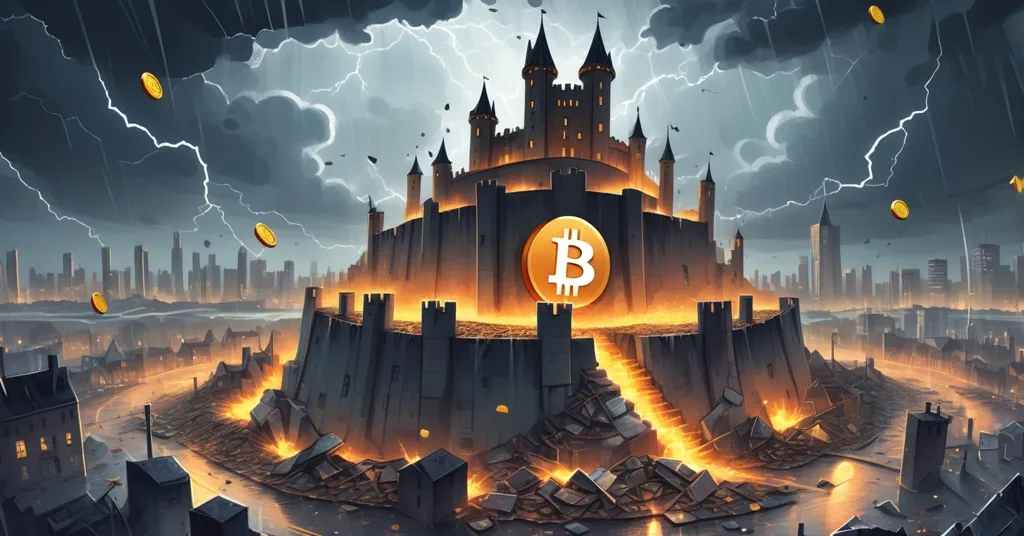
Imagine Bitcoin as the fortified castle in a raging storm—everyone scrambles to its walls for protection, leaving the smaller, riskier altcoin villages exposed to the elements. That’s the crypto market today. Bitcoin’s status as a store of value, battle-tested over a decade of volatility, combined with its unmatched liquidity, makes it the obvious refuge when fear spikes. And fear is spiking hard, not just because of crypto-specific issues, but due to a perfect storm of macroeconomic headwinds.
Central banks tightening monetary policy—think higher interest rates and reduced money supply—have made borrowing more expensive and speculative investments less appealing. Weak U.S. jobs data, oil prices surging past $100 a barrel, and whispers of stagflation (high inflation with stagnant growth) are spooking investors across all asset classes. Bitcoin, with its clear narrative as “digital gold” and deep market depth, becomes the go-to asset in this risk-off environment. Altcoins, often hyped on unproven tech or fleeting trends, get abandoned.
“Monetary conditions are meaningfully tighter than they were in previous cycles, and that shows in how conservatively people are positioned… the asset with the clearest narrative and deepest liquidity—Bitcoin,” explains Justin d’Anethan of Arctic Digital.
Macro Mayhem Behind the Altcoin Crash
Let’s dig deeper into these global headwinds. The U.S. Federal Reserve has been hiking rates since late 2025 to combat persistent inflation, with similar moves by the European Central Bank and others. These policies suck capital out of high-risk assets like altcoins and even tech stocks, redirecting it to safer bets like bonds or, in crypto’s case, Bitcoin. Add to that disappointing economic indicators—unemployment creeping up, consumer confidence tanking—and you’ve got a recipe for panic. For altcoins, many of which rely on speculative retail money, this is a deathblow.
Then there’s the regulatory shadow looming large. Ongoing SEC lawsuits against projects like XRP, coupled with murmurs of broader crackdowns on decentralized finance (DeFi) protocols, are scaring off institutional players who might otherwise stabilize altcoin markets. Bitcoin, with its relatively clear (though still debated) status as a commodity in many jurisdictions, escapes much of this heat. The result? Capital keeps flowing to BTC while altcoins bleed out.
Historical Hope for Altcoins: Cycles of Pain and Gain
Before you write off altcoins as dead and gone, let’s look at history. Crypto markets are cyclical, often tied to Bitcoin’s halving events, which cut mining rewards and historically spark price rallies. Post-halving, Bitcoin typically leads the charge, sucking up liquidity and attention, before dominance peaks and capital rotates into riskier altcoins. We saw this in 2017-2018, where Bitcoin dominance hit over 60% before altcoins exploded in the latter half of the cycle. The same played out in 2020-2021: post-halving, Bitcoin soared, dominance topped out near 70%, then dropped as altcoins like Ethereum and meme coins racked up insane gains.
Today, with Bitcoin dominance hovering around 58.8%, and 95% of altcoins below their 200-day SMA, we’re seeing echoes of those early capitulation phases. Low participation, extreme fear, and dirt-cheap valuations often mark bottoms before a reversal. But—and this is a big but—the macro environment needs to ease up. Without lower interest rates or a break in global economic tension, capital won’t flow back into altcoins, no matter how undervalued they seem.
“Looking back at previous cycles reveals a clear pattern… After the halving in 2020, Bitcoin led 2021, then dominance dropped and altseason exploded. The same was true in 2017–2018,” notes Binance Research.
Selective Rotation: Altcoins to Watch
Here’s the kicker: not all altcoins are created equal, and this isn’t shaping up to be a broad-based “altcoin season” where every random token moons. Any strength right now is highly selective, driven by specific narratives rather than blind sentiment. A few heavyweights are showing resilience, and they’re worth a closer look if you’re hunting for opportunities amid the wreckage.
Ethereum (ETH) remains a standout, buoyed by ongoing narratives around spot ETFs in major markets and continuous network upgrades enhancing scalability and energy efficiency. Its dominance in DeFi—decentralized finance, a sector of apps for lending, borrowing, and trading without banks—and NFTs (non-fungible tokens) gives it real-world utility Bitcoin doesn’t directly compete with. Solana (SOL), meanwhile, is carving a niche with its lightning-fast transactions and low fees, attracting developers building high-throughput apps. Recent data shows Solana’s daily active addresses spiking, hinting at growing adoption despite the market downturn.
XRP, tied to Ripple’s cross-border payment solutions, and BNB, Binance’s native token with deep ecosystem utility, are also seeing flickers of interest, often tied to legal resolutions or exchange-driven volume spikes. But let’s be crystal clear: these are exceptions, not the rule. The vast majority of altcoins—especially meme coins and half-baked projects—are dead weight, offering nothing but empty promises.
“This rotation is not broad-based… The move is selective, driven by targeted narratives rather than sweeping sentiment,” cautions AInvest analysis.
Risks of Buying the Dip
Tempted to scoop up altcoins at these bargain-basement prices? Pump the brakes. Yes, historical patterns and cheap valuations suggest a potential accumulation zone, but the risks are sky-high. A prolonged bear market could drag on if macro conditions worsen—think sustained rate hikes or a full-blown recession. Regulatory uncertainty is another landmine; a single harsh ruling on a major altcoin could tank the sector further. And let’s not forget liquidity traps: with trading volumes so low, even a small buy order can spike prices temporarily, only for you to get stuck unable to sell without cratering the market.
Bitcoin maximalists will tell you to skip the gamble entirely—stack sats (satoshis, the smallest BTC unit) and sleep easy knowing you’re in the safest crypto asset. They’ve got a point in this environment. But as believers in decentralization’s broader vision, we can’t ignore the innovation altcoins bring. Ethereum’s smart contracts, Solana’s speed, XRP’s payment rails—these fill gaps Bitcoin doesn’t (and arguably shouldn’t) touch. The trick is ruthless selectivity. Most altcoins are junk; focus on the few with proven traction or upcoming catalysts.
Calling Out the Shillers: No Room for Hopium
While we’re on the subject of caution, let’s address the circus of fake price predictions and “technical analysis” flooding X and YouTube. You’ve seen them—self-styled gurus swearing Ethereum will hit $10,000 or Solana $5 by next Tuesday, with zero evidence beyond squiggly lines on a chart. It’s pure nonsense, preying on the desperate or naive. We’re not here to peddle hopium or shill coins. Responsible reporting means sticking to data, not carnival-barker promises of moonshots. Reality check: no one can predict short-term prices in this macro mess, and anyone claiming certainty is either a liar or a fool.
That said, there’s a faint glimmer if you squint. Santiment’s data shows Bitcoin social dominance peaking often aligns with market bottoms, as fear maxes out and speculators abandon altcoins. Pair that with altcoin valuations at historic lows relative to past cycles, and you’ve got a setup for the bold—or reckless—to start nibbling. Just don’t expect fireworks until Bitcoin dominance dips and the global economy stops hammering risk assets.
Key Takeaways and Questions for Crypto Enthusiasts
- What’s behind the 2026 altcoin market crash?
Altcoins are in a brutal downturn, with 95% trading below their 200-day SMA and spot volumes collapsing 80-85% since late 2025, while Bitcoin hoards capital as the safe haven. - Why is Bitcoin dominating over altcoins right now?
Bitcoin’s proven resilience and deep liquidity shine amid economic uncertainty, with social dominance at a four-month high as traders ditch riskier altcoins. - How are macroeconomic factors impacting altcoins in 2026?
Tighter central bank policies, rising rates, weak jobs data, and stagflation fears are diverting capital from speculative altcoins to safer assets like Bitcoin. - Could an altcoin season emerge after this crash?
Not soon—any recovery is selective, favoring Ethereum and Solana with strong narratives, and depends on Bitcoin dominance falling below 58.8% plus better global conditions. - What do past crypto cycles suggest about altcoin recovery?
Cycles like 2017-2018 and 2020-2021 show altcoin rallies often follow peak Bitcoin dominance and low participation, but macro improvement is essential for capital rotation. - Is now a good time to invest in altcoins during this bear market?
Cheap valuations hint at an accumulation opportunity for the daring, but risks loom large without clear capital shifts from Bitcoin or regulatory clarity.
The altcoin market is a graveyard, and Bitcoin is sucking up all the oxygen. As advocates for decentralization, we see the unique value in altcoin innovation—Ethereum’s DeFi dominance, Solana’s scalability, and niche solutions like XRP—but we won’t sugarcoat the carnage. This is a moment for caution, not blind bets. Stack Bitcoin for safety, and if you’re venturing into altcoins, stick to the handful with real narratives and momentum. The rest? They’re just chum in this meat grinder of a market. One lingering thought remains: will altcoins claw their way back, or is this truly Bitcoin’s unchallenged era?