Altcoin Market Dead in 2026? Stagnation, Revival Signs, and Bitcoin’s Shadow
 LTB
LTB Is the Altcoin Market Dead in 2026? Unpacking Stagnation and Revival Chances
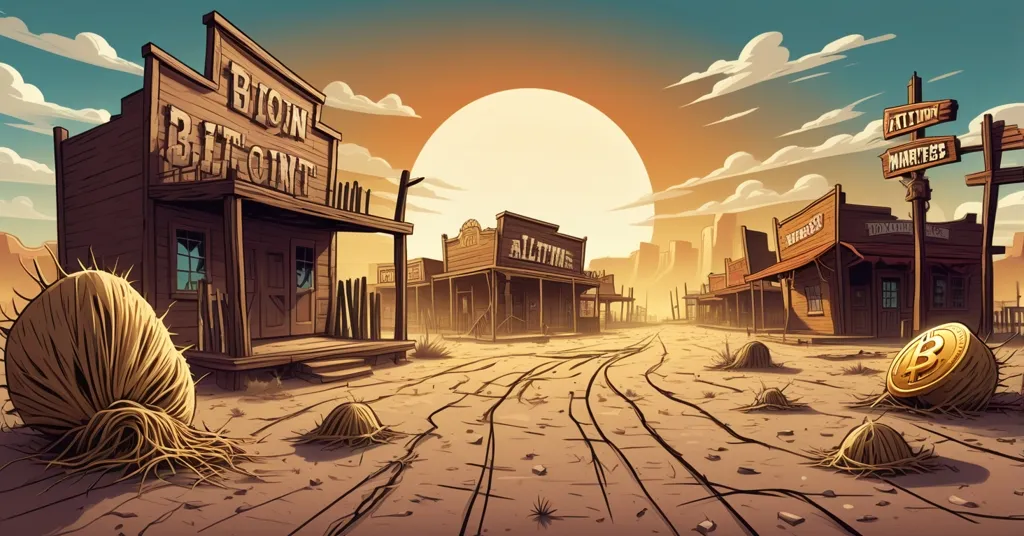
The altcoin market, once the Wild West of crypto speculation, has been eerily quiet in this cycle, leaving investors and traders frustrated with no sign of the explosive “altcoin season” that defined past bull runs. While Bitcoin continues to stand tall as the unchallenged king of decentralization, thousands of alternative cryptocurrencies languish in stagnation. Are altcoins dead, or merely dormant, waiting for the right spark to reignite?
- Market Stasis: No altcoin season or sustained breakout in the current crypto cycle.
- Economic Barriers: Macro conditions like limited liquidity and contracting activity have stifled growth.
- Flicker of Hope: Recent upticks in key indicators suggest a potential rally on the horizon.
Why Altcoins Are Stuck in Neutral
Altcoins—those myriad cryptocurrencies beyond Bitcoin—have historically been the playground for high-risk, high-reward bets in the crypto space. Past cycles, particularly the 2020/2021 bull run, saw altcoin seasons where capital flowed away from Bitcoin into speculative assets, pushing the market cap of cryptocurrencies outside the top ten, as tracked by the OTHERS index, from under $100 billion to a staggering near-$600 billion peak. It was a digital gold rush, with investors staking claims on everything from decentralized finance (DeFi) protocols to meme coins. Bitcoin dominance, a measure of BTC’s share of total crypto market capitalization, often dropped as altcoins stole the spotlight. Yet, in this current cycle, that rush has fizzled. The OTHERS index has barely budged, stuck in a sideways grind that mirrors the broader lack of momentum. So, what’s gone wrong? For deeper insights, check out this analysis on why altcoins have failed to gain traction.
Macro Factors: The Invisible Hand Holding Altcoins Down
Digging into the root cause, crypto analyst Sykodelic points to the broader economic environment as the primary culprit. Altcoins thrive on excess liquidity—when there’s a surplus of money sloshing around the economy, often due to low interest rates or massive government stimulus, making it easier for investors to pour cash into riskier assets. They’re the darlings of “risk-on” markets, where optimism fuels speculation on projects that might be little more than a flashy website and a promise. But for over two years, that liquidity has been scarce. Federal Reserve Net Liquidity, a gauge of available money in the financial system based on central bank policies, has shown no meaningful upward trend, trapped in a directionless range. When there’s no extra cash to gamble, speculative bets like altcoins get sidelined.
Compounding this is the Purchasing Managers’ Index (PMI), a critical measure of economic activity. Think of PMI as a pulse check on business health: readings above 50 signal expansion—factories humming, orders flowing—while below 50 indicates contraction, with businesses tightening their belts. Until early 2026, the PMI, specifically the ISM Manufacturing PMI, languished below 50 for 26 straight months, painting a picture of economic stagnation. Without growth, the appetite for speculative investments dwindles. Compare this to the 2020/2021 cycle, where Fed liquidity surged post-COVID with trillions injected into markets, and PMI flipped to expansion, creating the perfect storm for altcoin mania. That storm has been conspicuously absent until very recently.
Internal Crypto Challenges: Trust and Regulatory Shadows
Beyond macro headwinds, the altcoin market faces internal demons that have eroded investor confidence. The crypto space has matured since the naive exuberance of 2021, but not without scars. High-profile collapses like Terra/Luna in 2022, where billions in value vanished overnight due to algorithmic instability, left bagholders burned and wary. Countless rug pulls and outright scams—projects that hype a token only for founders to disappear with the funds—have tainted the space. The altcoin market is still a cesspool of hype-driven garbage in many corners, and investors are starting to wise up, demanding substance over slick marketing. Truthfully, for every legitimate innovation, there are a dozen scamcoins that wouldn’t pass a sniff test at a flea market.
Then there’s the regulatory specter. Governments worldwide, from the U.S. Securities and Exchange Commission (SEC) to the European Union with its Markets in Crypto-Assets Regulation (MiCA—a framework to standardize crypto oversight), are tightening the screws. Uncertainty over whether altcoins will be classified as securities, facing heavy compliance burdens, or outright bans in some jurisdictions, keeps capital on the sidelines. If macro conditions improve but a regulatory hammer drops, altcoins could remain mired in limbo. These internal hurdles, paired with external economic woes, paint a grim picture of a market struggling to find its footing.
Altcoin Niches: Where Innovation Still Burns Bright
Despite the gloom, let’s not forget why altcoins matter in the first place. Bitcoin remains the gold standard of decentralization—a peer-to-peer money system that challenges fiat tyranny—but it’s not built for every use case. Altcoins often fill critical niches, acting as the experimental sandbox for blockchain’s potential to disrupt the status quo. Ethereum, for instance, pioneered smart contracts, self-executing code on the blockchain that powers everything from DeFi lending platforms to non-fungible tokens (NFTs). Even in market doldrums, Ethereum’s ecosystem continues to churn out innovation, with Layer-2 solutions like Polygon slashing transaction costs and boosting scalability. Solana offers lightning-fast transactions, aiming to rival traditional payment systems, though it’s battled outages and centralization critiques. And then there’s Dogecoin, the meme coin that refuses to die, proving cultural staying power can sometimes outweigh technical merit.
These niches highlight why altcoins aren’t just speculative sidekicks—they’re testing grounds for decentralized systems that could one day outmaneuver legacy finance. From yield farming in DeFi to tokenized art in NFTs, altcoins push boundaries Bitcoin can’t or won’t touch. As champions of freedom and privacy, we see their value, even if the market hasn’t priced it in yet. The question is whether renewed liquidity will flow into these genuine innovators or get squandered on the next batch of empty hype trains.
Signs of Revival: A Faint Pulse in the Data
Now, let’s talk about the glimmer of hope that might just shock the skeptics. As of January 2026, macro indicators are showing signs of life. The ISM Manufacturing PMI climbed to 52.6%, crossing into expansion territory for the first time in over two years. It eased slightly to 52.4% in February, still beating expectations of 51.8%. Simultaneously, Fed Net Liquidity has begun trending upward, suggesting the spigot of cheap money might finally be opening. For altcoin bulls, this is the long-awaited signal—a potential catalyst for capital rotation out of Bitcoin’s safe harbor into riskier waters. Sykodelic projects that if these trends hold, the OTHERS index market cap could surge to around $560 billion, a significant leap from its current stagnation, though short of past peaks.
Historically, PMI upticks and liquidity injections have preceded altcoin rallies. If money becomes cheaper to borrow, speculative sectors like DeFi on Ethereum could see renewed interest as yield farming and staking regain appeal. NFT marketplaces, battered by overhype and subsequent crashes, might find fresh buyers if economic optimism returns. But this isn’t a guarantee—macro data can reverse course, and even favorable conditions don’t automatically translate to altcoin mania in a market scarred by past losses. Still, these shifts are worth watching closely.
Key Questions About the Altcoin Market in 2026
- Why is the altcoin market stagnant in 2026?
Poor economic conditions, including stagnant Federal Reserve Net Liquidity and a PMI in contraction for over two years until early 2026, have curbed the excess capital needed for speculative altcoin investments. - What macro factors drive altcoin performance?
Federal Reserve Net Liquidity, reflecting available money in the system, and PMI, indicating business activity, are crucial—altcoins need both in expansionary phases to attract risk-on investment. - Will altcoins recover in 2026?
There’s potential, with Fed Net Liquidity rising and PMI hitting 52.6% in January 2026, suggesting conditions for a rally; projections estimate the OTHERS index could reach $560 billion if trends persist. - How do Bitcoin and altcoins differ in market cycles?
Bitcoin often acts as a safe store of value during uncertainty, while altcoins surge when economic optimism and liquidity encourage investors to shift capital into riskier, speculative assets. - Are altcoins still relevant compared to Bitcoin?
Absolutely—while Bitcoin anchors decentralization, altcoins like Ethereum and Solana drive innovation in smart contracts and scalability, filling gaps Bitcoin doesn’t address.
Playing Devil’s Advocate: Do We Even Need Altcoins?
Let’s push back for a moment. As Bitcoin maximalists at heart, we could argue altcoins are a distraction—a speculative bubble that dilutes focus from the one true decentralized money. Bitcoin is battle-tested, scarce, and singular in its mission to upend fiat systems. Why bother with thousands of altcoins, many of which are outright scams or redundant? Could the future of crypto simply be Bitcoin, with everything else fading into obscurity?
Countering that, altcoins aren’t just noise—they’re the proving ground for ideas that Bitcoin, by design, can’t tackle. Smart contracts, interoperability, and niche use cases like tokenized real estate or gaming economies show blockchain’s broader potential. Even failures teach us how to build better decentralized tech. Bitcoin may be the foundation, but altcoins are the chaotic architects sketching the future. Dismissing them outright ignores the messy, necessary path of effective accelerationism—pushing tech forward through trial and error.
Looking Ahead: Dormant or Dead?
The altcoin market isn’t dead, just in a deep slumber, tethered to forces far beyond the blockchain. Macro indicators like PMI and Fed liquidity are starting to turn, hinting at a possible awakening. Yet, internal scars from scams, regulatory uncertainty, and investor caution could keep the snooze button pressed. Bitcoin remains the bedrock of this revolution, but altcoins carry the torch of experimentation, lighting paths to disrupt legacy systems. Whether they reclaim their spotlight or remain sidelined depends on economic tides and whether the crypto community can sift genuine innovation from the cesspool of grift. Keep your eyes on the data—and maybe, just maybe, the digital gold rush will ride again. Will it be worth the wait, or has the speculative fever finally broken?