Bitcoin Hashrate Crashes 12%: Miners Abandon Rigs Amid Price Stagnation Woes
 LTB
LTB Bitcoin Hashrate Plummets 12%: Miners Unplug as Price Stagnation Bites Hard
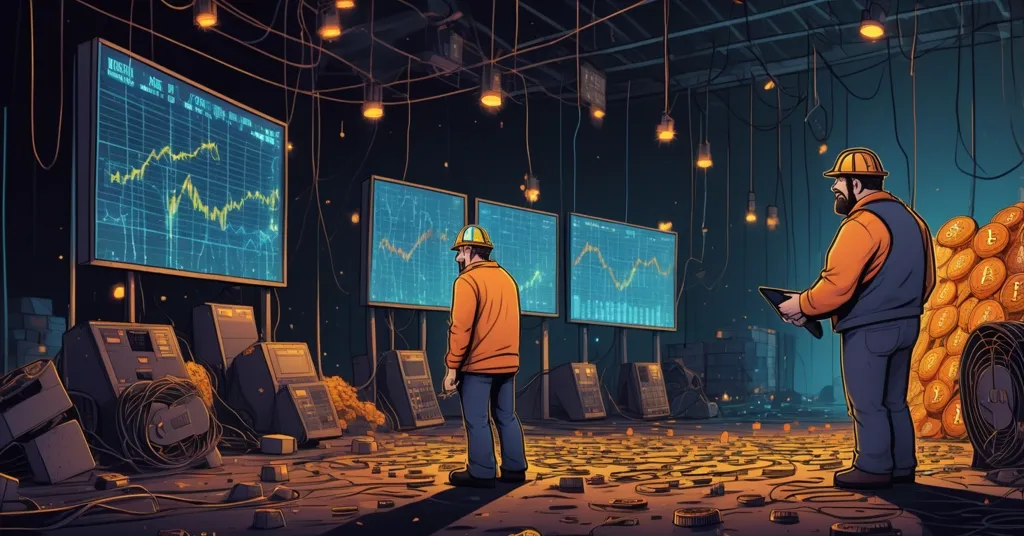
Bitcoin’s mining power has taken a brutal hit, with the network’s hashrate cratering nearly 12% from its March peak. As miners yank their rigs offline, the spotlight falls on profitability struggles, network dynamics, and what this means for the king of crypto’s relentless march toward decentralization.
- Hashrate Crash: Bitcoin’s 7-day average hashrate dropped from 1,083 EH/s on March 1st to 954 EH/s recently.
- Miner Exodus: Declining hashrate points to miners disconnecting, likely unable to cover skyrocketing operational costs.
- Price Pressure: Bitcoin’s stagnation around $73,200 squeezes revenue from block subsidies, pushing smaller players out.
What’s Driving the Bitcoin Hashrate Drop?
Let’s get straight to the numbers: Bitcoin’s hashrate, a measure of the total computing power securing the network, has nosedived from a high of 1,083 exahashes per second (EH/s) on March 1st to 954 EH/s, according to data from Blockchain.com. Think of hashrate as the army guarding Bitcoin’s fortress—the more soldiers, the tougher it is to breach. This 12% drop, as detailed in a recent report on Bitcoin’s mining power decline, means a significant chunk of that army just walked off the battlefield. For those new to the game, hashrate reflects how many complex calculations miners perform per second to validate transactions and mint new Bitcoin. When it falls, it’s a flashing neon sign that miners—Bitcoin’s network validators—are packing up.
The March peak came after a rebound from a US snowstorm that had disrupted mining hubs, particularly in regions like Texas, a major player in Bitcoin mining. But even after that recovery, the network couldn’t hold the line. Why? The cold, unforgiving economics of mining are largely to blame, compounded by a Bitcoin price that’s stuck in neutral at around $73,200 (per TradingView data). This isn’t just a minor hiccup; it’s a stark reminder of how tightly Bitcoin’s price and mining activity are shackled together.
Bitcoin Mining Profitability: A Savage Reality Check
Mining Bitcoin isn’t a charity gig—it’s a business, and a damn ruthless one at that. Miners earn their keep through block subsidies, currently 3.125 BTC per block after the latest halving, plus whatever transaction fees they can scoop up. For the uninitiated, block subsidies are essentially a fixed Bitcoin paycheck for solving a computational puzzle and adding a block to the chain. But here’s the kicker: while that reward is fixed in Bitcoin terms, its real-world value in USD swings wildly with market prices. When Bitcoin’s price languishes, as it has during this consolidation phase, miners’ revenue gets gutted while costs—electricity, hardware, cooling—keep piling up like unpaid bills.
At $73,200, Bitcoin has clawed back a bit of ground recently, but it’s nowhere near the bullish surge miners need to stay in the black. Smaller operations, or those in regions with punishing energy prices, are getting squeezed out fastest. This isn’t speculation; it’s basic math. If your rig costs $5,000 a month to run but your Bitcoin haul is worth less than that, you’re bleeding cash. No wonder miners are bailing faster than passengers on a sinking ship—though let’s be clear, Bitcoin itself isn’t sinking. Not yet, anyway.
Historical Patterns: Hashrate and Price in a Deadly Dance
Zoom out, and this isn’t a new story. Bitcoin’s hashrate and price have been locked in a savage tango for years. Back in October, when Bitcoin hit an all-time high, so did the hashrate, as miners rushed in to cash in on fat profits. But when bearish winds blow, as they have during recent dips and stagnation, the weaker players get culled. It’s a cycle as old as Bitcoin itself: price up, miners in; price down, miners out. The March 1st spike was a brief reprieve after external chaos—a brutal US snowstorm knocked out power to key mining farms—but without sustained price momentum, that recovery fizzled.
This pattern isn’t just trivia; it’s a window into Bitcoin’s brutal economics. Mining difficulty, which adjusts roughly every two weeks based on hashrate, is the network’s self-regulating mechanism. In layman’s terms, difficulty dictates how hard it is to mine a block—less hashrate, lower difficulty, and vice versa. The next adjustment will likely ease up, potentially tempting some miners back if their costs align. But for now, this 12% drop exposes the fragility of an industry where profitability can vanish overnight.
Network Security: Should We Be Worried?
A shrinking hashrate isn’t just about miners’ wallets—it raises questions about Bitcoin’s ironclad security. Fewer miners mean less computing power defending the network against potential attacks, like a 51% attack where a bad actor could theoretically control the majority of hashrate to double-spend or rewrite transactions. Let’s not panic, though. Bitcoin’s sheer scale—still hovering near 1,000 EH/s even after the drop—makes such an attack a pipe dream for all but nation-state actors with bottomless pockets. The bigger concern isn’t outright collapse; it’s creeping centralization.
Here’s the devil’s advocate angle: this miner purge might actually streamline efficiency, letting only the strongest players survive. But at what cost? If smaller miners keep dropping out, power could concentrate in the hands of giants like Foundry or AntPool, eroding Bitcoin’s decentralized ethos. Some argue this is a feature, not a bug—a Darwinian culling that fortifies the network long-term. Others warn it’s a slippery slope to a system where a handful of big fish call the shots. Both sides have weight, and as Bitcoin maximalists, we lean toward decentralization as non-negotiable. Still, the debate rages on.
Beyond Price: External Pressures Crushing Miners
Bitcoin’s price isn’t the only villain here. Mining is a global game, and external factors are piling on the pain. Take Texas, a Bitcoin mining hotspot thanks to cheap energy and lax rules. Recent grid strains and extreme weather have made operations dicey, with power costs spiking unpredictably. Then there’s the regulatory shadow—while the US isn’t as harsh as China’s outright mining ban, uncertainty around energy usage and environmental scrutiny is spooking operators. Don’t forget the post-halving hangover; with block rewards slashed to 3.125 BTC, margins are thinner than ever for everyone but the most efficient rigs.
Energy costs deserve a special mention. Mining rigs are power hogs, and in regions where electricity isn’t dirt-cheap—think Europe or parts of the US Northeast—miners are getting slaughtered. Some data suggests global energy price surges in 2023 have hit mining profitability harder than price stagnation alone. This isn’t just a Bitcoin problem; it’s a structural one. Until miners pivot to renewables or relocate to energy havens like Iceland or Kazakhstan (where regulation is another gamble), this pressure won’t let up.
Looking Ahead: Adaptation or Centralization?
So, where do miners—and Bitcoin—go from here? Adaptation is the name of the game. Some outfits are already eyeing cheaper energy sources, with reports of miners flocking to solar or hydroelectric setups to slash costs. Others might push for regulatory clarity, lobbying governments to treat mining as critical infrastructure rather than a climate scapegoat. Then there’s relocation—expect more operations to eye regions with rock-bottom power prices, assuming they can navigate the political minefield.
But let’s not kid ourselves: adaptation isn’t a silver bullet. If only the big players can afford these pivots, we’re staring down the barrel of centralization. Compare this to Ethereum’s shift to Proof of Stake, which sidestepped energy dramas entirely—but at the cost of its own decentralization debates. Bitcoin doesn’t have that luxury; Proof of Work is its bedrock, for better or worse. As champions of effective accelerationism, we believe Bitcoin must push forward, flaws and all, to disrupt the broken financial status quo. Miners getting hammered is the price of that disruption, but it’s a price worth scrutinizing.
One last jab: while Bitcoin’s miners bleed, let’s not forget the scammers circling like vultures. Cloud mining schemes and fake “guaranteed return” rigs are preying on desperate newcomers during this downturn. We’ve got zero tolerance for that garbage. If it sounds too good to be true in crypto, it’s a con—full stop.
Key Questions on Bitcoin’s Hashrate Drop and Miner Struggles
- What sparked Bitcoin’s 12% hashrate plunge?
Miners are unplugging rigs due to unprofitability, driven by Bitcoin’s price stagnation at $73,200 and relentless costs like electricity and hardware. - How does Bitcoin’s price stagnation cripple mining profitability?
Block subsidies are fixed in BTC, but their USD value tanks with price dips or plateaus, leaving miners unable to cover operational expenses. - Does a falling hashrate jeopardize Bitcoin’s network security?
It lowers the computing power guarding the chain, but Bitcoin’s massive scale still deters attacks; the real risk is mining power centralizing among fewer players. - Is this miner exodus a death knell for Bitcoin’s growth?
Hardly—it’s a cyclical hiccup tied to market swings. Mining difficulty adjustments may coax miners back, though profitability woes linger. - Can Bitcoin miners survive this brutal profitability crunch?
Survival means adapting—shifting to cheaper energy, relocating to friendly regions, or pushing for regulatory support—but only the efficient will endure.
Hashrate drops like this 12% dive are a gut punch, no question. They lay bare the gritty, unforgiving reality of Bitcoin mining and the broader crypto frontier. Yet, as we cheer Bitcoin’s potential to upend centralized finance, we can’t ignore these battle scars. Miners are the heartbeat of decentralization, and when they falter, it’s a wake-up call to address systemic pain points. Still, Bitcoin’s story is one of resilience. This isn’t the first storm it’s weathered, and it sure as hell won’t be the last. The network marches on, with a little less muscle for now, but with the same defiant spirit. Keep an eye on those difficulty adjustments—they might just signal the next chapter.