Bitcoin L2 Disasters: Why Scaling Solutions Fail and How to Fix Them
 LTB
LTB Bitcoin L2 Failures: Why Scaling Solutions Keep Crashing and What Can Save Them
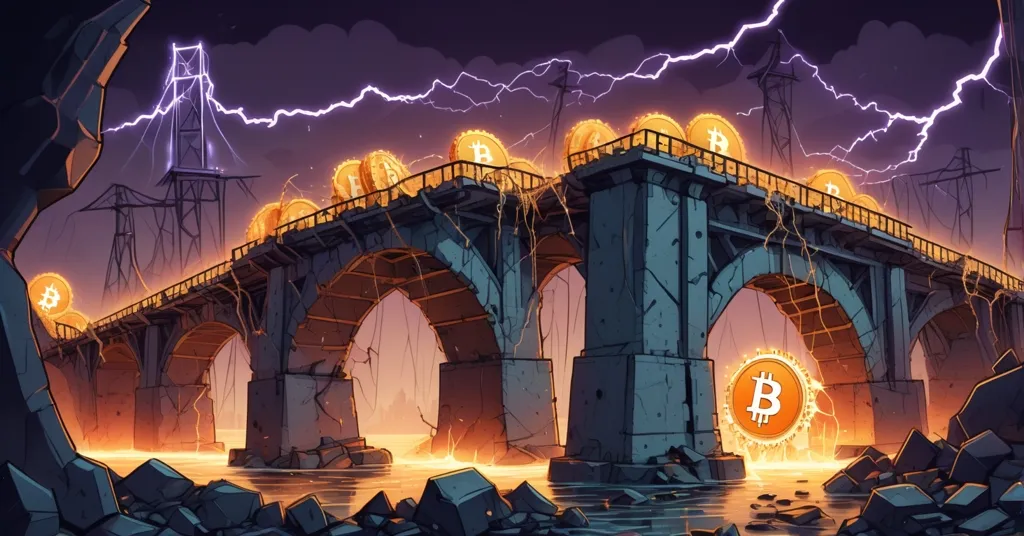
Bitcoin, the unchallenged titan of decentralized money, is stuck in a scaling quagmire that’s exposing both technical hurdles and philosophical rifts. With transaction speeds crawling and fees soaring during network congestion, developers and opportunists alike have rushed to build layer-2 (L2) solutions, promising to supercharge Bitcoin for payments, DeFi, and more. But the reality is grim—most of these projects are imploding, draining investor funds and dragging Bitcoin’s reputation through the mud. Let’s dissect this disaster, expose why so many Bitcoin L2s are failing, define what genuine scaling should look like, and highlight the few efforts that might actually preserve Bitcoin’s legacy.
- Root Cause: Most Bitcoin L2s are mislabeled sidechains, abandoning Bitcoin’s core security for centralized bridges and shaky setups.
- Crash and Burn: Projects like Merlin Chain and Babylon showcase the perils of token-driven hype, with devastating losses for users.
- True Hope: Scaling must cling to Bitcoin’s proof-of-work (PoW) strength, as seen in Lightning Network, BitVM, and select L1 innovations.
Unpacking the Bitcoin Scaling Mess
Bitcoin’s design as the original blockchain prioritizes security and decentralization above all else. Its layer-1 (L1) network, secured by miners burning energy through proof-of-work (PoW), is a fortress—but it’s not built for speed. During peak usage, transactions can take hours and fees can spike to $50 or more, making micro-payments or daily use a pipe dream without intervention. Enter layer-2 solutions, which aim to offload transactions from the main chain to boost speed and cut costs, ideally while still leaning on Bitcoin’s ironclad security. Think of L2s as express lanes bolted onto a slow but sturdy highway. Over the past couple of years, over 70 such scaling projects have emerged, per data from platforms like DeFiLlama, each claiming to unlock Bitcoin’s potential. Spoiler alert: most are a sham.
The bitter truth is that many so-called Bitcoin L2s aren’t L2s at all. They’re sidechains—separate blockchains with their own rules and weaker security models, often tethered to Bitcoin via bridges that are little more than digital death traps. Unlike a true L2, which should inherit Bitcoin’s base-layer protections, these sidechains force users to trust centralized federations (a fancy term for a small group of controllers who can vanish with your funds) or alternative consensus mechanisms like proof-of-stake (PoS), where security hinges on token ownership rather than Bitcoin’s energy-intensive mining. For newcomers, PoS often sounds efficient, but it lacks the decade-long battle-testing of Bitcoin’s PoW, leaving it vulnerable to manipulation or collapse. As Samuel Patt, aka Chad Master, a Bitcoin advocate and co-founder of OP_NET, cuts to the chase:
“Instead of selling a scaling solution for Bitcoin, they were selling speculative tokens about Bitcoin. The difference is critical.”
What a Real Layer-2 Should Be
To grasp why these projects are tanking, we need a clear benchmark for a true L2. Ethereum, despite its altcoin status, offers a damn good model. Its L2 ecosystem—think Optimism or Arbitrum—follows strict principles to ensure safety. Transaction data is stored on Ethereum’s main chain (data availability) so anyone can verify it, off-chain computations are proven correct through mathematical checks (verifiable execution via fraud or validity proofs), and users can pull their funds back to L1 without begging a middleman (permissionless exits). This means even if an Ethereum L2 implodes, your assets aren’t locked in purgatory. Most Bitcoin L2s don’t even pretend to match this standard, as highlighted in a recent opinion piece on Bitcoin layer-2 shortcomings. They’re often glorified sidechains with rickety bridges as their lifeline to Bitcoin—bridges that hackers love to target, as seen in the $624 million Ronin Bridge heist of 2022. Patt doesn’t mince words:
“If it doesn’t preserve L1 assurances, it’s not actually scaling Bitcoin.”
For those new to the jargon, let’s break it down further. Bitcoin’s L1 is the main network, a slow but unassailable ledger where miners validate transactions by solving complex puzzles, ensuring no central party can mess with the system. An L2 should handle transactions off this chain for efficiency, settling only the final results on L1 to keep things secure. Sidechains, by contrast, run parallel to Bitcoin with their own security (or lack thereof), often linked via bridges that act as single points of failure. When a project markets itself as an L2 but operates as a sidechain with a shiny new token, it’s not enhancing Bitcoin—it’s exploiting its name for a quick cash grab.
The Hall of Shame: Bitcoin L2 Flops
The graveyard of failed Bitcoin L2s is growing fast, and the headstones tell a brutal story. Merlin Chain, for instance, soared to the top of Bitcoin L2s by total value locked (TVL) in early 2023, peaking at over $1 billion according to DeFiLlama. By mid-2023, its TVL had cratered by more than 90%, as users bolted amid security fears and a collapsing token price. Babylon, another hyped project promising a staking breakthrough for Bitcoin, delivered an 84% loss to early investors as its token value evaporated. These aren’t one-off disasters; they’re the predictable outcome of flawed architecture. Relying on centralized bridges makes these projects sitting ducks for hacks, while their focus on speculative tokens fuels farm-and-dump schemes where early insiders cash out and leave retail investors holding the bag. It’s not innovation—it’s a con dressed up in tech buzzwords.
Imagine locking your hard-earned BTC into one of these shiny new “L2s,” only to watch it vanish in a bridge exploit or token crash. That’s the harsh reality for countless Merlin Chain and Babylon users. The obsession with tokenomics over utility, coupled with ditching Bitcoin’s PoW for unproven PoS or federated models, creates a house of cards. When the wind blows—be it a hack, a market dip, or just fading hype—it all comes tumbling down. These failures aren’t just financial; they’re a betrayal of Bitcoin’s promise of sovereignty and trust minimization.
Could Sidechains Have a Place? Playing Devil’s Advocate
Before we write off every non-L2 scaling attempt, let’s entertain a counterpoint. Some sidechains target specific niches that Bitcoin’s L1 can’t easily serve. Take Liquid Network, for example, which uses a federated model to offer faster settlements for institutions and exchanges. For high-volume traders needing quick transfers, this can be a practical workaround. But here’s the kicker: it’s not Bitcoin. You’re swapping decentralization for speed, trusting a select group of custodians instead of Bitcoin’s global miner army. For purists, that’s a dealbreaker. Scaling shouldn’t mean abandoning the very ethos that makes Bitcoin king. Even if sidechains carve out a use case, they’re a compromise, not a solution. Bitcoin deserves better than Band-Aids that bleed centralization risks.
Real Scaling: Sticking to Bitcoin’s Roots
Amid the rubble of failed hype trains, there are efforts that respect Bitcoin’s core values. The Lightning Network stands out as a genuine L2 for payments. It processes transactions off-chain through private channels between users, only settling final balances on Bitcoin’s L1. The result? Near-instant transfers with fees often under a cent. It’s not without flaws—liquidity is a hurdle, as users must lock funds in channels to enable payments, and setting up those channels can baffle newcomers. Routing issues also persist, with some transactions failing if a clear path isn’t found. Still, adoption is climbing, with over 5,000 BTC locked in channels as of late 2023 (per 1ML data), and practical use cases like Tether (USDT) running on Lightning for stablecoin payments prove its worth. This is scaling without the snake oil.
Looking ahead, BitVM offers a tantalizing glimpse of what’s possible. This emerging project explores rollups—batches of transactions compressed and verified on Bitcoin’s L1—aiming to enable trustless computation. In plain terms, it could bring smart contracts and DeFi to Bitcoin without forcing users to trust third parties or leave the safety of L1 security. It’s still in early development, with plenty of kinks to iron out, but the potential to mirror Ethereum-style rollups while staying true to Bitcoin’s design is massive. Metaprotocols are another frontier, leveraging Bitcoin’s base layer as an unchangeable data ledger for complex applications like tokenized assets or decentralized identity. These aren’t quick wins; they’re slow, methodical builds that prioritize security over flash. As Patt frames it:
“The future of Bitcoin scaling isn’t about creating faster, separate systems; it’s about using Bitcoin’s own finality and security to create a more stable and sovereign form of finance.”
Lessons from Bitcoin’s Scaling Wars
Scaling debates are baked into Bitcoin’s history. The block size wars of 2015-2017 split the community over a deceptively simple question: should Bitcoin increase its block size to handle more transactions, even if it meant fewer people could run nodes, risking centralization? The result was a hard fork, birthing Bitcoin Cash, and a hard lesson—scaling by brute force can fracture Bitcoin’s decentralized foundation. The SegWit upgrade, which enabled Lightning Network, was the compromise that stuck, proving small, security-focused steps beat reckless expansion. Today’s L2 craze is just the latest battleground, amplified by Ethereum’s DeFi dominance and the temptation to slap “Bitcoin” on anything for instant credibility. Projects like OP_NET, launched by Patt in 2023, push for L1 enhancements—native smart contracts, stablecoins, and yield directly on Bitcoin without bridges or custodians. It’s a grind, not a gimmick, and it honors Bitcoin’s roots. Patt’s disgust at the alternative is raw:
“Bitcoin deserves better than extraction disguised as innovation.”
Community Pulse: Cynicism Meets Cautious Optimism
Peek into Bitcoin’s online haunts—Twitter, Reddit’s r/Bitcoin, or old-school forums—and you’ll find a community split between jaded skepticism and guarded hope. Veterans torch failed L2s as “shitcoin distractions,” urging newcomers to stick to self-custody and ignore hype. Others share small victories, like buying a beer with Lightning, celebrating its slow but steady real-world traction. BitVM stirs excitement, though many question if its complexity will balloon into a mess. The overarching vibe? Bitcoin’s scaling must stay true to decentralization. No shortcuts. No centralized crutches. It’s a reminder that Bitcoin isn’t just tech—it’s a movement built on stubborn principles.
The Regulatory Storm on the Horizon
One looming shadow over Bitcoin scaling efforts is regulation, especially for token-heavy L2s or sidechains. In places like the U.S., the SEC has been ruthless, eyeing crypto offerings as potential securities. Bridges and federated models, with their centralized control points, are easy targets for regulators looking to crack down. Even legitimate scaling solutions could get caught in the crossfire if tied to speculative assets. This uncertainty chills innovation, pushing some projects underground or into legal gray zones. The path forward for Bitcoin scaling must dodge this minefield by doubling down on trust-minimized, decentralized designs that are harder for bureaucrats to strangle.
Charting Bitcoin’s Scaling Future
As someone who leans hard into Bitcoin maximalism, I’ll always bet on BTC as the bedrock of decentralized finance. Scaling must enhance its unyielding security and user sovereignty, not water them down with half-assed sidechains or outright scams. That doesn’t mean I’m deaf to the roles other blockchains play—Ethereum’s programmability and altcoins’ madcap experiments fill gaps Bitcoin shouldn’t chase. But when it comes to BTC, we can’t stomach hype over substance. The wreckage of Merlin Chain and Babylon screams a warning: flashy tokens and empty promises don’t forge trust; Bitcoin’s PoW and principles do. Let’s rally behind solutions that extend Bitcoin’s core assurances, not sidestep them for a fast buck.
Scaling Bitcoin isn’t a race to the finish line; it’s a slog that demands precision and an ironclad refusal to compromise what makes BTC the undisputed champ of crypto. The question lingers—what does the future hold for Bitcoin scaling: a patient “SlowFi” fortress or a reckless dash for DeFi dazzle? If we’re crafting the future of money, we’d better make bloody sure it’s built to endure.
Key Takeaways and Questions for Bitcoin Enthusiasts
- What qualifies as a true Bitcoin layer-2 solution?
A real L2 inherits Bitcoin’s L1 security by storing transaction data on the main chain, proving computations are correct, and allowing users to withdraw funds without intermediaries, avoiding new trust risks. - Why are so many Bitcoin L2s collapsing?
Most are sidechains with centralized bridges and speculative tokens, not tied to Bitcoin’s PoW security, leading to crashes like Merlin Chain’s 90% TVL drop and Babylon’s 84% investor wipeout. - How does Bitcoin’s scaling compare to Ethereum’s?
Ethereum’s L2s preserve base-layer security with tight safeguards, while many Bitcoin L2s are standalone networks with frail protections, leaving users open to hacks and fraud. - Which Bitcoin scaling efforts show real promise?
Lightning Network drives fast payments, BitVM pioneers secure rollups for smart contracts, and metaprotocols tap L1 data for complex apps—all rooted in trust minimization. - Should Bitcoin trade stability for speed in scaling?
Absolutely not. Bitcoin’s “SlowFi” emphasis on security and deliberate finality fosters lasting growth, sidestepping the boom-bust chaos of speculative chains. - How can Bitcoin users shield themselves from L2 scams?
Do the legwork—vet a project’s security setup, steer clear of token-driven mania, and favor solutions directly anchored to Bitcoin’s L1 protections over empty hype.