Bitcoin Mining Crisis 2026: Layoffs, Selloffs, and Shutdowns Threaten BTC’s Core
 LTB
LTB Bitcoin Mining Crisis 2026: Layoffs, Selloffs, and Shutdowns Shake the Core
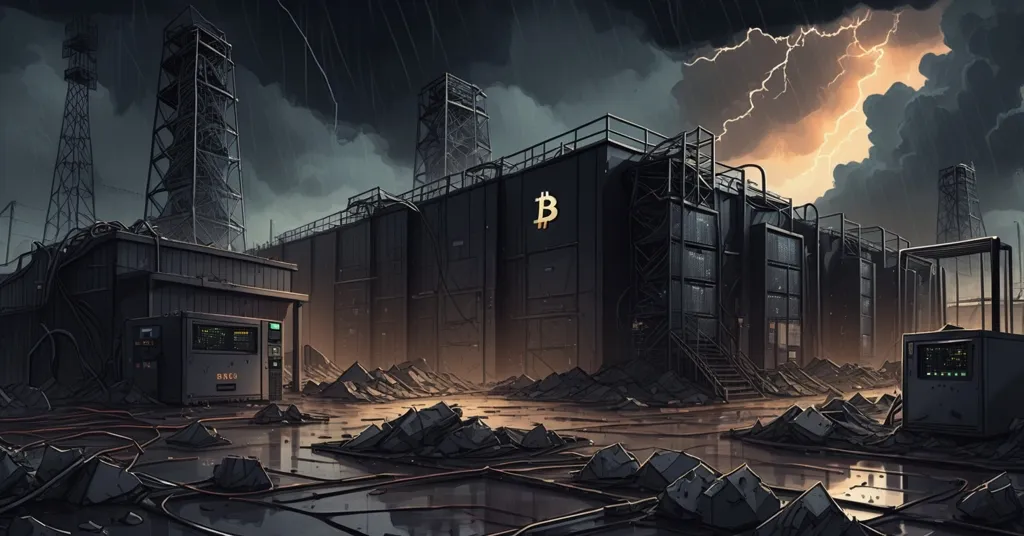
Bitcoin mining, the gritty engine of a decentralized financial uprising, is teetering on the edge of collapse in 2026. With costs crushing profitability, major players slashing jobs, dumping their Bitcoin reserves, and even fleeing to AI and high-performance computing (HPC), the industry faces a brutal reckoning. Add in geopolitical headwinds and a shrinking network hashrate, and you’ve got a perfect storm threatening the very foundation of BTC.
- Unprofitable Operations: Mining one BTC costs $83,000 while its market price languishes below $69,000.
- Massive Selloffs: Giants like Riot Platforms and MARA unload more BTC than they mine to stay afloat.
- Industry Exodus: Bitfarms, rebranded as Keel Infrastructure, abandons mining entirely for AI/HPC.
Let’s cut to the chase: the numbers are savage. Bitcoin network difficulty spiked nearly 4% to 139 trillion hashes as of the latest update, a bit shy of the November 2025 peak of 156 trillion, but still a punishing benchmark for miners drowning in red ink. The average cost to mine a single Bitcoin sits at a staggering $83,000, while its market price hovers under $69,000. It’s like trying to sell a car for less than it costs to build—every block mined is a loss. Worse, the network hashrate, a critical measure of mining power securing Bitcoin, dropped 4% in Q1 2026, marking the first first-quarter decline in six years. This isn’t just a blip; it’s a structural gut punch, amplified by geopolitical shocks like Iran’s reduced mining output—once 4% of the global total—following U.S. military action. But the real carnage is unfolding with the industry titans, who are bleeding cash and making cutthroat decisions to survive.
A Bloody History Repeating?
Bitcoin mining has never been a picnic. Flash back to the 2018 bear market or post-halving squeezes in 2020 and 2024—miners have always faced boom-bust cycles. Each time, the network adapted, whether through price recoveries or tech innovations like more efficient ASICs (application-specific integrated circuits, the specialized hardware built for mining Bitcoin). Yet, 2026 feels different. Post-2025’s price peak and subsequent halving of value, combined with soaring energy costs and regulatory chaos, this crisis cuts deeper. If history is any guide, Bitcoin’s resilience might pull it through—but only if the core infrastructure, its miners, hold the line. Right now, that line looks dangerously thin.
Giants Stumble: Riot’s Fire Sale and MARA’s Cuts
Riot Platforms, a heavyweight in the Bitcoin mining arena, is hemorrhaging. In Q1 2026, they offloaded 3,778 BTC—over double the 1,473 they mined—slashing their treasury from 19,233 to 15,680 coins. That desperate selloff raked in $289.5 million, a Band-Aid on a $633 million net loss for 2025. CEO Jason Les didn’t sugarcoat their pivot away from mining:
“We continue to convert power capacity from BTC to AI in order to maximize value for our shareholders… from a Bitcoin mining company with data center potential into a proven data center developer.”
In plain English, Bitcoin mining is a dead end for Riot, and they’re banking on AI to bail them out. They’re not alone. MARA, once a hashrate titan, sold 15,133 BTC to repurchase $1 billion in debt. On April 2, 2026, they axed 15% of their workforce—a clear signal of retreat. CEO Fred Thiel called it evolution:
“This is not purely a financial decision—it’s a strategic one… we’re focusing the company in a new direction. That means the shape of our team needs to change with it.”
VP of Investor Relations Robert Samuels insisted it’s not surrender: “This isn’t capitulation. That’s balance sheet management… we’ve always viewed BTC as a corporate asset, and that hasn’t changed.” But when you’re dumping reserves and forging AI-focused deals with Starwood Digital Ventures while snagging a 64% stake in French data center firm Exaion, it’s hard to argue you’re still all-in on Bitcoin.
Bitfarms’ Exit and Cango’s Collapse
Bitfarms, now rebranded as Keel Infrastructure, dropped the ultimate bombshell: they’re done with Bitcoin mining. Despite a 72% revenue surge to $229 million in 2025, they posted a crippling $284.5 million net loss. Their strategy? Liquidate their remaining $161 million in BTC and shutter mining operations by the end of 2026, doubling down on North American HPC infrastructure. CEO Ben Gagnon was blunt:
“We’re fully committing to North American HPC infrastructure development, leaving Bitcoin behind.”
That’s a stark rejection of Bitcoin’s roots. Meanwhile, Cango, a newer player, is flirting with disaster. With shares tanking to $0.42 (down 72% year-to-date), they risk NYSE delisting. They’ve sold over half their 7,528 BTC treasury, leaving just 3,313 coins, while reporting a $572 million loss in 2025 despite $688 million in revenue. A $65 million injection from leadership and a $10 million convertible note from Hong Kong’s DL Holdings offers little reassurance as they, too, pivot to AI/HPC.
Why AI and HPC? A Miner’s Escape Hatch
For the uninitiated, high-performance computing (HPC) means using massive data centers for heavy-duty tasks like machine learning or scientific simulations—basically, renting out raw computational muscle to tech giants. Bitcoin mining rigs, built for the proof-of-work algorithm (Bitcoin’s security mechanism where miners solve complex math puzzles to validate transactions), are often left idle or unprofitable in today’s market. Yet, their energy-hungry infrastructure is a near-perfect fit for AI workloads, which are in skyrocketing demand. Industry whispers suggest HPC contracts could yield margins far exceeding Bitcoin mining losses, though hard numbers remain elusive. This isn’t just diversification—it’s a survival tactic. But here’s the rub: miners are Bitcoin’s lifeblood. If they abandon ship, who secures the network? This pivot might save balance sheets, but it risks gutting the decentralized ethos we fight for.
Geopolitical Quagmire: U.S. Pushes and Russian Bans
Politics is pouring fuel on the fire. In the U.S., the Trump administration is hell-bent on domestic dominance, with the President advocating for all remaining Bitcoin to be mined stateside. Senators Cynthia Lummis and Bill Cassidy rolled out the “Mined in America Act” on March 31, 2026, aiming to certify domestic mining facilities, ramp up U.S. hardware production, and ban foreign-made ASICs—pointing fingers at China’s Bitmain, which controls 97% of the mining hardware market. Senator Elizabeth Warren flagged national security risks tied to Bitmain’s dominance, pressing Commerce Secretary Howard Lutnick for action. Sounds patriotic, right? But forcing miners to swap proven Bitmain gear for untested American alternatives could tank efficiency and jack up costs even further. Historically, tech trade wars with China have backfired—think Huawei bans leading to supply chain chaos. This could be another own goal, strangling an already struggling sector.
In Russia, the situation is a regulatory dumpster fire. Year-round mining bans have been renewed in regions like Buryatia and Zabaykalsky Krai until 2031, bringing the total to 13 regions with restrictions. Only 1,489 of an estimated 50,000 miners have registered, paying a pathetic $7.1 million in taxes—less than 10% of projections. Duma Deputy Anton Gorelkin slammed the lack of incentives, while Energy Ministry officials like Andrei Maksimov push for more bans to ease grid strain. With penalties for illegal mining looming in the Duma on April 14, 2026, Russia’s miners are choked out. Globally, these crackdowns—coupled with Iran’s drop-off—chip away at Bitcoin’s hashrate, leaving the network exposed.
Network Security at Stake: A Ticking Time Bomb?
Let’s break this down for newer folks: Bitcoin’s security hinges on miners running the proof-of-work system, collectively maintaining the blockchain’s integrity through raw computing power, measured as hashrate. A declining hashrate—down 4% in Q1 2026—means fewer miners are protecting the network, slowing transaction confirmations and potentially hiking fees for users. Worse, it opens the door to a 51% attack, where a single entity controlling over half the network’s power could manipulate transactions or double-spend coins. With giants like Riot and MARA selling reserves and scaling back, and others like Bitfarms exiting entirely, the risk of centralization grows. If mining power consolidates to a handful of players, Bitcoin’s decentralized dream could crumble. Everyday hodlers might not notice today, but delayed transactions or spiked fees tomorrow could hit hard.
Community Fights Back and Altcoin Relevance
Amid the wreckage, the Bitcoin community isn’t sitting idle. Maximalist forums are buzzing with calls for decentralized mining pools to counter centralization, while developers float ideas like protocol tweaks to lower mining barriers. It’s grassroots grit, the kind that built Bitcoin. Meanwhile, let’s not forget the broader crypto ecosystem. Altcoins like Ethereum, with its proof-of-stake model sidestepping mining crises altogether, or Solana, tackling scalability, fill niches Bitcoin never aimed for—think smart contracts or lightning-fast DeFi. As much as we champion BTC as king, the revolution isn’t a solo act. A diverse blockchain landscape bolsters decentralization, even if Bitcoin’s miners stumble.
A Glimmer of Hope—and a Solo Miner’s Miracle
Buried in the rubble, there’s a spark of the underdog spirit. On April 2, 2026, a solo miner with a laughable 0.00002% of the network’s hashrate beat 1-in-28,000 odds to claim a block reward. It’s a middle finger to the giants—a reminder that Bitcoin was born from garage tinkerers, not corporate boardrooms. But let’s not get misty-eyed. One lucky strike doesn’t fix an industry where $83,000 production costs crush even the big dogs. Still, it hints at Bitcoin’s unpredictable resilience. Could a price surge post-halving or a drop in energy costs turn the tide? Possibly. Miners pivoting to AI might even return if BTC rebounds, using HPC profits to bankroll mining rigs. History says don’t count Bitcoin out—it thrives on chaos. But right now, that chaos is testing every ounce of its grit.
Key Takeaways and Questions for Reflection
- What’s fueling the Bitcoin mining crisis in 2026?
Unprofitability is the killer—mining costs of $83,000 per BTC dwarf market prices under $69,000, while network difficulty climbs and hashrate drops 4% in Q1 2026, alongside staggering losses like Riot’s $633 million in 2025. - Why are miners abandoning BTC for AI and HPC?
With mining bleeding cash, firms like MARA and Bitfarms/Keel see better margins in AI and data centers, repurposing infrastructure for tech-driven revenue over uncertain Bitcoin gains. - How do geopolitical moves impact global Bitcoin mining?
U.S. policies like the “Mined in America Act” push domestic mining and restrict Chinese hardware, while Russia’s bans across 13 regions and Iran’s reduced output shrink global hashrate, straining the network. - Is Bitcoin’s network security under threat?
Yes—falling hashrate from selloffs and shutdowns weakens resistance to attacks like 51% exploits, risking centralization and slower, costlier transactions for users if fewer miners uphold the blockchain. - Can Bitcoin mining bounce back from this downturn?
Recovery depends on a price rally, cheaper energy, or policy relief, but if miners keep exiting for AI, this could mark a permanent shift—though Bitcoin’s knack for defying odds keeps hope alive.
Bitcoin mining in 2026 is a war zone of layoffs, reserve selloffs, and regional clampdowns, as reported in detailed accounts of BTC miners facing major layoffs and shutdowns. We’re at a crossroads where adaptation isn’t optional—it’s do or die. As advocates for decentralization, privacy, and disruption, we see Bitcoin as the future of money, but only if its miners, the network’s first line of defense, weather this storm. The pivot to AI might keep companies solvent, but at the risk of eroding Bitcoin’s core. Governments tightening the vise—from U.S. hardware wars to Russian grid grabs—threaten the borderless vision we hold dear. Yet, Bitcoin has clawed back from worse. Will miners return to fight another day, or has the king of crypto lost its guardians? Time, price, and sheer cypherpunk stubbornness will tell.