Bitcoin Mining: Debunking Environmental Myths and Grid Stability Benefits
 LTB
LTB Debunking Bitcoin’s Environmental Myths: Mining’s Role in Renewable Energy and Grid Stability
Bitcoin has been slammed as an environmental disaster for years, but what if the critics are just recycling bad data? ESG researcher Daniel Batten recently dropped a bombshell on X, tearing apart nine pervasive myths about Bitcoin’s energy consumption and ecological footprint. Armed with peer-reviewed studies and real-world examples, he argues that Bitcoin mining isn’t just misunderstood—it might even be a force for good in energy systems. Let’s cut through the noise and get to the truth.
- Myth-Busting Breakdown: Batten challenges nine false claims about Bitcoin’s energy use, water consumption, and e-waste, exposing outdated or inflated stats.
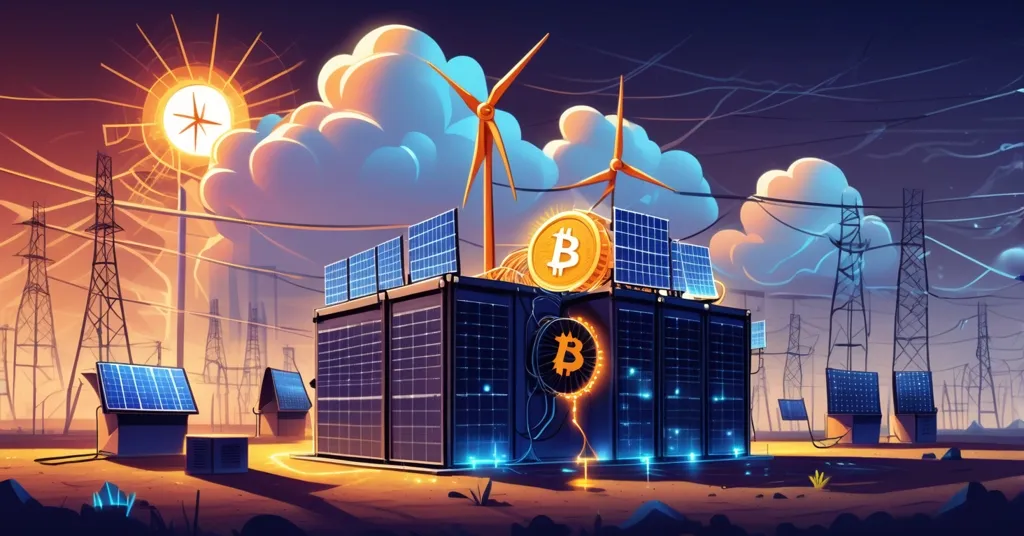
- Grid Support Hero: Bitcoin miners bolster electricity grids, with Texas’ 2022 heatwave showing their clutch demand response.
- Green Energy Edge: Over 50% of Bitcoin’s power is renewable, with potential to eliminate waste in remote energy setups.
Why All the Bitcoin Backlash?
Bitcoin’s been under fire since its 2009 debut, often painted as a planet-killer by mainstream voices. Outlets like Dow Jones have called it an “environmental catastrophe,” pointing to its energy demands, water use for cooling hardware, and discarded mining rigs as proof of harm. High-profile moments, like China’s 2021 crackdown on mining over energy concerns, only amplified the criticism. Even Harvard University caught heat for dabbling in Bitcoin investments, with skeptics dismissing it as a “fake currency” that’s torching the Earth. But is this hate based on hard facts, or just a knee-jerk reaction to something new and disruptive? Batten leans toward the latter, comparing Bitcoin’s rough start to the early backlash against game-changers like bicycles, radios, and the internet. As he puts it:
“Every nascent disruptive technology is accompanied by claims that are based on lack of understanding, lack of data, and a fear of something unknown. This happened to the bicycle, the radio, and the Internet. It has also happened with Bitcoin mining.” – Daniel Batten
Myth 1: Bitcoin as an Energy Vampire
The biggest knock on Bitcoin mining is its supposed energy gluttony, a narrative pushed hard by Alex de Vries’ 2018 paper claiming that more transactions equal a bigger environmental hit. Sounds plausible, until you dig into the data. Batten, in his detailed analysis, addresses these misconceptions head-on, as highlighted in a recent report challenging myths about Bitcoin’s energy consumption. He points to four peer-reviewed studies and Cambridge University’s Bitcoin Electricity Consumption Index (CBECI), which show no direct tie between transaction volume and energy use. Here’s the deal: Bitcoin’s power draw comes from its Proof of Work (PoW) system, where miners use hefty computing power to solve puzzles, secure the network, and earn rewards. For the uninitiated, PoW is like a digital lock—miners are the key-makers, and their energy use depends on the lock’s complexity, not how many people pass through the door (transactions). So Bitcoin can scale to global adoption without a matching energy explosion, a vital fact for its long-term viability as a decentralized currency.
That’s not to say Bitcoin sips power like a smartwatch. It accounts for roughly 0.1% of global electricity, per 2023 CBECI estimates, and in areas with coal-heavy grids—like parts of China before the 2021 ban—that translates to real carbon output. But the story doesn’t end there. Miners hunt for the cheapest electricity, often renewables in remote spots, and their unique flexibility can turn a perceived flaw into a strength, as we’ll explore.
Myth 2: A Mountain of E-Waste?
Critics also love to claim Bitcoin mining buries us in electronic waste (e-waste) from burned-out hardware. De Vries threw out a figure of 30 kilotonnes annually—imagine the weight of about 15,000 cars piling up in landfills. Shocking, until Cambridge University recalculated and pegged the real number at just 2.3 kilotonnes, a 1,204% overestimation. Batten calls this sloppy math, pointing out that miners, driven by razor-thin margins, often repurpose or recycle old rigs. Let’s be real: Bitcoin isn’t tossing gear into a dumpster while your forgotten smartphone rots in a junk drawer. Globally, e-waste from consumer tech hits 50 million tonnes yearly, per UN stats, dwarfing Bitcoin’s share. If we’re pointing fingers, why’s crypto the only scapegoat?
Still, e-waste isn’t zero. Mining hardware has a shelf life, often 3-5 years before it’s obsolete. But the scale of the problem is nowhere near what critics hype, and the industry’s profit motive pushes constant efficiency upgrades, not waste.
Myth 3: Grid Wrecker or Grid Rescuer?
Here’s where Bitcoin flips from bogeyman to potential ally. Detractors say mining destabilizes electricity grids by guzzling power, but studies from Duke University and data from ERCOT—Texas’ grid operator and host to the world’s largest Bitcoin mining hub—tell a different story. Miners act as a “controllable load,” able to cut usage on a dime during high-demand periods, a tactic called demand response (basically, stepping back to let the grid breathe). Picture a blistering Texas summer in July 2022, with heatwaves pushing air conditioners to the limit and the grid on the brink. Bitcoin miners powered down, freeing capacity for homes to stay cool and averting blackouts. Former ERCOT interim CEO Brad Jones highlighted their role:
“Bitcoin mining operations have found a way to come into the market and take some of that excess wind in off-peak periods. Then it can turn down whenever we need the power for other customers… And if a generator trips offline, it can very quickly respond to that frequency disruption and allow us to balance our grid more efficiently.” – Brad Jones
Jones dubbed miners a “non-rival energy user,” meaning they don’t steal renewables from households. Instead, they often tap surplus power—like wind energy at night—that would otherwise go unused. This isn’t just a Texas quirk. In Iceland, miners run on geothermal energy, while in Canada, outfits like Bitfarms leverage hydropower, often in remote areas where power can’t reach urban centers. Bitcoin isn’t draining the system; it’s mopping up the spills.
Myth 4: Jacking Up Your Power Bill?
Another popular jab is that Bitcoin mining spikes electricity costs for regular folks. Batten says show me the proof—there’s no peer-reviewed evidence backing this up. On the contrary, real-world cases suggest miners can lower costs. In Norway, power prices were 20% cheaper when miners were active; rates climbed after they left. In rural Kenya, a Bitcoin mining setup using excess hydropower slashed local electricity costs from 35 to 25 cents per kWh, as reported by CNBC, directly benefiting communities. The logic? Miners often fund grid improvements or use stranded energy (power generated far from users, typically wasted), easing utility burdens. They’re not bleeding grids dry—they’re chasing cheap juice, and smart systems can turn that into a win for everyone.
Of course, if mismanaged, mining in tight energy markets could strain local resources. But that’s a policy failure, not a Bitcoin problem. The data leans toward cost stabilization, not hikes, when grids adapt.
Myth 5: A Carbon Catastrophe?
Bitcoin’s carbon footprint clocks in at 39.8 million tonnes of CO2 equivalent per year, based on 2022 estimates. That’s a big number, no doubt, until you compare it. Electric vehicles (EVs) in just China and the US emit 80 million tonnes during production and use. Yet EVs get hailed as green saviors while Bitcoin’s branded a villain. Double standard much? Batten notes over 50% of Bitcoin’s energy mix comes from sustainable sources, per the Bitcoin Mining Council’s 2023 data, often beating traditional industries. Miners flock to cheap hydro in Quebec or wind farms in West Texas not for eco-cred, but because it’s dirt-cheap in remote zones. Still, emissions are real in coal-reliant regions—nobody’s pretending otherwise. The answer isn’t to demonize Bitcoin; it’s to nudge miners toward greener grids with incentives, not bans.
The Other Side: Bitcoin’s Not Spotless
Let’s not slap a halo on Bitcoin and call it a day. Mining does burn serious energy, and in places like pre-2021 Inner Mongolia, where coal fueled rigs, the carbon hit was ugly. Not every operation plays nice with grids—some smaller miners chase quick profits over stability. And e-waste, while overhyped, still exists as hardware ages out. Batten’s core push, though, is that critics often cherry-pick worst-case scenarios, ignore broader context, and skip Bitcoin’s upside. If we’re gunning for Bitcoin over energy, let’s at least drag gaming consoles—sucking up 0.4% of global power—or those gaudy holiday light displays into the ring. Fair game, right?
Looking Ahead: Tech and Policy Fixes
Bitcoin mining’s environmental saga is far from over, and the future looks promising if we play our cards right. Cutting-edge tech like immersion cooling—dunking rigs in liquid to slash energy waste—and next-gen ASIC miners (specialized hardware built for efficiency) are already shrinking footprints. Layer-2 solutions like the Lightning Network let Bitcoin handle thousands of transactions off the main blockchain, trimming on-chain energy costs. On the policy side, governments could offer tax breaks for renewable-powered mining or push carbon offset programs—some miners already fund reforestation to balance emissions. This aligns with effective accelerationism: push innovation hard, solve problems faster. Bitcoin’s young; its impact depends on how we shape it.
Transparency is another gap to close. The industry needs to openly report energy sources and impacts, countering critics with raw data. Meanwhile, regulators should focus on guiding miners to sustainable zones rather than blanket bans that just shift the problem elsewhere. It’s not about coddling crypto—it’s about pragmatic solutions over panic.
Key Questions and Takeaways
- What myths are tied to Bitcoin’s environmental impact?
Daniel Batten calls out nine falsehoods, from sky-high energy and water use to bloated e-waste figures, grid chaos, and consumer cost spikes, often rooted in shaky or old data. - Does Bitcoin’s energy use balloon with more transactions?
Nope. Cambridge University and peer-reviewed studies confirm energy ties to securing the network via Proof of Work, not transaction volume, meaning growth doesn’t automatically mean more power draw. - Can Bitcoin mining actually help electricity grids?
Yes, Duke University research and ERCOT data from Texas show miners stabilize grids via demand response, like during the 2022 heatwave when they cut usage to dodge blackouts. - Does Bitcoin mining drive up electricity prices?
No hard evidence says so. Cases in Norway and Kenya highlight mining lowering costs by tapping surplus energy and easing grid strain. - How does Bitcoin’s carbon output compare to other sectors?
At 39.8 million tonnes of CO2 equivalent yearly with over 50% renewable energy, Bitcoin’s footprint is smaller than the 80 million tonnes from EVs in China and the US alone. - What’s the path to greener Bitcoin mining?
Tech like immersion cooling, efficient ASICs, and off-chain tools like Lightning Network, paired with policies pushing renewables, can slash impacts further.
So, where does this leave us? Bitcoin mining isn’t the eco-monster it’s made out to be, nor is it some flawless savior. Batten’s deep dive forces us to ditch lazy narratives and face the numbers head-on. If miners can prop up grids, harness wasted renewables, and even cut costs in places like Kenya, maybe Bitcoin’s not the enemy—it’s a rough-around-the-edges ally in reimagining energy. This tech is still in its infancy, and like any disruptive force, its legacy hinges on our next moves. Let’s junk the fear, prioritize hard solutions, and ask ourselves: could Bitcoin mining be an unexpected key to a decentralized, sustainable tomorrow?