Bitcoin Outflows Surge as U.S. and Europe Trading Volumes Skyrocket: What’s Next?
 LTB
LTB Bitcoin Exchange Outflows Persist as Trading Volumes Explode in U.S. and Europe
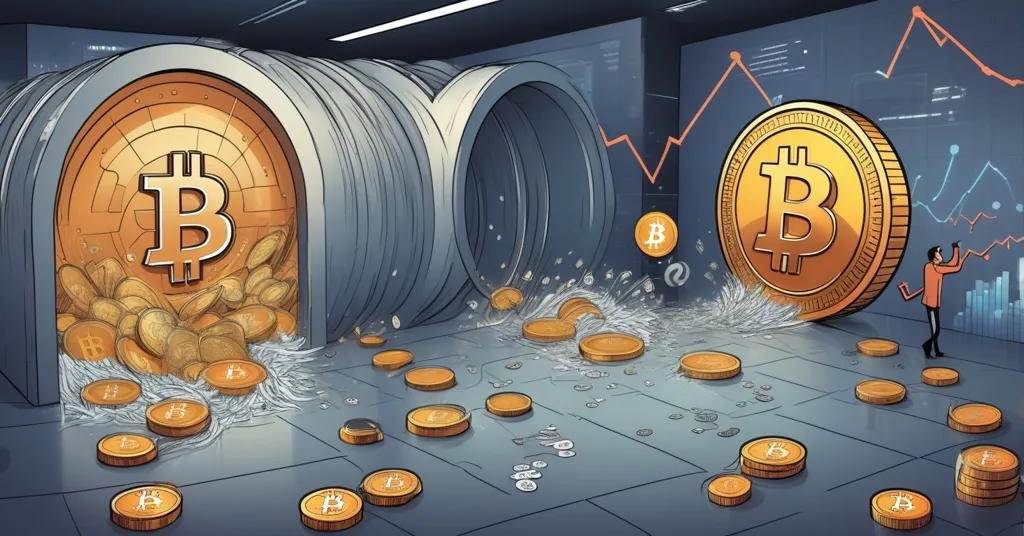
Bitcoin is caught in a fascinating tug-of-war: coins are streaming out of centralized exchanges while trading floors in the U.S. and Europe are buzzing with unprecedented activity. As of March 30, data reveals a market grappling with long-term conviction and short-term speculation, leaving us all wondering what’s next for the king of crypto.
- Steady Reserves, Persistent Outflows: Bitcoin holdings on major exchanges sit at 2.45 million BTC, with net outflows of 1,064 BTC daily, 10,305 BTC weekly, and 27,200 BTC monthly.
- Trading Frenzy: Binance’s BTC/USDT pair saw volumes spike, with Europe up 459% and the U.S. up 88% in their sessions.
- Market Crossroads: Outflows tighten liquidity, while soaring volumes hint at intense engagement—direction remains unclear.
Outflow Trends: Where’s the Bitcoin Going?
The numbers don’t lie—Bitcoin is leaving centralized exchanges at a steady clip. According to data from CoinGlass, total reserves on major platforms stood at 2,453,214 BTC as of March 30 at 04:25 UTC. That’s a significant pile, but the flow of coins tells a more compelling story. Over the last 24 hours, a net outflow of 1,064 BTC was recorded. Over the past week, that figure climbs to 10,305 BTC, and over the last month, a hefty 27,200 BTC has exited exchange wallets. For those new to the space, a net outflow means more Bitcoin is being withdrawn than deposited. Often, this signals a shift to self-custody—where users store their coins in personal wallets like hardware devices (think Ledger or Trezor) rather than leaving them on platforms for trading or easy access.
Why does this matter? Moving Bitcoin off exchanges typically suggests two things: either investors are playing the long game, betting on future price gains with a HODL mentality (a crypto slang for “hold on for dear life”), or they’re wary of centralized platforms after debacles like the FTX collapse in 2022. Self-custody aligns with Bitcoin’s ethos of financial sovereignty, summed up by the mantra “not your keys, not your crypto”—if you don’t control the private keys to your wallet, you don’t truly own your funds. But it’s not all rosy; self-custody comes with responsibility. Lose your keys or get hacked, and there’s no customer support to call.
Exchange-by-Exchange Breakdown: Diverging Behaviors
Zooming into specific exchanges, the picture gets messier—and more interesting. Coinbase Pro, a dominant player in the U.S., holds the largest Bitcoin stash at 853,660 BTC but saw net outflows of 362 BTC in a day and 1,386 BTC over a week. This slow bleed suggests users are pulling funds, perhaps spooked by past exchange failures or simply embracing cold storage. Binance, with 627,628 BTC in reserves, shows a split personality: a daily inflow of 913 BTC but a weekly outflow of 4,219 BTC. This could mean short-term traders are piling in, only to withdraw after making their moves. Bitfinex, holding 403,953 BTC, plays contrarian with net inflows of 617 BTC daily and 1,505 BTC weekly—some users apparently see it as a safe crypto vault while others flee. Meanwhile, OKX recorded the biggest daily outflow at 1,355 BTC, followed by Kraken at 1,033 BTC. Smaller exchanges like bitFlyer eked out a modest inflow of 141 BTC.
These divergences highlight varied investor behaviors across platforms. Some exchanges are hubs for quick trades (hence inflows), while others are exit ramps for long-term holders. It’s a fragmented narrative, and anyone claiming they’ve cracked the code on market sentiment from this alone is peddling nonsense. Let’s keep it real: these flows are signals, not gospel.
Trading Volume Explosion: Western Markets Ignite
While coins are vanishing from exchanges, trading desks are lighting up like a Bitcoin miner’s rig on overclock. Trading volume for Binance’s BTC/USDT pair—a benchmark for Bitcoin liquidity—has skyrocketed across regional sessions. For the uninitiated, BTC/USDT pits Bitcoin against Tether, a stablecoin pegged to the U.S. dollar, acting as a digital proxy for fiat currency without needing direct bank involvement. In Asian hours, volume hit $228.0 million, a 26% jump from the prior day’s $161.3 million. U.S. hours saw an 88% leap to $758.0 million from $401.5 million. But Europe stole the show with a staggering 459% increase to $368.7 million from just $66.0 million the day before, as detailed in recent market insights on Bitcoin exchange outflows and trading surges.
What’s fueling this frenzy, especially in Western markets? It could be a cocktail of factors. Institutional interest might be growing—think hedge funds or asset managers testing the waters amid ETF chatter in the U.S. Retail speculators could also be jumping in, driven by FOMO (fear of missing out) as Bitcoin stays in the headlines. Then there’s the regulatory angle: Europe’s recent Markets in Crypto-Assets (MiCA) framework aims to standardize crypto rules across the EU, potentially offering clarity that spurs activity. In the U.S., ongoing battles between the SEC and CFTC over whether Bitcoin is a commodity or security might be pushing traders to act before policies solidify. Or, hell, maybe it’s just herd mentality. Whatever the cause, these volumes scream engagement—and in crypto, engagement often means volatility isn’t far behind.
The Bullish Case: Outflows as Empowerment
As someone who cheers for decentralization, I can’t help but see these outflows as a defiant jab at the old financial overlords. Every Bitcoin moved to a personal wallet is a step toward the sovereignty Satoshi Nakamoto envisioned—a world where you don’t need a bank or a middleman to control your wealth. Outflows often signal conviction, a belief that Bitcoin’s value will climb over time, or at least that it’s safer in your own hands than on a platform that could implode overnight. Post-FTX, trust in centralized exchanges is rightfully shaky, and this trend feels like a collective middle finger to counterparty risk. It’s also a nod to effective accelerationism (e/acc)—the idea that tech like Bitcoin should speed toward mass adoption, bumps and all, to disrupt the status quo faster.
For Bitcoin maximalists, this is the dream: a network where users hold their own keys, miners secure the blockchain, and centralized choke points fade into irrelevance. Outflows could be laying the groundwork for a more resilient ecosystem, one less dependent on the whims of exchange CEOs or regulatory crackdowns. If you’re a newbie, this might inspire you to start small—transfer a few sats (short for satoshis, the smallest Bitcoin unit) to a hardware wallet and feel the power of ownership. For OGs, it’s validation of why you got into this space to begin with.
The Bearish Risk: Liquidity Crunch Dangers
But let’s play devil’s advocate—outflows aren’t all sunshine and rainbows. They’re tightening liquidity on exchanges, and that’s a fancy way of saying there’s less Bitcoin readily available to trade. Think of exchange reserves like water in a reservoir: if levels drop too low, even a small surge in demand can cause a flood (price spike) or a drought (crash) if sellers can’t meet the rush. With 27,200 BTC leaving exchanges in a month, the supply buffer is shrinking. Pair that with the manic trading volumes we’re seeing, and you’ve got a recipe for wild price swings. A whale—a large investor with massive holdings—dumping their stack could trigger a panic if there aren’t enough coins on hand to absorb the sell-off.
Moreover, are these outflows really about conviction, or are they fear in disguise? Some holders might be pulling funds not to HODL, but because they smell a market top or an impending crash. And while self-custody is empowering, it’s not foolproof—plenty of horror stories exist of lost keys or hacked wallets. Exchanges, for all their flaws, still provide liquidity and fiat on-ramps that Bitcoin alone can’t replicate. They’re a necessary evil, especially for onboarding newbies who aren’t ready to navigate private key management. Let’s not pretend decentralization solves everything overnight.
External Catalysts: What’s Stirring the Pot?
These trends don’t exist in a vacuum. Regulatory shifts are a big piece of the puzzle. Europe’s MiCA framework, set to roll out fully by late 2024, promises a unified set of rules for crypto across the EU. That could stabilize markets by reducing uncertainty, explaining part of the 459% volume spike during European hours. But it’s a double-edged sword—overregulation might stifle innovation or drive users to less regulated jurisdictions. In the U.S., the SEC’s hardline stance on classifying most cryptos as securities (while the CFTC argues Bitcoin is a commodity) creates a legal gray zone. Traders might be piling in now, fearing harsher rules or banking on ETF approvals to legitimize Bitcoin further.
Institutional moves could also be behind the volume explosion. Are giants like BlackRock or Fidelity quietly accumulating via over-the-counter deals or ETF filings, driving U.S. activity? Hard data is scarce, but the $758 million in U.S.-hour volume on Binance’s BTC/USDT pair isn’t just retail noise. Then there’s the role of stablecoins like Tether (USDT) and competitors like USDC, which power these trading pairs. They’re critical to liquidity, but not without risk—if a stablecoin loses its peg or faces regulatory heat, the trading frenzy could turn to chaos. Historically, outflows have spiked after bull runs (like 2021) as holders lock in gains, or during bear markets (like 2018) out of fear. Is this cycle different, or just history rhyming? Macro factors—interest rates, geopolitical tensions—might also be nudging behavior, though they’re harder to pin down without specific triggers tied to March 30.
What’s Next for Bitcoin Markets?
Looking ahead, a few things could tip the scales. The next Bitcoin halving, expected in 2024, will cut miner rewards in half, historically a bullish catalyst by reducing new supply. Keep an eye on network metrics like hash rate—how much computing power secures Bitcoin—which signals miner confidence. Exchange policies, like withdrawal fee hikes, could slow outflows, while economic data releases (think inflation or Fed rate decisions) might sway trading sentiment. And don’t ignore altcoins or stablecoins—they fill niches Bitcoin doesn’t, from smart contracts on Ethereum to fiat proxies like USDT. Their interplay with Bitcoin shapes this ecosystem, even if BTC remains the heavyweight champ.
For now, the market feels like a chessboard mid-game—plenty of pieces in play, no checkmate yet. Anyone screaming “$100K tomorrow” or “crash incoming” is just noise. We’re not here to shill or scare; we’re here to cut through the hype. Trends like these are signals, not certainties. Secure your funds, do your homework, and don’t let volume spikes or outflow stats dictate your next move without context.
Key Questions and Takeaways on Bitcoin Trends
- What do persistent Bitcoin outflows from exchanges reveal about investor trust?
They suggest a shift toward self-custody, likely fueled by past exchange failures like FTX and a desire for direct control over assets, reflecting eroded trust in centralized platforms. - Why are trading volumes spiking so dramatically in the U.S. and Europe?
A mix of institutional interest, retail speculation, and regulatory developments like Europe’s MiCA or U.S. ETF hopes could be driving urgency and engagement in these regions. - Does tightening liquidity on exchanges threaten Bitcoin’s stability?
Yes, reduced supply can amplify volatility, making price swings sharper if demand surges or a major sell-off hits without enough coins to absorb the impact. - Are these outflows bullish or a warning sign for Bitcoin markets?
They’re bullish if they signal HODL conviction and decentralization, but caution is warranted—outflows could also mean fear of a downturn, and liquidity risks loom large. - How can Bitcoin holders navigate these mixed signals practically?
Start with self-custody if you’re ready—test small transfers to a secure wallet. Stay informed on regulatory and market shifts, and don’t chase hype-driven trades without research. - Will Bitcoin maintain dominance amid such complex dynamics?
Likely, as outflows may reflect core strength, but altcoins and stablecoins will keep complementing it by filling gaps in trading, DeFi, and innovation that Bitcoin shouldn’t tackle alone.
Bitcoin’s current push-and-pull between outflows and trading spikes mirrors its broader saga—part rebellion against centralized power, part speculative casino, and all uncertainty. For newcomers, dig into the why behind these numbers, not just the what. For veterans, it’s another chapter in a familiar story of testing resolve. Whether you’re stacking sats or eyeing the charts, one truth holds: Bitcoin doesn’t sit still, and neither should your thinking. Is this the quiet before the next storm, or the dawn of mainstream acceptance? Only time—and your wallet—will tell.