
Bitcoin’s Future: Scaling, Ossification, and the New Mining Landscape
 LTB
LTB Bitcoin’s Path Forward: Navigating Scaling, Ossification, and Mining Dynamics
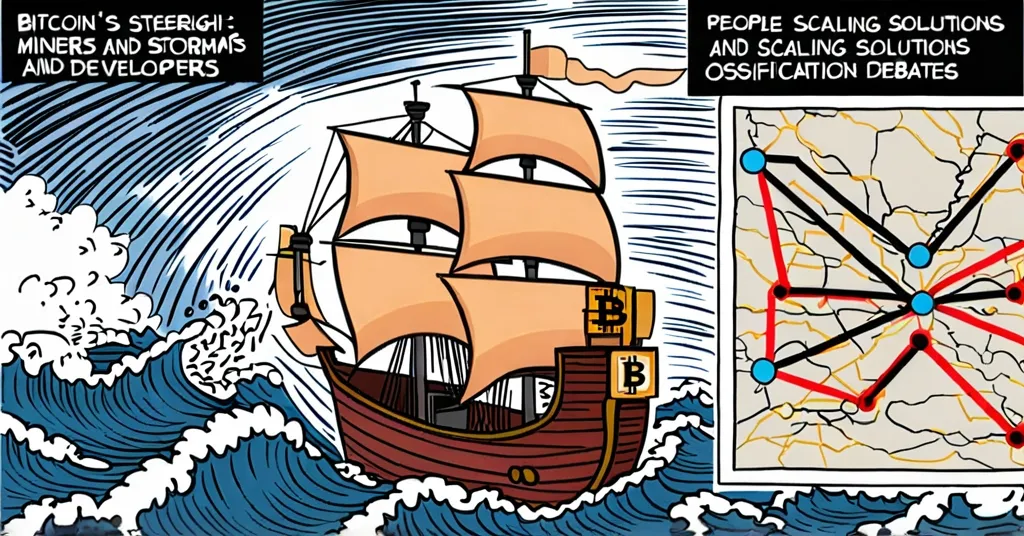
Bitcoin’s future is at a pivotal juncture, with scaling solutions, the ossification debate, and the shifting landscape of mining post-China ban shaping its trajectory. As the community grapples with these issues, collaboration between miners and developers becomes crucial.
- Bitcoin scaling solutions at OP NEXT
- The ossification debate
- Post-China mining dynamics
- Collaboration between miners and developers
Bitcoin Scaling Solutions at OP NEXT
Scaling Bitcoin, or improving its ability to handle more transactions efficiently, remains a central topic of discussion. The upcoming OP NEXT conference, a revival of the Scaling Bitcoin conference, aims to bring together developers and miners to tackle these challenges. Scheduled for 2024 in Boston, MA, the conference will delve into both technical and philosophical aspects of Bitcoin’s future.
While some argue that scaling isn’t an urgent issue, others believe it’s critical for Bitcoin’s growth. Solutions like the Lightning Network, which enables faster and cheaper transactions off the main blockchain, and sidechains like Anduro, are gaining traction. These layer 2 solutions could be key to enhancing Bitcoin’s capacity without altering its core protocol.
The Ossification Debate
The term “ossification” in the context of Bitcoin refers to the debate over whether the cryptocurrency should remain unchanged, focusing only on bug fixes, or if it should evolve to meet new demands and challenges. This debate touches on Bitcoin’s very essence: should it stay true to its original design, or adapt to a growing user base?
Proponents of ossification argue that Bitcoin’s stability and security are paramount, advocating for minimal changes. Critics, however, believe that Bitcoin must evolve to remain relevant and competitive. Key figures like Adam Back and Luke Dashjr have voiced strong opinions on this matter, with Back favoring stability and Dashjr advocating for necessary updates.
Post-China Mining Dynamics
The China mining ban of 2021 marked a seismic shift in the Bitcoin mining ecosystem. As Winston Ma, an adjunct professor at NYU Law School, stated, “The China mining ban marks the end of an era for cryptomining in China.” This ban led to a significant redistribution of global hashrate, with miners relocating to countries like Kazakhstan and the United States.
This shift has not only professionalized the mining industry but also made it more financially robust. Public miners, with their access to capital markets, have been able to leverage this to their advantage, while private miners focus on operational efficiencies. The next Bitcoin halving event, which reduces the reward for mining, will further test the resilience of these miners.
The environmental impact of Bitcoin mining, a key factor in China’s decision to ban it, continues to be a topic of discussion. The industry is exploring ways to become more sustainable, with initiatives like using renewable energy sources gaining ground.
Miners and Developers Collaboration
Collaboration between miners and developers is increasingly seen as vital for Bitcoin’s future. As Will Foxley, co-founder of BlockSpace Media, emphasized, “Collaboration between miners and developers is growing in importance.” This partnership is essential for addressing scaling challenges and ensuring the network’s sustainable growth.
Initiatives like the Bitcoin Mining Council and various governance models are fostering more inclusive decision-making processes. These efforts aim to balance the interests of all stakeholders, ensuring that Bitcoin evolves in a way that benefits the entire ecosystem.
Custodial Solutions vs. Self-Custody
Custodial solutions play a crucial role in Bitcoin security and wealth protection. They provide a convenient option for users who prefer not to manage their private keys. However, the ethos of self-custody remains a cherished principle within the Bitcoin community, emphasizing the importance of individual control over one’s assets.
This balance between security and sovereignty is a defining feature of Bitcoin’s journey. As the ecosystem evolves, both custodial and non-custodial solutions will likely coexist, catering to different user preferences and needs.
Key Takeaways and Questions
What is the primary focus of the OP NEXT conference?
The primary focus is on Bitcoin scaling solutions, aiming to improve transaction efficiency through discussions on technologies like the Lightning Network and sidechains.
How has the Bitcoin mining ecosystem changed post the China mining ban?
The ecosystem has become more professionalized and globally dispersed, with new mining hubs emerging in countries like Kazakhstan and the United States.
What is the ossification debate in the context of Bitcoin?
It’s a debate about whether Bitcoin should remain unchanged or evolve to meet new challenges, focusing on stability versus adaptability.
Why is collaboration between miners and developers important for Bitcoin’s future?
Collaboration is crucial for addressing scaling challenges and ensuring the network’s sustainable growth, fostering inclusive decision-making.
What role do custodial solutions play in Bitcoin’s future?
They provide security and wealth protection, but self-custody remains a core principle cherished by many in the Bitcoin community.
How do public and private miners differ in terms of capital access and efficiency?
Public miners often leverage capital markets, while private miners focus on operational efficiencies due to different financial structures.
Bitcoin’s journey is far from over, and as we stand at this crossroads, the decisions made today will shape its future. Whether it’s scaling solutions, the ossification debate, or the evolving role of miners, one thing is clear: Bitcoin’s future is a shared endeavor, and it’s up to all of us to steer it towards a sustainable and inclusive path.