CLARITY Act Draft Sparks Crypto Lobbying, Ethics Fight and Stablecoin Battle in Congress
 LTB
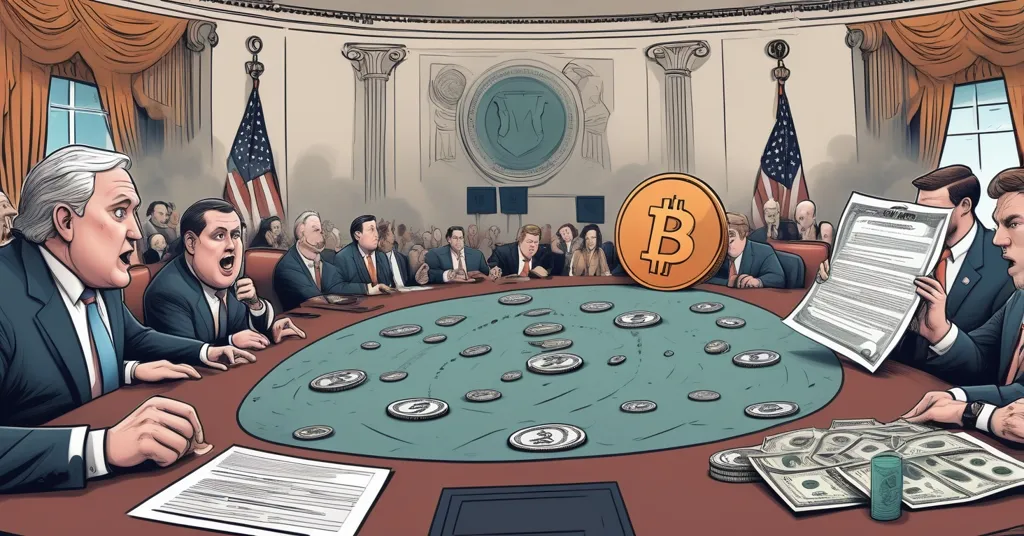
LTB Congress has dropped a new 309-page CLARITY Act draft, and the fight over U.S. crypto market structure is now entering its ugliest phase: last-minute lobbying, ethics drama, and a Thursday markup vote that could still go sideways.
- 309-page draft hits Congress
- Stablecoin rewards, DeFi, and token rules still unresolved
- Banks, unions, crypto PACs, and Trump-linked interests are all pressing lawmakers
- Ethics concerns are now central, not peripheral
The Senate Banking Committee released the latest CLARITY Act draft late Monday night, and the timing immediately kicked off the usual Washington circus: everyone wants “clarity,” while half the lobbyists in town are really asking for special treatment with better branding. Proposed amendments were due by 5:00 pm ET Tuesday, and the committee’s markup vote is scheduled for Thursday, May 14.
A markup is the committee’s line-by-line review of a bill, where lawmakers debate changes, file amendments, and decide what survives. After that, the bill still has a very long road: it has to be reconciled with the Senate Agriculture Committee version, pass the Senate floor, potentially get adjusted again if the House changes it, and then make it to President Trump’s desk. So yes, there is still plenty of room for this thing to become a regulatory hairball.
The CLARITY Act is supposed to define the rules for digital asset market structure in the U.S. In plain English, that means figuring out who regulates what across exchanges, brokers, token issuers, custody, and trading. Right now, that space is a mess of overlapping agencies, political games, and enforcement-by-headline. The bill is meant to fix that. Whether it does so cleanly, or just hands the biggest players a more polished loophole machine, is the real question.
Stablecoin rewards have banks in full panic mode
One of the biggest unresolved fights is over stablecoin rewards. Stablecoins are crypto tokens designed to track a currency like the U.S. dollar. Payment stablecoins are meant for transfers and everyday use, not just trading. The controversy is that some versions can offer yield or rewards, which starts looking a lot like a bank account — and that has banks reaching for the smelling salts.
Six major banking trade groups sent a May 8 letter opposing yield or rewards on payment stablecoins. Their argument is straightforward: if stablecoins start behaving like interest-bearing cash substitutes, money could leave bank deposits and move into crypto products instead. That would mean deposit flight — people pulling money out of banks — which banks say could reduce lending and disrupt credit.
That concern is not pure fantasy. Banks use deposits to make loans. If deposits shrink, the lending machine gets tighter. On the other hand, banks are not exactly innocent public servants here. They are defending their moat, and they know it. If a payment stablecoin can offer a better yield, faster settlement, and fewer middlemen, that is a serious competitive threat. No wonder they’re screaming.
The American Banking Association is treating this like a five-alarm fire. ABA CEO Rob Nichols called it an “urgent advocacy fight.” More than 8,000 letters were reportedly sent to senators urging tighter restrictions on stablecoins. Six major banking groups were involved in the May 8 letter. Senator Bernie Moreno, who sits on the Senate Banking Committee, mocked the bankers’ resistance, and honestly, he has a point: when incumbents feel the floor shake, they suddenly rediscover “consumer protection.”
But the banks’ critique also exposes a real policy issue. If lawmakers let stablecoins act like bank deposits without bank-style rules, they may create a parallel financial system with weaker safeguards. That is not decentralization; that is just old finance wearing a hoodie.
DeFi protections are getting narrower, and that matters
The other major fight is over DeFi developer protections. DeFi stands for decentralized finance, and non-custodial DeFi means software where users control their own funds instead of handing them to a company or exchange. That distinction matters because lawmakers do not want to treat open-source code like a criminal enterprise by default.
Section 604 of the latest draft slightly narrows the DeFi language. It clarifies that prosecution is still possible if someone has specific intent to transfer criminal funds or funds intended to support unlawful activity. That is an important line to draw. Open-source developers should not be treated like money launderers just because bad actors use their code. At the same time, “decentralized” cannot become the industry’s favorite get-out-of-jail-free pass.
That is the policy knot. Protecting software innovation is one thing. Shielding people who intentionally help move illicit funds is another. Lawmakers are trying to keep the two from collapsing into each other, which is harder than it sounds when lobbyists start throwing around words like “innovation” as if they were magic spells.
Some earlier drafts had drawn pushback from lawmakers like Sen. Chuck Grassley, and the current language suggests negotiators are still trying to thread a very narrow needle. If they go too far, they risk criminalizing builders. If they go too soft, they hand scammers and money launderers a tidy legal umbrella.
The ethics fight is no longer optional
The nastiest part of this whole mess is the ethics debate. Senate Banking Democrats want language that would stop elected officials and their families from profiting from crypto while also helping shape crypto regulation. That is not some wild ideological demand. It is basic conflict-of-interest hygiene.
Sen. Elizabeth Warren did not bother with velvet gloves, warning that the draft would
“turbocharge Donald Trump’s crypto corruption.”
That line may be incendiary, but it lands because the Trump-family crypto angle is impossible to ignore. Bloomberg and Tokenomist.ai estimated that Trump family-linked World Liberty Financial has generated $1.55 billion in token sales and added $660 million to family wealth. Bloomberg also said WLF is now worth more to the family than any other business, including their stake in Trump Media & Technology Group, or even Mar-a-Lago.
Sens. Kirsten Gillibrand and Ruben Gallego reportedly met with GOP senators and White House crypto adviser Patrick Witt to discuss ethics provisions. That tells you this is not just partisan chest-thumping. There is a real negotiation happening over whether the people writing crypto rules are also cashing in on crypto exposure.
And yes, that looks bad. Very bad. If the public sees lawmakers trying to regulate an industry while family-linked ventures are minting money at the same time, the “regulatory clarity” pitch starts sounding like a cover story. Or, as one line in the political scrum put it:
“The American people are watching.”
Trump Media adds another layer of absurdity
Trump Media & Technology Group is doing its best impression of a financial tragicomedy. The company reported a $405.9 million net loss on just $871,200 in revenue for Q1. That is not a typo; it is a warning label.
At the same time, TMTG held 9,452 BTC, bought for $1.13 billion, worth about $647 million at quarter-end. It also held 756 million CRO tokens, purchased for $114 million, worth about $53 million at quarter-end. So the company is bleeding cash while sitting on a massive BTC treasury strategy position and a pile of Cronos-linked tokens. That is one way to say you believe in crypto. It is also one way to say you are improvising your business model in real time.
Bitcoin here is the least ridiculous part of the story. A BTC treasury strategy can make sense for companies that want a hard-asset reserve on the balance sheet. But it does not magically fix a business with weak revenue and oversized losses. Bitcoin is not a miracle cure for bad execution, no matter how many conference panels say otherwise.
Exchanges want looser token rules
Another quiet but important fight is over token listings. Coinbase, Kraken, and Gemini reportedly pushed to remove language that would have required listed tokens to be “not readily susceptible to manipulation.”
That phrase matters. It would have made exchanges think harder before listing thinly traded assets that are easy to pump and dump — including some memecoins that exist mainly to separate retail traders from their money. The rule would have forced more caution around assets with low liquidity and obvious manipulation risk.
Coinbase’s Brian Armstrong is expected to speak at a closed-door Senate GOP lunch, which says a lot about the lobbying temperature here. Coinbase’s Stand With Crypto also said it will score the markup vote and update lawmaker ratings accordingly. In practice, that means lawmakers are being told: vote the wrong way and the industry will remember.
That is how modern crypto lobbying works. It is not just backroom meetings anymore. It is scorecards, PAC money, targeted ads, “grassroots” branding, and a lot of very polished pressure dressed up as civic participation. The crypto industry can call it advocacy if it wants. Critics are free to call it astroturf with a nicer logo.
Crypto money is everywhere in politics
Fairshake PAC and affiliated crypto PACs reportedly have nearly $200 million to spend in the next election cycle. That kind of war chest changes behavior. Lawmakers know who can bankroll challengers, fund attacks, and flood districts with messaging. If you think that does not matter, you have not been paying attention.
Stand With Crypto, the Coinbase-linked political arm, is part advocacy group, part pressure machine. And on the other side, labor groups including the AFL-CIO, SEIU, and AFT are opposing any move to allow crypto in retirement accounts.
The unions’ argument is simple: retirement savings should not be turned into a speculative playground. They warn that workers and retirees, not crypto billionaires, will pay the price if volatile assets get a special lane into pensions and 401(k)s. That concern is not unreasonable. Retirement accounts are supposed to be boring. Boring is underrated when your nest egg is on the line.
Could Bitcoin have a role in long-term retirement portfolios? Sure, for some investors and through carefully managed exposure. But broad retirement access to speculative crypto products, especially thinly traded or hype-driven tokens, is a different animal entirely. There is a huge gap between “store some BTC for the long haul” and “let your pension fund moonbag into digital nonsense because an exchange needs more volume.”
What the CLARITY Act is really trying to solve
The U.S. has spent years fumbling the basic question of who regulates crypto. The SEC says one thing, the CFTC says another, Congress drags its feet, and the industry keeps demanding certainty while fighting over every possible edge case. The CLARITY Act is meant to untangle that mess.
But market structure legislation is never just about structure. It decides who gets power, which businesses get room to grow, where liability falls, and whether consumers are protected from the dumbest and most predatory parts of the market. That is why the fights over stablecoins, DeFi, exchange listings, and ethics all matter at once.
The uncomfortable truth is that crypto does need clearer rules. Serious builders, investors, and users benefit when the legal rails are understandable. But clarity is not the same thing as giving banks immunity from competition, letting exchanges list junk without standards, or handing politically connected insiders a clean legal wash.
That is the real test facing lawmakers on Thursday. Do they produce actual rules that protect users and reward honest builders? Or do they hand the biggest players a more respectable way to tilt the board and call it reform?
Key questions and takeaways
What is the CLARITY Act?
A Senate digital asset market structure bill meant to define how crypto exchanges, brokers, token issuers, and custody are regulated in the U.S.
Why is the markup vote important?
Markup is where lawmakers revise the draft line by line. What survives there is what moves forward, so this is where the real fight happens.
Why are banks attacking stablecoin rewards?
Because yield-bearing payment stablecoins could pull deposits out of bank accounts, reduce lending, and disrupt the credit system.
What does non-custodial DeFi mean?
It means users control their own funds instead of depositing them with a company. The legal question is how to protect that software without shielding criminals.
Why are ethics rules part of the crypto debate?
Because lawmakers are trying to regulate an industry that includes politically connected family ventures, and that creates obvious conflict-of-interest problems.
Why are exchanges fighting token manipulation language?
Because stricter listing standards would make it harder to list thinly traded and easily manipulated tokens, including risky memecoins.
How much influence does crypto lobbying have?
A lot. Between PAC spending, advocacy groups, scorecards, and direct meetings with lawmakers, the industry has serious political muscle.
What does this mean for Bitcoin?
Bitcoin likely benefits more from clean market structure and less regulatory chaos than from any one lobbying victory. But the broader bill could still be written in ways that favor platforms and altcoin issuers more than BTC itself.
Is the bill likely to pass easily?
No. Even if it clears committee, it still faces Senate, House, and reconciliation fights, plus the usual swarm of interested parties trying to rewrite the fine print.
What is the biggest risk here?
That “clarity” becomes a political slogan that hides bad incentives, weak safeguards, and too many carveouts for the loudest players in the room.