Crypto Bill Markup Delayed to Jan 29 as Winter Storm and Politics Stall Progress
 LTB
LTB Crypto Market Structure Bill Markup Pushed to January 29 as Winter Storm Freezes Capitol Progress
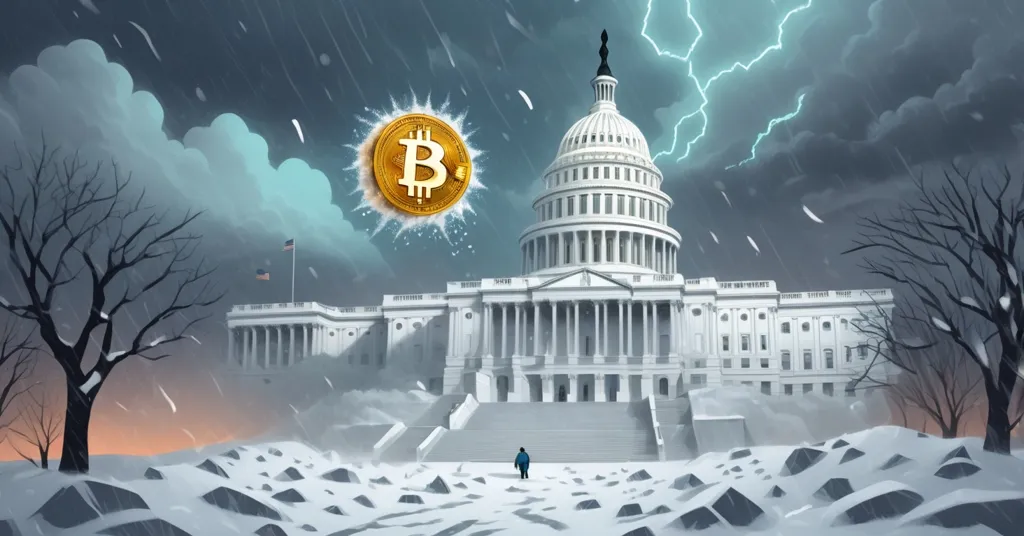
A brutal winter storm has derailed the U.S. Senate’s timeline for advancing the crypto market structure bill, known as the CLARITY Act, with the markup session by the Senate Agriculture Committee now postponed to January 29. While snow and ice have temporarily halted proceedings in Washington, D.C., deeper systemic issues like partisan disagreements and bureaucratic delays continue to threaten regulatory clarity for Bitcoin and the broader cryptocurrency ecosystem.
- CLARITY Act markup delayed to January 29 due to a severe winter storm disrupting Senate schedules.
- Partisan gridlock persists, with only Republican support confirmed despite bipartisan talks.
- Crypto industry praises the latest draft for protecting noncustodial developers and omitting contentious stablecoin rules.
- Further delays into February or March loom as the Senate Banking Committee stalls its efforts.
Weather Woes Stall Critical Crypto Legislation
The cryptocurrency sector’s push for regulatory clarity hit an unexpected roadblock as a punishing winter storm swept through Washington, D.C., forcing the Senate Agriculture Committee to reschedule its markup of the CLARITY Act to 3 p.m. on January 29. For those unfamiliar, a markup is a legislative session where committee members review, amend, and vote on a bill before it advances to the full Senate. Heavy snowfall and icy conditions led to the cancellation of a Senate voting session last Friday, with many members unable to return until Tuesday afternoon due to widespread flight delays and cancellations nationwide. Even with the new date set, there’s no guarantee all committee members will make it back in time for this critical discussion on digital asset regulation. Nature, it seems, is as indifferent to Bitcoin’s decentralized ethos as it is to Capitol Hill’s agenda.
The Senate Agriculture Committee’s role in this process stems from its jurisdiction over commodities, a category many digital assets like Bitcoin fall under, as opposed to securities which are overseen by agencies like the SEC. This distinction is key to understanding why crypto regulation often feels like a jurisdictional tug-of-war between different government bodies. But while the storm is a temporary setback, it’s merely a symptom of the larger chaos surrounding U.S. crypto policy—a mess of political infighting and sluggish governance that keeps the industry in limbo. For more details on this delay, check out the latest update on the crypto market structure bill postponement.
Partisan Divide: The Unending Blizzard for Crypto Regulation
Beyond the literal weather, the CLARITY Act faces a far more persistent obstacle: a deep disagreement between political parties. Despite two weeks of negotiations aimed at bipartisan consensus, only Republican members of the Senate Agriculture Committee have publicly endorsed the bill. This split reflects a fundamental divide in how lawmakers view cryptocurrencies—many Republicans see Bitcoin and blockchain as tools for financial freedom and a way to disrupt centralized systems, aligning with the ethos of decentralization we champion. Democrats, on the other hand, often raise valid concerns about consumer protection, market manipulation, and systemic risks, fearing a repeat of disasters like the FTX collapse in 2022. Without broader support, the bill’s path forward is as treacherous as a D.C. sidewalk in January.
Senate Agriculture Committee Chair John Boozman remains hopeful, suggesting that the collaborative process has refined the legislation even without a final agreement. His optimism, however, feels like a long shot given the history of crypto bills stalling in Congress—look at the Digital Commodities Consumer Protection Act, which has been gathering dust for years. The inability to bridge this ideological gap isn’t just frustrating; it’s a damning indictment of regulatory incompetence that leaves innovators and investors stranded in a gray zone of uncertainty.
Industry Cheers Draft, But Is It Enough?
Amid the gloom, there’s a sliver of good news. The crypto industry has reacted with unexpected enthusiasm to the Senate Agriculture Committee’s latest draft of the CLARITY Act, released on January 21. A standout feature is the inclusion of protections for noncustodial software developers and blockchain infrastructure providers—the unsung heroes who build decentralized tools like wallets and protocols where users control their own private keys, unlike custodial platforms (think exchanges like Binance) that hold funds on behalf of users. This provision is a rare nod to the principle of self-sovereignty that Bitcoin pioneered, ensuring that the builders of decentralized systems aren’t unfairly penalized under laws designed for centralized entities.
Another win in the draft is the exclusion of rules around stablecoin yields, a hot-button issue that previously led Coinbase, a leading crypto exchange, to withdraw support for the Senate Banking Committee’s rival version of the bill. Stablecoins are digital assets pegged to stable reserves like the U.S. dollar to avoid the wild price swings of Bitcoin or Ethereum, often used as a safe harbor or for earning interest (yields) when staked. Regulating these yields as if they’re traditional bank interest was seen as overreach by many in the space, so scrapping those provisions has earned a sigh of relief. It’s a small victory, but for an industry often at war with regulators, every inch of ground matters.
Looming Delays and the Bigger Picture
Don’t get too comfortable, though. While the Agriculture Committee’s draft is a step forward, the Senate Banking Committee—equally critical to the bill’s fate—is dragging its heels. Reports suggest their portion of the legislation could be delayed until late February or even March, pushing broader negotiations further into 2024. This isn’t just a scheduling quirk; every week of uncertainty chips away at market confidence, deters institutional investment, and risks driving blockchain innovation to more crypto-friendly jurisdictions like Singapore or Switzerland. The U.S. could lose its edge in this financial revolution if lawmakers can’t get their act together faster than a Bitcoin block confirmation (that’s roughly 10 minutes, for the uninitiated).
Zooming out, the CLARITY Act is a microcosm of a global struggle to regulate digital assets without killing the golden goose of innovation. The EU, for instance, has made strides with its Markets in Crypto-Assets (MiCA) framework, offering a clearer path for firms while still tackling fraud. The U.S., by contrast, remains stuck in a cycle of half-measures and delays, a pattern evident in ongoing battles like the SEC’s lawsuit against Ripple over XRP’s status as a security. If the CLARITY Act fails or drags on indefinitely, the worst-case scenario isn’t hard to imagine: a brain drain of talent and capital to offshore hubs, leaving American crypto users and businesses in a regulatory no-man’s-land.
Bitcoin, Altcoins, and the Decentralization Dream
From a Bitcoin maximalist perspective, the CLARITY Act could be a defining moment. Clear rules classifying Bitcoin as a commodity rather than a security would solidify its status as digital gold—a sovereign asset free from the speculative baggage of countless altcoins. Yet, I’ll concede that altcoins and other blockchains like Ethereum have their place. Ethereum’s smart contract ecosystem powers decentralized finance (DeFi) protocols that Bitcoin isn’t designed to support, filling niches like lending and automated trading. The CLARITY Act’s protections for developers could turbocharge these innovations, embodying the spirit of effective accelerationism—pushing tech adoption forward, flaws and all, to disrupt outdated financial systems. But let’s not kid ourselves: any regulatory framework must prioritize anti-fraud measures over endless bureaucratic stalling, or we risk more FTX-style scams tainting the space.
There’s a counterpoint worth chewing on, though. While protections for noncustodial developers sound great, could they be a double-edged sword? Bad actors might exploit these loopholes to dodge accountability, prompting regulators to swing back with harsher rules down the line. It’s a tightrope—too much leniency, and you’ve got a haven for scammers; too much control, and you choke the life out of decentralization. The balance this draft strikes is promising, but it’s far from bulletproof.
Key Questions and Takeaways for Crypto Enthusiasts
- What is the CLARITY Act, and why does it matter to the crypto space?
It’s a U.S. Senate bill aimed at regulating digital asset markets, offering legal clarity for participants like developers and firms. It’s crucial for fostering innovation while setting boundaries to prevent overreach or fraud. - Why was the markup delayed to January 29?
A severe winter storm disrupted Senate schedules with heavy snow and flight cancellations, forcing the Senate Agriculture Committee to postpone the session. - What’s behind the partisan gridlock slowing the bill?
Republicans often view crypto as a tool for financial freedom, while Democrats prioritize consumer safeguards, creating a stalemate that stalls progress. - How does the industry view the latest draft of the CLARITY Act?
The crypto sector welcomes protections for noncustodial developers and the exclusion of stablecoin yield rules, seeing it as a balanced approach. - Could further delays into March harm Bitcoin and blockchain innovation?
Yes, prolonged uncertainty risks shaking investor trust and pushing talent and capital to crypto-friendly countries, stunting U.S. leadership in the space. - Are noncustodial developer protections a true win for decentralization?
They’re a major step, aligning with Bitcoin’s self-sovereignty ethos, but there’s a risk bad actors could exploit gaps, inviting future crackdowns. - How might the bill impact altcoins and DeFi compared to Bitcoin?
While Bitcoin could solidify its commodity status, Ethereum-based DeFi projects might benefit from developer protections, boosting innovation in specialized niches.
The markup of the CLARITY Act on January 29 is a pivotal moment for Bitcoin and the wider crypto landscape, but it’s just one skirmish in a drawn-out battle for sane regulation. The winter storm may have iced over Capitol Hill, but the real freeze comes from political infighting and governmental inertia that threaten to bury this bill before it can breathe. Still, the industry’s positive take on the draft offers hope—a signal that lawmakers might finally craft a framework that nurtures decentralization without strangling it. As we brace for more delays and debates, one thing is clear: the fight for regulatory clarity is as volatile as a memecoin pump, and we’re all along for the ride. Keep your eyes on D.C.—this saga is just getting started.