EU Sanctions Crypto Platforms Helping Russia Evade Restrictions
 LTB
LTB The European Union is preparing a fresh sanctions package that could hit foreign crypto services helping Russia dodge restrictions, a move that would mark the EU’s first country-level ban tied to sanctions evasion.
- 21st EU sanctions package: targets crypto, banks, oil traders, and more
- First country-level crypto ban: non-EU jurisdictions could be cut off
- A7A5 stablecoin: a ruble-backed token under heavy scrutiny
- Russia’s response: domestic crypto rules and licensed exchanges may be next
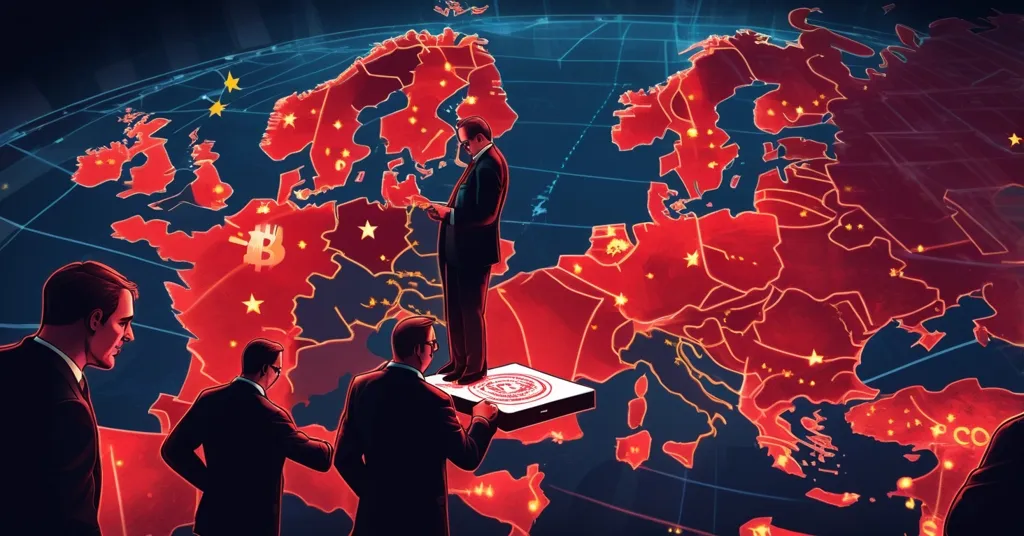
The European Commission has proposed its 21st sanctions package, naming 20 non-EU entities, including banks, oil traders, and crypto platforms. The big shift is not just more names on a blacklist, but a more aggressive approach: the EU may be able to ban crypto services from entire non-EU jurisdictions if those jurisdictions are hosting platforms that help sanctioned Russian actors move money around.
That is a serious escalation. Instead of chasing one exchange, one shell company, or one wallet cluster at a time, Brussels is considering a broader hit on the infrastructure that makes sanctions evasion easier. It is the regulatory equivalent of saying, “If you keep letting crooks use your house, don’t be shocked when we start boarding up the neighborhood.”
European Commission President Ursula von der Leyen made the intention plain.
“It will act as a strong deterrent for the countries hosting platforms that help Russia evade our sanctions,” she said.
“Our sanctions keep biting hard and cutting deep; they are weakening the economic foundations of Russia’s war effort.”
Sanctions are government restrictions designed to limit access to banking, payments, trade, assets, and other financial channels. They are meant to pressure a state or specific actors without direct military force. Since Russia’s invasion of Ukraine, Western governments have been trying to squeeze Moscow’s access to capital and cross-border payments. Crypto has naturally come under scrutiny because it can move value across borders without relying on the traditional banking system.
That does not mean every blockchain transaction is some covert Kremlin scheme. Let’s not turn every wallet into a spy novel. But it does mean that bad actors can exploit the same rails honest users rely on, especially when exchanges are weak on compliance or operate in gray legal zones.
Why the EU is targeting crypto services
The logic behind the EU’s move is straightforward: if sanctioned Russian entities can still move money through foreign crypto platforms, then the sanctions regime has a leak. The European Commission wants to close that leak by targeting the services, providers, and jurisdictions that are allegedly making it possible.
That matters because crypto can be used to move value outside normal banking rails, where governments, banks, and payment processors can more easily block transfers. Stablecoins in particular are useful for this kind of workaround because they are designed to hold a steady value and can be transferred quickly across borders.
This is where the A7A5 stablecoin comes into the picture. Chainalysis reported $154 billion in illicit cryptocurrency address inflows in 2025, a figure that refers to funds entering wallet addresses linked to criminal or sanctioned activity. The firm also flagged $93.3 billion in transaction volume tied to A7A5, a ruble-backed stablecoin described as being linked to Russia-related activity.
A ruble-backed stablecoin is exactly what it sounds like: a token tied to the Russian currency, which can make it easier to move value while staying anchored to a fiat reference point. In plain English, it is a digital wrapper that can be used to shuttle money around without going through the same channels that sanctions are meant to choke off.
Elliptic previously identified five crypto exchanges it said were being used to bypass sanctions. The UK later sanctioned Huobi Global S.A. in May over alleged links to the Russia-connected A7 network, with HTX also drawn into the broader discussion through that connection. The details matter here, because these cases show regulators are not just barking at “crypto” in general; they are focusing on specific platforms and networks that appear to be doing dirty work.
That is the crucial distinction. Crypto itself is not the villain. Bad operators, weak controls, and obvious laundering-friendly setups are. Still, when enough shady platforms cluster around sanctioned activity, regulators start treating the whole zone like a contamination risk.
Why a country-level ban matters
A country-level ban is much harsher than punishing one exchange. If the EU uses this power, it could restrict crypto services from an entire non-EU jurisdiction if that jurisdiction is seen as hosting platforms that help evade sanctions. That is a blunt tool, but blunt tools are exactly what governments reach for when narrower measures keep getting gamed.
For exchanges and service providers, that raises the stakes fast. Compliance will no longer be a box-ticking exercise with a few half-hearted checks and a shiny logo on the homepage. Jurisdictional risk is now part of the game. If a platform is in the wrong place, with the wrong relationships, it could become collateral damage even if not every user on it is a bad actor.
That is where the criticism comes in. Broad restrictions can catch genuine abuse, but they can also hit legitimate businesses and users who are not laundering money for sanctioned states. Governments love sweeping tools because they look decisive. Sometimes they are effective. Sometimes they are just a bureaucratic sledgehammer with a fancy press release.
Russia is not waiting around
Russia, unsurprisingly, appears to be building a domestic answer. Reports say Moscow is preparing a crypto regulatory framework expected in July, including licensed trading platforms. That suggests the Kremlin wants more activity kept inside a controlled national system rather than leaving it dependent on foreign services.
That could mean more oversight, more visibility, and less reliance on offshore platforms. Or it could mean a state-managed lane for digital asset movement with a nice legal sticker on top. Licensed exchanges do not automatically equal clean markets. Sometimes they just make the laundering look more official.
This is the classic sanctions cat-and-mouse game. Close one route, another opens. Block the banking system, and people turn to stablecoins, shell entities, offshore platforms, or trade-based workarounds. Governments can make evasion harder, but they rarely eliminate it entirely. They redirect it.
Crypto under pressure, but not the root problem
The broader point is worth keeping in view: crypto is being used as a pressure point because it is fast, borderless, and difficult to police when platforms do not take compliance seriously. But it is not the only channel for sanctions evasion. Bad actors have always used banks, commodity trades, intermediaries, front companies, and shipping routes to move value around. Crypto just gives them another tool.
That also means the solution is not “ban the whole industry and call it a day.” That kind of lazy thinking is exactly how you end up with policy that punishes legitimate users while the real sharks slip out through another crack in the wall.
The EU’s broader package also hits Russia’s energy and trade sectors, including oil vessels and fisheries. That is not a side note. It shows the sanctions regime is widening to cover every practical route that could help Moscow keep resources flowing. Crypto is just one piece of a much larger financial chokehold.
From a Bitcoin and decentralization standpoint, the tension is obvious. Permissionless networks are powerful because they are hard to censor and hard to shut down. That is the whole point. But the same properties that protect ordinary users also make these systems attractive to sanctioned actors, black-market operators, and every other flavor of financial grifter. Freedom is messy. Finance is messier.
And that is why regulators keep circling crypto. Not because the technology is inherently evil, but because it removes friction. Sometimes friction is annoying bureaucracy. Sometimes friction is the only thing stopping a sanctions-busting operation from moving millions across borders at warp speed.
The new EU approach suggests one thing clearly: enforcement is getting more serious, and exchanges operating in risky jurisdictions are going to feel the heat. The days of pretending compliance is optional are over. Anyone still running a platform like it is 2017 and the rules are just decorative is asking for a very expensive wake-up call.
- What is the EU trying to do?
It wants to tighten sanctions enforcement by cutting off crypto services that help sanctioned Russian actors move funds. - Why is crypto under scrutiny?
Because it can move value outside the traditional banking system, which makes sanctions harder to enforce when platforms are weak on compliance. - What is A7A5?
A7A5 is a ruble-backed stablecoin tied to Russia-related transaction activity and now under heavy scrutiny from blockchain analysts. - Why does a country-level ban matter?
It could block crypto services from an entire non-EU jurisdiction, not just one exchange, making the policy much broader and more disruptive. - Is this only about Russia?
No. The same enforcement logic is showing up elsewhere too, including U.S. action against Iranian crypto exchanges. - What is Russia doing in response?
It is reportedly preparing a domestic crypto framework with licensed trading platforms to keep more activity inside a controlled system. - Does this mean all crypto is for sanctions evasion?
No. Most crypto use is not illicit, but bad actors can exploit the same tools, especially where compliance is weak or nonexistent.
The likely outcome is more pressure on foreign exchanges, more scrutiny of stablecoins, and more suspicion aimed at jurisdictions that let sanctioned actors slip through the cracks. Whether this actually stops evasion or just pushes it deeper underground is the million-dollar question — and probably a few billion-dollar one, given the sums flowing through these networks.
Either way, the message from Brussels is blunt: if your platform helps sanctioned money move, the EU may decide your entire jurisdiction is part of the problem.