Michael Saylor’s Bitcoin Bet: Could XRP Diversification Be on the Horizon?
 LTB
LTB Michael Saylor’s Bitcoin Strategy: Could XRP Diversification Ever Happen?
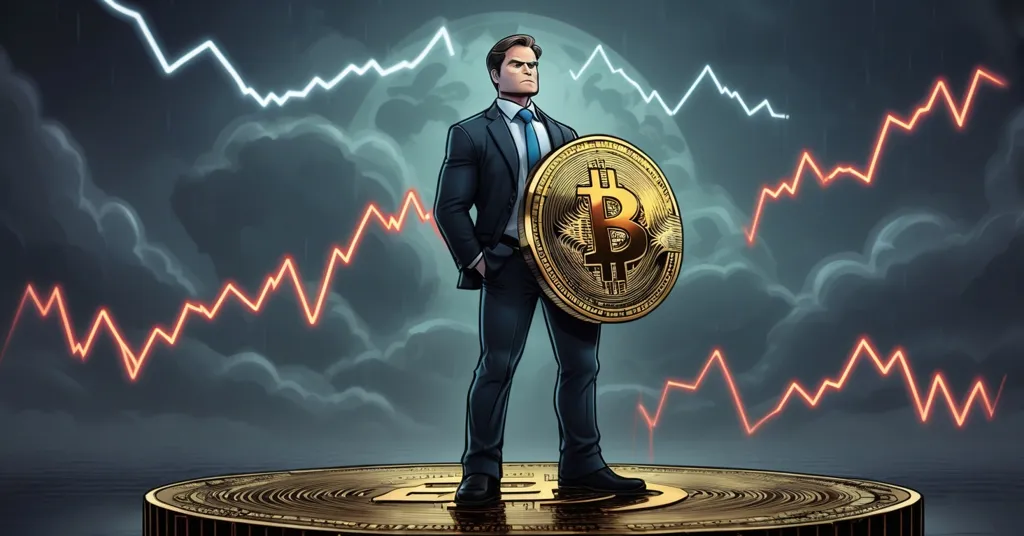
Michael Saylor, the unrelenting Bitcoin advocate and executive chairman of MicroStrategy, has built a legacy as the face of corporate Bitcoin adoption. Yet, a recent interview pressing him on the risks of a prolonged Bitcoin downturn has ignited a heated debate: could even this staunch maximalist ever consider diversifying into something like XRP, a cryptocurrency focused on payment efficiency, if the market turns brutal?
- Central Debate: Is Michael Saylor, a diehard Bitcoin supporter, open to adding XRP or other cryptocurrencies to MicroStrategy’s portfolio?
- Market Shift: Institutional investors are increasingly hedging risks by spreading capital across various blockchain networks for volatility protection and unique use cases.
- Saylor’s Position: No evidence exists that Saylor or MicroStrategy plans to stray from their Bitcoin-only strategy at this time.
Saylor’s Bitcoin Legacy: A Fortress of Conviction
Michael Saylor isn’t just a Bitcoin enthusiast—he’s the poster child for corporate belief in cryptocurrency as the future of money. Since 2020, under his leadership, MicroStrategy has amassed one of the largest Bitcoin reserves held by any publicly traded company, reportedly holding around 214,400 BTC as of late 2023, valued at billions depending on market swings. Saylor often describes Bitcoin as “digital gold,” a superior treasury asset to fiat currency or traditional investments, acting as a hedge against inflation and a store of value in turbulent times. His rhetoric has been a rallying cry for Bitcoin maximalism, the belief that Bitcoin is the only cryptocurrency worth serious consideration, dismissing most altcoins as distractions or outright scams.
But Saylor’s strategy isn’t just ideological—it’s financial. MicroStrategy has leveraged debt to acquire more Bitcoin, borrowing funds to amplify their holdings. This means they’re not just betting on Bitcoin’s rise; they’ve doubled down with loans that could magnify gains or losses depending on price movements. If Bitcoin soars, they’re geniuses. If it tanks, their balance sheet could take a serious hit. This high-stakes gamble has made Saylor a hero to Bitcoin purists but also a lightning rod for criticism from those who see it as reckless in a market known for vicious volatility.
The Crack in the Armor: A Rare Moment of Doubt
The speculation about Saylor potentially diversifying didn’t come from nowhere. During a recent interview, he was grilled on a nightmare scenario: what if Bitcoin enters a prolonged bear market, dropping to levels that threaten MicroStrategy’s financial stability? For a man who’s spent years preaching Bitcoin’s inevitable triumph, this wasn’t the usual softball question about adoption or price predictions. While Saylor stood firm, expressing confidence that Bitcoin wouldn’t collapse to extreme lows, the very act of addressing such a dire hypothetical raised eyebrows. He didn’t flinch, but the crypto community started buzzing anyway. If the market turns into a bloodbath, could even Saylor be forced to rethink his all-in approach?
Let’s be upfront—there’s no hint, no whisper, no leaked memo suggesting Saylor or MicroStrategy is eyeing a pivot away from Bitcoin. His public stance remains rock-solid: Bitcoin is the ultimate long-term bet. Yet, the question itself reflects a broader tension in the crypto space. The market isn’t static, and neither are the strategies of big players. Institutional investors—hedge funds, corporations, and family offices—aren’t just stacking Bitcoin anymore. They’re looking at the full spectrum of blockchain networks to manage risk and capture different opportunities. And that’s where assets like XRP come into the picture, offering something Bitcoin was never designed to do.
XRP’s Niche: Speed and Utility Over Store of Value
For those new to the space, XRP isn’t just another altcoin—it’s a cryptocurrency with a specific purpose, tied to Ripple, a company focused on revolutionizing global payments. Unlike Bitcoin, which uses a proof-of-work system where miners solve complex math puzzles to validate transactions (a secure but slow and energy-intensive process), XRP operates on the XRP Ledger, a faster, less resource-heavy mechanism. Transactions settle in mere seconds, compared to Bitcoin’s average of 10 minutes or more, and cost just a fraction of a penny. This makes XRP a darling for cross-border payments and settlements, areas where Bitcoin’s clunky speed and higher fees make it less practical.
Ripple has actively courted traditional financial institutions, forging partnerships with entities like Santander and MoneyGram to facilitate remittances and interbank transfers. The appeal is obvious: in a world where moving money across borders can still take days and incur hefty fees, XRP offers a near-instant, dirt-cheap alternative. However, it’s not without baggage. Ripple holds a significant chunk of XRP’s total supply, raising concerns about centralization among decentralization purists. Plus, an ongoing legal battle with the U.S. Securities and Exchange Commission (SEC), which claims XRP is a security like a stock (subject to strict regulations) rather than a currency like Bitcoin, adds a layer of uncertainty. Ripple disputes this, but the outcome could impact XRP’s future adoption.
Despite these hurdles, XRP fills a niche Bitcoin doesn’t touch. While Bitcoin is pitched as a decentralized store of value, XRP is a utility token built for real-world financial systems. For institutions looking to hedge against Bitcoin’s volatility or tap into practical blockchain use cases, XRP represents a stark contrast—a tool for efficiency rather than ideology.
Market Pressures: The Push for Crypto Diversification
The crypto landscape has matured since MicroStrategy’s headline-grabbing Bitcoin buys in 2020. Back then, Bitcoin dominated institutional interest, peaking at over 70% of the total crypto market cap. Today, its share hovers below 50%, with altcoins and other blockchain networks eating into that dominance. A 2023 Fidelity report noted that 58% of institutional investors now hold multiple cryptocurrencies, up from just 22% three years prior. The reasoning is straightforward: putting all your chips on one asset, even one as battle-tested as Bitcoin, is a gamble in a market where black swan events—think sudden regulatory bans or tech failures—happen with alarming regularity.
Diversification isn’t about abandoning Bitcoin; it’s about balancing risk. Assets like Ethereum offer smart contracts for decentralized apps, while XRP provides payment solutions. Spreading capital across these networks lets institutions weather Bitcoin-specific downturns while leveraging blockchain’s broader potential. This isn’t a betrayal of decentralization—it’s a pragmatic nod to the reality that no single chain can do everything. And frankly, let’s not sugarcoat it: betting everything on Bitcoin in a market this wild is either visionary or downright foolish. Saylor’s banking on the former, but not everyone shares his ironclad resolve.
This trend raises a deeper question for Bitcoin maximalists. As institutional adoption grows, will sticking to a single-asset strategy remain viable, or will diversification become the default? Saylor’s influence has inspired other corporations to dip into Bitcoin, but if peers start hedging with altcoins while he holds the line, could MicroStrategy’s position start looking like stubbornness rather than strength? His decisions don’t just affect his company—they shape market confidence in Bitcoin as a corporate treasury asset.
Will Saylor Bend? The Case For and Against Diversification
On one hand, the case for Saylor diversifying is rooted in cold, hard pragmatism. A brutal Bitcoin crash—say, a drop below $10,000 sustained for months—could strain MicroStrategy’s finances, especially given their debt-fueled buying spree. Adding a utility asset like XRP, even as a small hedge, could provide operational flexibility, especially if payment efficiencies become a corporate need. Market maturity also suggests that holding a mix of assets with different strengths isn’t just cautious—it’s smart. If other institutions normalize diversified crypto portfolios, Saylor risks looking out of touch by clinging to a purist stance.
On the flip side, Saylor’s entire brand is Bitcoin. To diversify, even marginally, could be seen as a crack in his conviction, signaling to the market that even the biggest bulls are wavering. His strategy has weathered massive downturns before—Bitcoin’s 2018 crash to $3,000 didn’t deter him, and post-2021 drops were treated as buying opportunities, not panic signals. Doubling down during a crash might be the bolder play, reinforcing Bitcoin’s resilience and his own credibility. Plus, regulatory uncertainty around XRP, with the SEC case unresolved, makes it a risky bet for a company already navigating scrutiny over its Bitcoin hoard. And let’s not forget the financial tangle—swapping BTC for anything else could complicate their leveraged positions, triggering PR and investor backlash. For more insight into this ongoing debate, check out this discussion on whether Michael Saylor might ever consider XRP over Bitcoin.
Stepping back, this debate isn’t just about Saylor—it mirrors a historic tension in crypto between ideological purity and practical adaptation. Early Bitcoiners fought tooth and nail against altcoins in 2017, only to see Ethereum and others carve out real value. Today, with institutional stakes higher than ever, the pressure to adapt is even stronger. Saylor might stay the course, but the market won’t wait for him. If anything, this push for diversification could accelerate blockchain adoption overall, aligning with the idea of effective accelerationism—market forces driving faster, broader tech integration, even if it means challenging Bitcoin’s throne.
A Nod to Decentralization: Maximalism vs. Ecosystem Growth
As champions of decentralization, privacy, and disrupting the status quo, we see Saylor’s maximalism as a powerful stand for Bitcoin’s core ethos—a system free from centralized control, a middle finger to traditional finance. Yet, over-reliance on one asset risks undermining the broader vision of a diverse, resilient crypto ecosystem. Bitcoin is king, no doubt, but other networks like XRP or Ethereum aren’t just competitors; they’re pieces of a larger puzzle. A future where institutions—and individuals—balance Bitcoin’s strength with complementary tools might be messier, but it’s also more robust. Saylor may never budge, but the conversation itself is a reminder that decentralization isn’t about one chain ruling all—it’s about freedom to choose.
Key Questions and Takeaways on Saylor, Bitcoin, and XRP
- Why is there talk of Michael Saylor diversifying into XRP?
A recent interview where Saylor tackled questions about MicroStrategy’s strategy in a severe Bitcoin downturn sparked speculation about whether even a maximalist might consider other assets for risk management. - Is there any indication Saylor will move away from Bitcoin?
None whatsoever—Saylor and MicroStrategy show no signs of reducing Bitcoin holdings or exploring alternatives like XRP at this moment. - What’s behind the institutional shift to crypto diversification?
Institutions are investing across blockchain networks to offset Bitcoin’s volatility, leveraging unique strengths like XRP’s fast payments or Ethereum’s smart contracts for a balanced portfolio. - Could Bitcoin maximalism evolve into a more diversified approach?
While Saylor seems unlikely to shift soon, increasing market maturity suggests diversification might become a standard tactic, even for Bitcoin’s fiercest advocates, as a hedge against uncertainty. - How does XRP stand apart from Bitcoin for institutional appeal?
XRP focuses on speed and low-cost transactions for cross-border payments, attracting banks and financial platforms, while Bitcoin prioritizes decentralized value storage over utility. - Should individual investors follow Saylor’s Bitcoin focus or diversify like institutions?
It depends on risk tolerance—mimicking Saylor means betting big on Bitcoin’s long-term dominance, while diversification offers protection but dilutes ideological purity. Know your goals and the market’s unpredictability before deciding.
Michael Saylor’s Bitcoin bet is the stuff of legend, but legends face tests. Whether he ever entertains a side glance at XRP or any other cryptocurrency remains a long shot, closer to fantasy than forecast. Still, the mere fact we’re debating it shows how much the crypto space has grown—and how unforgiving its pressures can be. Bitcoin may wear the crown, but even kings must keep an eye on the horizon. In this game of innovation and uncertainty, adaptability isn’t just a strategy; it’s the key to staying relevant.