Poland Weighs Crypto Ban as Sejm Battles Over KNF Powers and MiCA Enforcement
 LTB
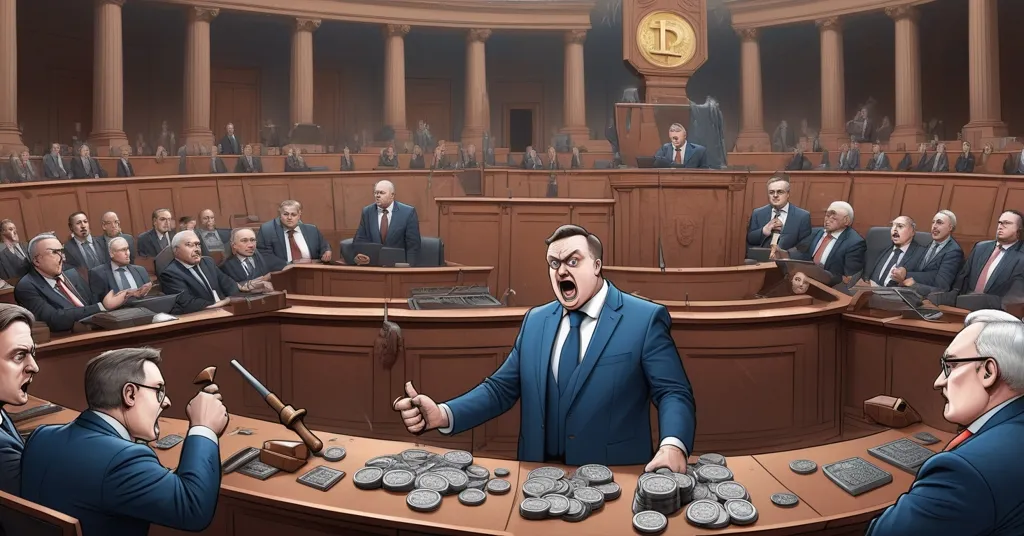
LTB Poland’s crypto regulation fight has turned into a messy showdown, with four rival bills, a fresh push for a total ban, and a debate over whether the country’s financial watchdog should be armed with serious enforcement teeth or a bureaucratic hammer.
- Four competing crypto bills are under review in Poland’s Sejm
- KNF powers over account freezes and fines are the main battleground
- PiS wants a full crypto ban, a rare move in the EU
- MiCA is already in force, so the fight is about enforcement, not legalization
- Zondacrypto and political financing questions are adding extra heat
Poland’s Sejm is reviewing four competing crypto bills at once, with a second reading vote expected Thursday. That would already be enough to make the process chaotic. Then the Law and Justice party, or PiS, threw in a separate proposal to ban all crypto-related activity in Poland outright. In a European Union where the Markets in Crypto-Assets regulation, better known as MiCA, is already live, this is not a question of whether crypto should be regulated. It is a fight over how hard Poland wants to crack down, and how much power to hand the Polish Financial Supervision Authority, KNF, to freeze accounts and punish firms with heavy fines.
The competing drafts come from the government, the presidential office, Poland 2050, and the Confederation party. That alone shows how fractured the political landscape is on crypto. President Karol Nawrocki has made things even messier by vetoing crypto-related legislation twice, forcing lawmakers back to square one and exposing just how deep the divide runs. When a law keeps getting vetoed, it usually means the issue is no longer about fine print. It is a straight-up political brawl with spreadsheets.
KNF is the heart of the dispute. For readers unfamiliar with it, KNF is Poland’s financial regulator, the body that would oversee compliance and enforcement under any national crypto framework. The real argument is not whether crypto firms should be supervised — MiCA already settled that across the EU — but whether KNF should have the power to freeze accounts and levy serious penalties if businesses step out of line.
That matters because enforcement power can cut both ways. In the best case, it helps shut down scams, forces exchanges to keep proper records, and gives the market more credibility. In the worst case, it becomes a blunt instrument that can be used to pressure firms, scare off builders, and make compliance feel like a tax on existing. Same tool, very different outcomes. Regulators always say they are only protecting consumers. Sometimes that is true. Sometimes it is just government with a bigger stick.
There is also a real difference in the proposed penalty levels. One draft linked to the presidential side sets maximum fines at 20 million zlotys, while the Ministry of Finance version raises that ceiling to 25 million zlotys. That works out to roughly $5.5 million versus $6.9 million. Those are not toy numbers. In a sector already full of bad actors, fake promises, and the occasional exchange that deserves to be thrown into the sun, the threat of meaningful penalties can be a good thing. But if enforcement gets sloppy, legitimate firms could end up paying for the sins of the clowns.
MiCA entered into full force across all 27 EU member states in December 2024, which is why Poland is not debating whether to regulate crypto under MiCA. That decision has already been made at the bloc level. Poland is deciding how aggressively to set national enforcement parameters. In plain English: MiCA is the floor, and Warsaw is arguing over how much steel to put in the walls.
For crypto businesses, that distinction is huge. Poland has one of the largest retail crypto user bases in Central and Eastern Europe, so whatever happens in Warsaw will matter far beyond a single national market. Exchanges, custodians, payment firms, and token projects all need clarity. Investors need it too. Uncertainty does not just slow down innovation; it drives capital and talent somewhere else, often to jurisdictions that are either more sensible or more shamelessly lax.
Zondacrypto has become part of the political noise around the debate. It is one of Europe’s older and better-capitalized domestic exchanges, and it is operating under a MiCA transitional license. For readers who do not follow regulatory jargon closely, a transitional license is basically a temporary authorization that lets a company keep operating while it moves into full compliance with the new rules. That should, in theory, be a boring administrative detail. In practice, it becomes a flashpoint the second politicians start sniffing around industry money.
That is where Speaker of the Sejm Włodzimierz Czarzasty comes in. He confirmed the review process and raised questions about whether crypto-related political financing may have influenced the debate, including references to Zondacrypto. If that sounds uncomfortable, good. It should. Crypto has spent years battling a reputation problem because too many politicians, grifters, and venture tourists have treated it like a quick buck or a convenient villain. Any hint of political money sloshing around a regulatory process deserves scrutiny, not a shrug.
PiS’s ban proposal is the most aggressive move on the table, and it stands out for a simple reason: it is the only outright ban proposal among major EU member states in this context. That makes it politically dramatic, but also legally and practically hard to defend in a MiCA-era Europe. A blanket ban would put Poland at odds with the broader EU framework and almost certainly trigger serious pushback. It is the kind of move that sounds tough in a press release and absurd once someone starts asking what happens to existing users, licensed firms, custody providers, and tax revenue.
There is a legitimate argument for stricter supervision. Crypto is not some sacred digital temple. It is a financial system with plenty of fraud, leverage, and opportunists trying to make a fast exit with other people’s money. Clean rules, real enforcement, and clear licensing standards can help separate builders from parasites. But there is a line between serious regulation and reflexive hostility. Poland is skating right along that line, and the ban proposal by PiS looks less like a policy solution than a political grenade.
The country’s current mess also highlights a broader European reality: MiCA may harmonize the baseline, but national politics still decide how painful compliance becomes. One government can use MiCA to build a credible market. Another can turn enforcement into a cudgel and pretend it is consumer protection. That is why Poland matters. It is not just about one country’s internal drama. It is a test case for whether EU crypto regulation can produce a workable market, or whether local politics will keep turning the screws in wildly different directions.
Key questions and takeaways
What is Poland deciding right now?
Poland is deciding how to implement and enforce MiCA nationally, especially how much power to give KNF over account freezes and fines.
Why does the PiS ban proposal matter?
Because it is an outright ban on crypto-related activity in a country already covered by EU-wide MiCA rules, making it one of the most extreme proposals on the table.
What is KNF?
KNF is Poland’s financial regulator, the body that would oversee compliance and enforcement for crypto firms under the proposed rules.
What is the main fight over KNF?
Lawmakers are split over whether KNF should be able to freeze accounts and impose heavy fines on crypto companies that violate the rules.
How big are the proposed fines?
One draft sets maximum fines at 20 million zlotys, while another raises the ceiling to 25 million zlotys.
Does MiCA already apply in Poland?
Yes. MiCA is already in full force across the EU, including Poland. The debate is about domestic enforcement, not whether MiCA exists.
Why should crypto users outside Poland care?
Poland has one of the largest retail crypto markets in Central and Eastern Europe, so the outcome could affect exchanges, compliance standards, and regional business activity.
Why is Zondacrypto being mentioned?
Because it is one of Europe’s older and better-capitalized domestic exchanges, operates under a MiCA transitional license, and has become part of questions around possible political financing.
Could a full crypto ban actually happen?
It would face major legal and political obstacles, especially because MiCA already sets the EU-wide framework. It is more likely to fuel political theater than become practical policy.
Poland’s crypto debate is no longer about whether digital assets belong in the legal system. They already do. The real question is whether lawmakers want to build a credible market with sensible oversight or keep swinging a regulatory sledgehammer and calling it leadership. MiCA set the floor. Warsaw is deciding whether to build something useful on top of it or just pile on more chaos.