Poland’s Crypto Market Act Delayed: Senate Halts Bill Amid Innovation Fears
 LTB
LTB Polish Parliament Halts Crypto Market Act Amid Fierce Backlash and Innovation Concerns
Poland’s contentious journey toward regulating its cryptocurrency market has hit a significant roadblock, with the Senate postponing discussions on the Crypto-Asset Market Act until January. This delay follows a controversial revival of the bill by the Sejm, the lower house of parliament, despite a presidential veto and intense criticism from the local crypto community, who fear overregulation could strangle blockchain innovation and drive startups out of the country.
- Legislative Stalemate: Sejm pushes through near-identical bill after veto, but Senate delays until January.
- Presidential Resistance: President Nawrocki stands firm, warning of threats to freedom and market growth.
- Community Outrage: Polish crypto advocates decry bill as a death knell for startups and decentralization.
Setting the Stage: Poland’s Crypto Ambitions Under Threat
Poland has been carving out a niche as an emerging hub for blockchain technology in Eastern Europe, with a burgeoning community of developers and startups drawn to its tech-friendly reputation. Bitcoin adoption, though not yet mainstream, is gaining traction among younger Poles hungry for financial alternatives outside the traditional banking system. However, the Crypto-Asset Market Act, introduced in June 2023, has cast a dark shadow over this progress. Intended to align with the European Union’s Markets in Crypto-Assets (MiCA) framework—a set of regulations designed to standardize crypto oversight across member states for consumer protection and market stability—Poland’s version has sparked a firestorm for going far beyond what many deem necessary, as detailed in recent reports about the controversial revival of the crypto market act in Poland.
Presidential Veto: A Stand for Freedom
On December 1, President Karol Nawrocki made a decisive move by vetoing the initial draft of the bill. His rationale cut to the core of what many in the crypto space hold dear, arguing that the legislation posed significant dangers to individual liberties and economic progress.
“The legislation could pose a real threat to the freedoms of Poles, the stability of the state, and market innovation,” Nawrocki stated.
In Poland’s legislative system, a presidential veto requires a three-fifths majority in the Sejm to override, a threshold that lawmakers failed to meet in an earlier attempt. Yet, showing a stubborn disregard for these concerns, the Sejm voted last Thursday to pass what’s essentially a carbon copy of the vetoed bill, referred to as “version 2.0.” The only notable amendment was a reduction in fees for crypto trading intermediaries—entities like exchanges or wallet providers that facilitate transactions—from 0.4% to 0.1% of transactions, paid to the Polish Financial Supervision Authority (KNF). This tweak, however, was made against government advice, as noted by Deputy Finance Minister Jurand Drop.
“Although the KNF’s projections indicate that these fees will not exceed 0.1%, and in the first year, they will not be collected at all, the question remains what will happen if this market grows and, as a result, the fees are forced to exceed 0.1%,” Drop cautioned.
Fee Fracas: Walking a Regulatory Tightrope
Let’s break down this fee debate with a simple analogy: imagine a small business paying a tax to operate. Set it too high, and they’re bankrupt before they can blink; set it too low, and the government can’t afford to police the streets. The KNF, Poland’s financial regulator, is tasked with overseeing markets to prevent scams and ensure stability, and these fees are meant to fund that mission. But in an emerging sector like crypto, striking the right balance is a bloody nightmare. Too harsh, and you kill off the small players driving decentralized finance (DeFi); too lenient, and you leave the door ajar for fraudsters—something no Bitcoin advocate wants. The government’s outright rejection of even this modest 0.1% rate reeks of internal disarray, a concern mirrored by the Senate Budget and Public Finance Committee, which opted to slam the brakes until January for a thorough reevaluation.
Fees are just the surface issue, though. Buried in the bill are provisions that far exceed MiCA’s baseline requirements. Think draconian Know Your Customer (KYC) and Anti-Money Laundering (AML) mandates that could saddle small firms with unbearable compliance costs, alongside licensing hurdles that might block new entrants altogether. For a technology rooted in permissionless access and decentralization, this feels like a deliberate gut punch to the ethos of Bitcoin and blockchain.
Community Rage: A Betrayal of Innovation
The Polish crypto community has been in open revolt since September, and to put it bluntly, they’re livid. Their central argument is damning: the Crypto-Asset Market Act oversteps the EU’s MiCA standards by a mile, threatening to suffocate an industry built on freedom from oppressive control. Startups and small businesses—the beating heart of blockchain experimentation—could be forced to uproot and seek refuge in more welcoming jurisdictions like Estonia or Switzerland if these regulations become law. Poland, poised to be a leader in Eastern Europe’s tech renaissance, risks becoming a backwater if it drives away the very talent fueling its digital economy.
This isn’t idle whining. While hard numbers on Poland’s crypto market size are scarce, the potential impact is clear. Blockchain startups contribute to the broader tech sector, which employs thousands. Losing even a fraction of these innovators could deal a lasting blow to the nation’s economic ambitions—a direct contradiction to the “effective accelerationism” we champion, where technology should race forward to disrupt outdated systems, not be shackled by bureaucratic overreach.
Global Lens: Poland’s Struggle in Context
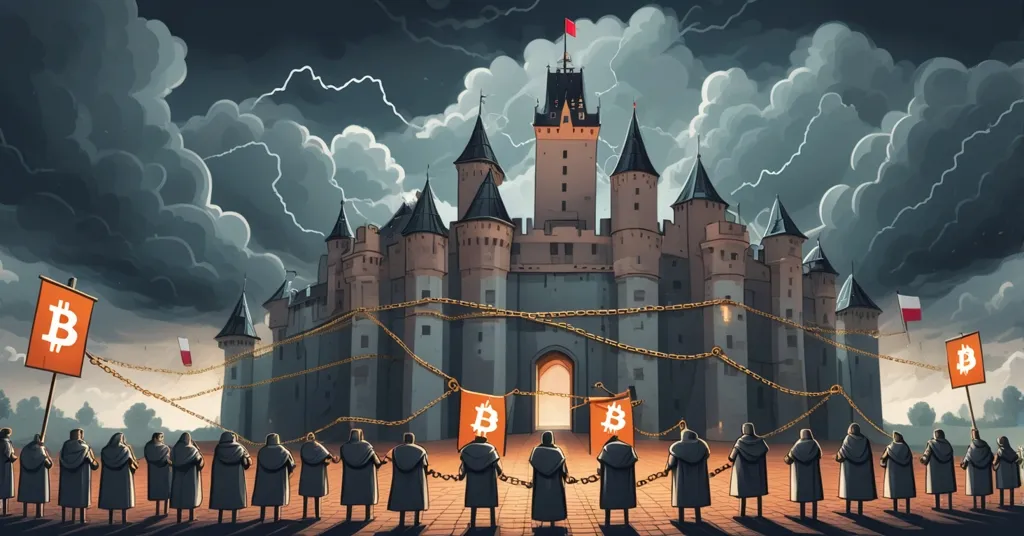
Poland’s regulatory drama isn’t happening in a vacuum; it mirrors a worldwide clash over how to handle cryptocurrencies. From Russia’s heavy-handed crackdowns to the UK’s tentative steps toward oversight, nations are wrestling with how to rein in the wild west of digital assets without slaughtering the innovation that makes it valuable. The EU’s MiCA framework seeks a middle ground, but implementation varies wildly. Germany, for instance, has embraced MiCA while offering incentives to nurture blockchain startups, positioning itself as a leader. Poland, by contrast, seems hell-bent on building a fortress of restrictions, raising the question: will it lead the charge for decentralized finance in Eastern Europe, or will it fall behind, mired in its own tone-deaf policies?
Let’s play devil’s advocate for a second. Some regulation is undeniably needed—scammers, rug pulls, and fraud have no place in this space, and protecting users is critical. If a major crypto con were to hit Poland tomorrow, lawmakers could claim vindication for tightening the screws. But here’s the counterpunch: there’s a vast difference between targeting bad actors and smothering an entire industry. This bill doesn’t just aim to curb fraud; it threatens to outlaw innovation by default, spitting in the face of Bitcoin’s founding principles of financial sovereignty and decentralization.
The Stakes: Freedom vs. Control in the Blockchain Era
This fight transcends a single piece of legislation; it’s about Poland’s identity in the age of blockchain. Bitcoin and cryptocurrencies were forged to upend centralized power, to hand control back to individuals through trustless, decentralized systems. If Polish lawmakers aren’t careful, they’ll sabotage that revolutionary potential. Yes, oversight has its place—we’re all for hunting down scammers and ensuring the space isn’t a cesspool of fraud. But there’s a fine line between safeguarding and strangling, and Poland is flirting dangerously with the latter.
The Senate’s January debate looms as a make-or-break moment. Will it inject some goddamn sense into this fiasco, or are we on the cusp of chronicling the great Polish crypto exodus? As staunch defenders of decentralization and financial freedom, we’re holding out hope for a resolution that nurtures Bitcoin and blockchain growth without letting crooks run wild. But let’s not delude ourselves—this is a brutal, messy brawl, and the outcome is anyone’s guess. Poland’s crypto destiny is on the line: will it seize the decentralized future, or crumble under the weight of bureaucratic control?
Key Questions and Takeaways on Poland’s Crypto Regulation Crisis
- What is the Crypto-Asset Market Act, and why is it sparking such controversy in Poland?
It’s a proposed law from June 2023 to regulate Poland’s crypto market under the EU’s MiCA framework, but it’s ignited fury for overreaching with rules that could cripple blockchain innovation and push startups abroad, as underscored by President Nawrocki’s veto. - Why did President Nawrocki veto the bill, and how did the Sejm respond?
Nawrocki rejected it on December 1, citing risks to personal freedoms, state stability, and market progress. The Sejm defied this by passing a near-identical version last week, though an earlier veto override failed for lack of a three-fifths majority. - What caused the Senate to push discussions to January?
Pushback from Deputy Finance Minister Jurand Drop over trivial amendments, a contested fee cut from 0.4% to 0.1%, and government-wide dissent led the Senate Budget and Public Finance Committee to delay for closer examination. - How does Poland’s crypto community view this proposed law?
They’ve been fiercely against it since September, arguing it goes beyond MiCA with oppressive KYC/AML and licensing demands, potentially forcing small firms and startups to flee to crypto-friendly regions. - What might the fee reduction mean for crypto intermediaries in Poland?
Dropping to 0.1% could briefly lighten the load for businesses enabling crypto trades, but as Drop warned, market expansion might drive fees up later, sowing uncertainty and financial pressure in the sector. - How does Poland’s regulatory stance stack up against other EU nations under MiCA?
Unlike blockchain-welcoming countries like Germany, which pair MiCA with startup support, Poland’s harsh approach risks making it an outlier, potentially sidelining its role in the EU’s decentralized finance movement. - What’s the bigger picture for Bitcoin and blockchain innovation?
Excessive regulation could derail Poland’s status as a rising crypto hub, pushing talent elsewhere and clashing with Bitcoin’s core of decentralization, while insufficient rules risk fraud—finding equilibrium is paramount.