Pro-Bitcoin Bill Pulte Named Acting Intel Chief While Keeping FHFA Post
 LTB
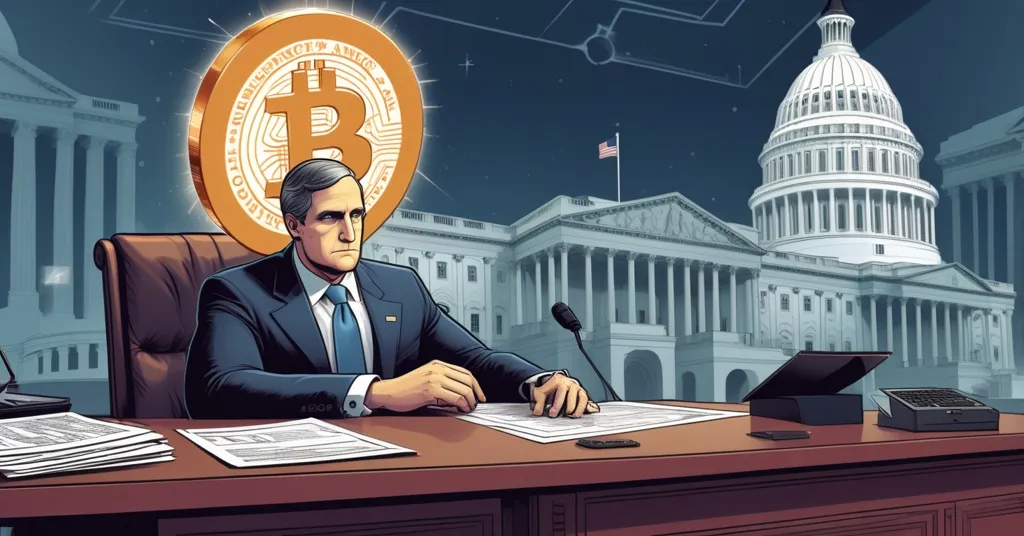
LTB Bill Pulte has been named acting director of national intelligence while keeping his grip on the Federal Housing Finance Agency, adding a loud pro-Bitcoin conservative to one of Washington’s most powerful lanes.
- Bill Pulte becomes acting director of national intelligence
- Tulsi Gabbard exits on June 30
- Trump says Pulte keeps FHFA, Fannie Mae, and Freddie Mac duties
- Pro-Bitcoin conservative with a combative political record
- Bitcoin adoption keeps moving deeper into U.S. power circles
Pulte, who currently leads the Federal Housing Finance Agency (FHFA), is set to replace Tulsi Gabbard as acting director of national intelligence on June 30. According to Donald Trump’s announcement, Pulte will retain his other roles, including continued leadership of the FHFA and chairmanship of Fannie Mae and Freddie Mac. That is a lot of authority for one person, even by Washington standards, where oversized egos and oversized portfolios are practically a government program.
For readers less steeped in the alphabet soup of federal institutions: the FHFA oversees major housing finance entities that sit at the center of the U.S. mortgage market. Fannie Mae and Freddie Mac are government-backed entities that help keep home loans flowing by buying and guaranteeing mortgages. In plain English, Pulte now has influence over both housing finance and national intelligence. That overlap is unusual enough to raise eyebrows before you even get to his politics.
Pulte is not a bland technocrat quietly filling out forms in a beige office. He is the heir to a major real estate empire, made a name for himself through social media philanthropy, and has built a reputation as a combative political operator. He pushed mortgage fraud accusations against New York Attorney General Letitia James and Senator Adam Schiff, but both efforts went nowhere. He also called for Federal Reserve Chair Jerome Powell to be removed and even showed Trump a mock “wanted poster” of Powell. Subtlety, apparently, was not invited to the meeting.
Supporters may see that style as fearless, aggressive, and effective. Critics will call it performative, partisan, and reckless. Both interpretations can be true at once. That is the ugly little magic trick of modern politics: a person can be promoted as a disruptor while also acting like a one-man feed of public drama.
The Bitcoin angle is what makes this appointment especially notable for crypto watchers. Pulte has publicly supported Bitcoin since at least 2020 and has positioned himself as an early believer in its mainstream legitimacy. He said:
“Wall Street has started to pick up the wisdom of Bitcoin.”
He also told his 3 million followers to:
“keep an eye”
on Bitcoin.
That is not exactly the language of a casual bystander. Pulte has also argued that Bitcoin can help unbanked populations — people who do not have access to traditional banking services — gain financial access. That point matters. Bitcoin’s strongest real-world case has never been “number go up,” despite the endless parade of chart goblins pretending every candle is destiny. The serious case is financial freedom, self-custody, and permissionless access to money for people the legacy system ignores or excludes.
He has even put some cash behind the message. Pulte previously gave money to Cash App users to encourage them to
“stack some sats”
— crypto slang for accumulating small amounts of Bitcoin over time. For the uninitiated, “sats” are satoshis, the smallest unit of Bitcoin. One bitcoin equals 100 million satoshis. So “stack some sats” simply means buy a little BTC when you can and keep adding to the pile. Simple, direct, and a lot less stupid than most of the fake “expert” price predictions clogging the internet.
The larger significance is not that Pulte likes Bitcoin. Plenty of people like Bitcoin. What matters is that a openly pro-Bitcoin conservative is now sitting even closer to the machinery of the U.S. state, while already holding major influence over housing finance. That is another sign that Bitcoin is no longer a fringe political curiosity. It is being absorbed into the mainstream, sometimes by people who understand it, and sometimes by people who just smell relevance and sprint toward the orange glow.
There is a real upside to that normalization. When major officials acknowledge Bitcoin, they are acknowledging a monetary technology that is censorship-resistant, borderless, and increasingly difficult to dismiss. Wall Street has already started doing the homework. Governments are slower, messier, and usually more self-serving, but the direction of travel is hard to ignore.
Still, there is a downside to celebrate carefully. A pro-Bitcoin label does not automatically make someone a hero for decentralization. Bitcoin was built to reduce dependence on gatekeepers, not to hand more influence to politically connected operators with a flair for public combat. If Bitcoin becomes a tool for the establishment to polish its image while keeping the same old power structures intact, that is not victory. That is branding with a block reward.
Pulte’s rise also highlights a broader tension in crypto politics: adoption versus capture. Bitcoin adoption is good. More mainstream recognition is good. But institutional embrace can become a trap if it turns into co-optation, where the system loves Bitcoin only when it can control the narrative, tax the gains, and sanitize the edges. The same people who sneered at Bitcoin yesterday will happily sell commemorative merch tomorrow if it helps them look visionary.
That is why the details around Pulte matter beyond the headline. He is not just a Bitcoin supporter. He is a political heavyweight with influence over housing finance and now national intelligence, making him one of the more unusual crypto-adjacent figures to rise in the Trump administration. Whether that ends up helping Bitcoin’s legitimacy or just adding more theater to Washington’s endless circus depends on what he does next.
- Who is Bill Pulte?
He is the current head of the FHFA and now acting director of national intelligence, with a background in real estate, social media philanthropy, and public Bitcoin support. - Why does his appointment matter?
Because he holds major influence over U.S. housing finance while also stepping into a top intelligence role, which is an unusually broad concentration of power. - What is Pulte’s connection to Bitcoin?
He has backed Bitcoin publicly for years, praised its rising legitimacy, and said it can help unbanked people access financial services. - Did Pulte push any major political claims?
Yes. He pushed mortgage fraud accusations against Letitia James and Adam Schiff, though both efforts failed. - What does “stack some sats” mean?
It means buying and accumulating small amounts of Bitcoin over time, with “sats” referring to satoshis, the smallest unit of BTC. - Does this mean the U.S. government is now pro-Bitcoin?
Not as a whole. It does show that Bitcoin-friendly voices are moving closer to power, but Washington still runs on politics, ego, and institutional self-interest.
Bitcoin is winning the argument in more rooms than it used to. The question is whether the people walking into those rooms are there to understand freedom, or just to wear it like a lapel pin.