Ripple-Deutsche Bank Deal, Bitcoin Whales Bet $2B, Logan Paul Slammed in Crypto News
 LTB
LTB Crypto News Weekly: Ripple-Deutsche Bank Breakthrough, Bitcoin Whales’ $2B Bet, Logan Paul Drama
Another explosive week in the crypto sphere brings a blend of institutional milestones, market muscle-flexing, and eyebrow-raising controversies. From Ripple’s landmark deal with Deutsche Bank to Bitcoin whales snapping up billions in BTC amid a price slump, and Ripple’s own David Schwartz taking a swing at Logan Paul, there’s plenty to dissect. Add in Bitcoin’s shifting valuation against gold and Shiba Inu’s quiet lull, and you’ve got a snapshot of an industry pushing boundaries while wrestling with its demons.
- Ripple and Deutsche Bank Team Up: A major blockchain adoption move for cross-border payments, targeting 30% cost cuts.
- Bitcoin Whales Stack $2B: Over 30,000 BTC accumulated despite market dips, hinting at bullish confidence.
- Logan Paul Under Fire: Ripple CTO David Schwartz slams a $16.49M Pokémon card sale for unfair investor splits.
- Bitcoin Breaks Gold Trend: A 12-year valuation pattern snaps as quantum tech risks loom.
- Shiba Inu Hits Pause: SHIB enters low-volatility consolidation amid cautious market vibes.
Ripple and Deutsche Bank: Blockchain’s Big Break in Finance
Ripple has just clinched a game-changing partnership with Deutsche Bank, one of Europe’s financial heavyweights, to revolutionize cross-border payments using blockchain technology. For the uninitiated, cross-border payments are the slow, costly process of transferring money internationally—think days of waiting and hefty fees through intermediaries like SWIFT, the traditional global payment network. Ripple’s tech, powered by its XRP Ledger, promises near-instant settlements and slashes transaction costs by up to 30%. This isn’t just hype; it’s a concrete step toward dismantling inefficient financial gatekeepers and dragging legacy banking into the decentralized future we champion.
Deutsche Bank adopting Ripple’s infrastructure, as highlighted in recent reports like Ripple’s collaboration with major financial players, signals a growing trust in blockchain to tackle real-world inefficiencies. Imagine sending money to a relative overseas without losing a chunk to fees or waiting a week—that’s the potential here. This move aligns with a broader trend of institutional adoption, where major players in traditional finance are starting to see crypto tech as a viable solution rather than a speculative gamble. But let’s pump the brakes on the celebration. Execution at scale isn’t guaranteed—regulatory hurdles, technical glitches, or integration challenges could derail the best-laid plans. And here’s a devil’s advocate thought: could this partnership, while groundbreaking, risk tainting Ripple’s decentralized ethos by tying it too closely to centralized legacy finance? Are we disrupting the system, or just becoming its new pet project?
Bitcoin Whales Bet Big: $2B Accumulation Amid Market Slump
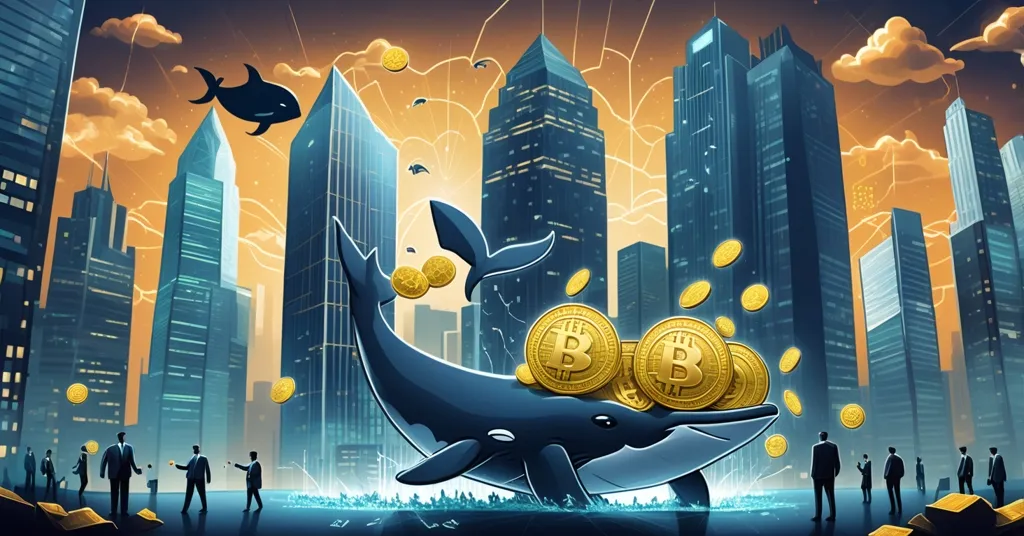
While institutions cozy up to blockchain, Bitcoin’s big players are making their own power moves. In just one week, Bitcoin whales—those deep-pocketed investors with the clout to sway markets—have scooped up over 30,000 BTC, valued at more than $2 billion at an average price of roughly $67,000 per coin. This buying frenzy, tracked by on-chain data platforms like Glassnode and CryptoQuant, comes despite Bitcoin trading over 50% below its all-time high, battered by macroeconomic fears, rising interest rates, and regulatory uncertainty.
For context, Bitcoin’s price volatility is nothing new; it’s a rollercoaster driven by everything from inflation scares to government crackdowns. Yet these whales, often seen “stacking sats” (a slang term for steadily accumulating Bitcoin), are unfazed. Their $2 billion bet screams confidence—either they’re banking on a near-term rebound, or they’re playing the long game, viewing current prices as a bargain. As Bitcoin maximalists at heart, we see this as a nod to BTC’s enduring status as the gold standard of crypto, a true store of value even in turbulent times. But let’s not drink the Kool-Aid blindly. Whale accumulation doesn’t guarantee a moonshot; markets can stay irrational longer than you can stay solvent. And here’s a counterpoint: are these whales genuinely bullish, or are they setting the stage for a pump-and-dump, luring retail traders into a trap? History’s littered with such manipulations—stay sharp.
Bitcoin vs. Gold: A Historic Break and Quantum Shadows
On a more technical front, Bitcoin is stirring up serious debate with a historic shift in its valuation compared to gold. For 12 years, BTC has followed a relatively predictable trend against the precious metal, often hailed as “digital gold” by its proponents for its scarcity and store-of-value traits. That pattern has now snapped, and on-chain analyst Willy Woo has dropped a bombshell theory dubbed the “Quantum Discount.”
Woo warns that if quantum technology advances enough to crack Bitcoin’s cryptographic security, it could unlock roughly 4 million “lost” Bitcoins—coins tied to addresses with forgotten private keys—flooding the market with unexpected supply and suppressing prices for years.
Let’s break this down. Quantum computing is a cutting-edge field that could, in theory, solve insanely complex problems—like breaking encryption—at speeds today’s computers can’t touch. Bitcoin’s security hinges on cryptographic algorithms that are near-unbreakable with current tech. Think of it as a vault with a lock no one can pick… yet. If quantum tech becomes a master key, it’s game over for that narrative of unassailable scarcity. This isn’t just sci-fi paranoia; it’s a reminder that Bitcoin’s value proposition—only 21 million coins, ever—could face existential threats beyond our control.
That said, let’s not sound the alarm just yet. Quantum breakthroughs are likely years, if not decades, away. Plus, Bitcoin’s open-source community isn’t asleep at the wheel; developers are already exploring quantum-resistant cryptography to future-proof the network. Critics of Woo’s theory argue the threat is overblown—Bitcoin could adapt long before any real danger emerges. Still, it’s a sobering gut check for anyone banking on BTC as an eternal safe haven. As champions of effective accelerationism, we’re all for tech pushing boundaries, but this is a stark reminder that progress cuts both ways.
Logan Paul Controversy: Ripple CTO Slams $16.49M Pokémon Card Sale
Switching to a juicier saga, the crypto community is abuzz over a public spat between Ripple CTO Emeritus David Schwartz and internet personality Logan Paul. Schwartz, a heavyweight in blockchain and architect of the XRP Ledger, has called out Paul over a staggering $16.49 million sale of a PSA 10 Pikachu Illustrator Pokémon card at Goldin in February 2026. The deal, facilitated through Paul’s platform Liquid Marketplace, offered fractional ownership—essentially splitting the value of this ultra-rare collectible into digital shares that everyday investors could buy, making high-value assets theoretically accessible to all.
Schwartz criticized the deal’s structure, alleging it concentrated massive upside with the sponsor while offloading downside risk onto retail investors who bought fractional shares.
This isn’t just a Twitter feud; it’s a glaring red flag about fairness in crypto-adjacent spaces. Fractional investing sounds like democratization, but if the payout structure is rigged, it’s just another way to fleece the little guy. Liquid Marketplace, co-founded by Paul, is part of a growing niche allowing regular folks to own pieces of rare items. Yet, Schwartz’s critique echoes broader concerns seen in past influencer-driven crypto scams—think rug pulls or overhyped NFT drops where celebrities walk away rich, and fans get burned. The lack of clear regulation in this gray area only amplifies the risk. Are we building decentralized tools to empower users, or just crafting shiny new traps for influencers to exploit? As advocates for transparency and freedom, we’re all for innovation—but not at the expense of the retail crowd. This stinks of opportunism, plain and simple.
Shiba Inu Stalls: Consolidation Reflects Market Caution
Lastly, let’s talk Shiba Inu, the meme coin darling known as SHIB. Remember the frenzy when SHIB skyrocketed on social media hype, dubbed the “Dogecoin killer”? Well, the party’s hit a pause. SHIB has entered a consolidation phase, marked by low volatility and a drop in trading volume—down roughly 40% week-over-week, per CoinGecko data. In plain terms, the price isn’t swinging wildly anymore; traders are sitting tight, neither buying nor selling with gusto. This mirrors broader caution in the crypto market, where selling pressure and economic uncertainty have cooled enthusiasm for riskier assets like meme coins.
Shiba Inu’s passionate community has defied odds before, carving out a cultural niche that Bitcoin doesn’t touch. Updates like Shibarium, a layer-2 scaling solution, show there’s still developer activity behind the scenes. But let’s be real—this current lull isn’t exactly a rallying cry. Meme coins are speculative playthings, thriving on hype and crumbling without it. As Bitcoin leaners, we’re skeptical of SHIB’s long-term value, but we get its appeal as a cultural phenomenon. Still, a word of caution: don’t bet the farm on a dog-themed token. It’s like expecting a pup to fetch you riches overnight—adorable, but delusional. Is this calm a prelude to another meme-driven storm, or a sign the fad’s fizzling? Only the market’s mood will tell.
Key Takeaways and Questions to Ponder
- What does the Ripple-Deutsche Bank partnership mean for blockchain in traditional finance?
It’s a significant endorsement, showing major banks trust blockchain for faster, cheaper global payments, potentially speeding up mainstream adoption of tech like Ripple’s XRP Ledger. - Why are Bitcoin whales accumulating $2 billion in BTC during a downturn?
They likely view current prices as a steal, betting on Bitcoin’s long-term growth or a near-term rebound, despite market volatility and external pressures. - What’s the significance of David Schwartz’s criticism of Logan Paul’s Pokémon card sale?
It exposes ethical cracks in fractional investment platforms, raising urgent questions about transparency and fairness in crypto-adjacent ventures exploiting retail investors. - Should Bitcoin investors fear the ‘Quantum Discount’ threat?
It’s a distant concern for now, not an immediate crisis. While quantum tech could challenge Bitcoin’s scarcity, the community’s proactive push for quantum-resistant upgrades offers hope. - Does Shiba Inu’s price consolidation signal the end of meme coin mania?
Not necessarily—it reflects broader market hesitation. SHIB’s future hinges on community momentum and crypto trends, but it remains a high-risk gamble.
This week’s developments paint a vivid picture of crypto’s dual nature—groundbreaking strides paired with persistent pitfalls. Institutional giants like Deutsche Bank embracing blockchain is a middle finger to outdated systems, while Bitcoin whales doubling down amid uncertainty reaffirms BTC’s dominance. Yet, ethical messes like Logan Paul’s collectible sale, existential risks like quantum computing, and stagnating altcoins like Shiba Inu remind us the road to a decentralized future isn’t paved with gold—it’s littered with traps. As champions of freedom, privacy, and disrupting the status quo, we’re thrilled by the progress but refuse to ignore the cracks. So, a final thought to chew on: as crypto bridges to traditional finance and faces cutting-edge tech threats, are we still forging a freer financial system, or just trading one set of gatekeepers for another? Stay vigilant, stack wisely, and always question the hype.