Ripple’s RLUSD Gains Binance Support, XRP Volatility Looms, Litecoin Halving Buzz Begins
 LTB
LTB Morning Crypto Pulse: Ripple’s RLUSD Scores Binance Boost, XRP Faces Volatility Trap, Litecoin Halving Stirs Speculation
Thursday morning finds the cryptocurrency market locked in a tense stalemate, with traders on edge awaiting the U.S. GDP report for Q3 2025 that could spark significant volatility. Bitcoin is clawing back ground, Ripple’s stablecoin lands a major win on Binance, XRP teeters in a dangerous trading range, and Litecoin’s distant halving already has speculators buzzing. Let’s break it all down.
- Market Hesitation: Bitcoin at $89,900, Ethereum above $3,010, XRP at $1.96, all flat as macro data looms.
- Ripple’s RLUSD Push: Binance listing with zero fees, backed by former CTO David Schwartz, market cap hits $1.3 billion.
- Litecoin Halving Hype: 2027 event to cut rewards to 3.125 LTC, past rallies fuel early speculation despite fading impact.
- XRP Volatility Trap: Price stuck in ‘Crocodile Zone’ between $1.78 and $2.11, breakout or breakdown imminent.
Market Snapshot: Where Prices Stand
Before diving deep, here’s a quick glance at the state of major cryptocurrencies as of this morning. The numbers paint a picture of caution, with most assets holding steady but lacking decisive momentum.
- Bitcoin (BTC): $89,900, up slightly after a rough patch of liquidations.
- Ethereum (ETH): $3,010+, leading the pack with subtle strength.
- XRP: $1.96, up 3%, but trapped in a volatile range.
- Litecoin (LTC): Hovering around $98, with long-term speculators eyeing accumulation.
Bitcoin’s Shaky Recovery After Liquidation Bloodbath
Bitcoin, the heavyweight champ of crypto, is trying to shake off a brutal beating. After a staggering $625 million in liquidations on Tuesday—where overleveraged traders got forcibly kicked out of their positions for failing to cover losses—it’s limping along at $89,900. For those new to the game, liquidations are like a casino bouncer dragging out a gambler who can’t pay up; they happen when borrowed funds (leverage) amplify losses beyond what traders can sustain, triggering automatic sales. Bitcoin needs a solid close above $90,000 to signal the bulls are back in charge. Without it, we’re stuck in no-man’s-land, vulnerable to another sucker punch.
What’s intriguing, though, is whether institutional players—big money like hedge funds or ETFs—are stepping in to buy this dip. On-chain data suggests some accumulation, but it’s far from a stampede. Bitcoin remains the linchpin of market sentiment; if it stumbles, altcoins often follow. Yet, let’s not overstate its invincibility. Even the king can falter when macro winds blow hard, and with U.S. economic data pending, risk looms larger than a bear market shadow.
Ethereum Shines Amidst the Gloom
Ethereum, often hailed as Bitcoin’s brainier sibling thanks to its smart contract capabilities, is holding its own above $3,010. It’s outpacing most major coins, with eyes on a push toward $3,050 or even $3,200 if buying pressure persists. What’s fueling this resilience? Beyond raw price action, Ethereum benefits from a thriving decentralized finance (DeFi) ecosystem and staking rewards post its transition to proof-of-stake. Think of DeFi as a parallel financial system—lending, borrowing, and trading without banks—and Ethereum is its backbone.
Unlike Bitcoin, which is primarily a store of value, Ethereum’s utility in powering decentralized apps and non-fungible tokens (NFTs) gives it a unique edge. Recent spikes in DeFi transaction volume suggest it’s not just hype; real users are engaging. Still, it’s not immune to broader market drags. If Bitcoin can’t break $90,000, Ethereum’s solo run might hit a wall. Altcoin strength is real, but it often needs the big dog to lead the pack.
Macro Uncertainty: U.S. GDP Report and Fed’s Next Move
Hovering over this uneasy market is a macroeconomic storm cloud. The U.S. GDP report for Q3 2025, set to drop at 8:30 a.m. ET, is projected to show a hearty 4.3% growth. That sounds like a win, but the devil’s in the details. If inflation numbers tied to this report hint at an overheating economy, the Federal Reserve might play hardball with tighter monetary policy—think higher interest rates or reduced stimulus. For crypto, that’s often bad news, as investors flee riskier assets like Bitcoin for safer bets like bonds.
To break it down for newcomers, the Fed is the U.S. central bank, and its moves ripple through global markets. A “hawkish” Fed means they’re cracking down on inflation with aggressive rate hikes, which sucks liquidity out of speculative investments like crypto. A “dovish” Fed, favoring low rates, could fuel a risk-on rally. Bitcoin might not care about GDP reports in theory, but traders sure as hell do. We could see a sharp swing either way based on this data, so brace for impact. The irony of a decentralized asset bowing to centralized policy isn’t lost on us, but that’s the reality we’re stuck with—for now.
Ripple’s RLUSD: Stablecoin Steps Up on Binance
Switching focus to Ripple, there’s legitimate excitement around their stablecoin, RLUSD, which just secured a high-profile listing on Binance, the titan of crypto exchanges. It’s now tradable in three pairs—RLUSD/USDT, RLUSD/FDUSD, and XRP/RLUSD—with zero fees, a sweet deal for volume-hungry traders. Deposits are open, though withdrawals are delayed until January 23. Boasting a market cap of $1.3 billion and availability on 16 platforms including Coinbase, Gemini, Kraken, and Bitstamp, RLUSD is gunning to rival heavyweights like Tether’s USDT and Circle’s USDC.
For the uninitiated, stablecoins are cryptocurrencies pegged to a stable asset, usually the U.S. dollar, to dodge the wild price swings of Bitcoin or Ethereum. They’re used for trading, payments, or just parking funds without volatility. Ripple’s angle with RLUSD is clear: dominate cross-border payments, leveraging blockchain’s speed against traditional finance’s clunky systems. Former Ripple CTO David Schwartz reposting the Binance listing news on X isn’t a direct endorsement, but it’s a loud signal to the XRP community that this is a milestone worth watching.
Yet, let’s not get carried away. Stablecoins live or die by trust, liquidity, and regulatory green lights. Ripple’s lingering SEC lawsuit over XRP’s status as a potential security hangs like a guillotine, and RLUSD isn’t immune to scrutiny. Remember Tether’s past wobbles with reserve transparency? Similar doubts could plague RLUSD if adoption stutters or regulators pounce. While the Binance boost is a step toward mainstream clout, it’s no guarantee of a knockout against USDT or USDC. Success here could lift Ripple’s ecosystem—and maybe XRP—but failure would sting hard.
XRP’s Dangerous Dance in the ‘Crocodile Zone’
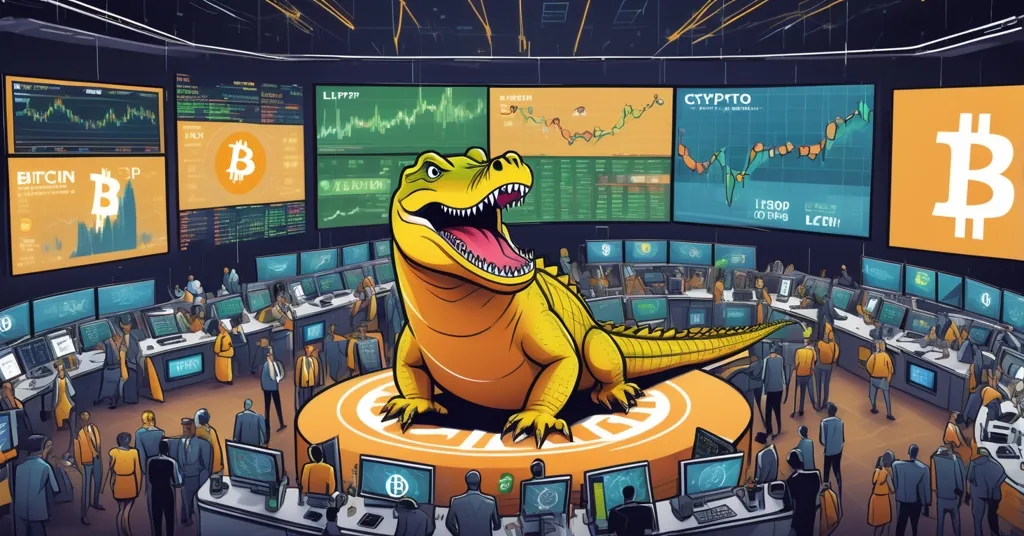
Speaking of XRP, its price action at $1.96 is a heart-pounding thriller for traders. Up a modest 3%, it’s ensnared in what’s dubbed the ‘Crocodile Zone’—a trading slang for a tight price range between fierce support at $1.78 and stubborn resistance from $1.97 to $2.11. Imagine a crocodile’s jaws clamping down; jump in too soon as a bull or bear, and you’re lunch. A break above $2.11 could unleash a rally toward blue skies, while a drop below $1.78 might crater to legacy support at $1.42.
Digging into the data, Glassnode’s Unspent Realized Price Distribution (URPD)—a metric showing at what prices holders bought their coins and whether they’re still holding—marks $1.89 as a hotspot where many XRP owners are parked. Analyst Ali Martinez’s visualization on X highlights this as a battleground; if selling pressure mounts here, it’s bearish, but holding firm could signal strength. Catalysts like RLUSD trading volume on Binance or the U.S. GDP report could snap those jaws shut in either direction. For now, XRP traders are wading through predator-infested waters. Only the sharp or insanely lucky will dodge the bite.
Litecoin Halving 2027: Early Hype or Fading Relevance?
Litecoin, often dubbed the ‘Digital Silver’ to Bitcoin’s gold, is sounding a far-off siren with its next halving scheduled for 2027. For those unfamiliar, a halving is a coded event in some blockchains that slashes the reward miners receive for verifying transactions—here, dropping from 6.25 LTC to 3.125 LTC per block. The idea is scarcity; less new supply should, in theory, drive prices up if demand holds. History backs this with Litecoin’s past cycles: an 820% surge before the 2015 halving, 550% in 2019, though each rally has been followed by sharp post-halving dumps as miners offload to cover costs, before longer-term gains kick in.
Here’s the rub: each cycle shows diminishing returns. As Litecoin matures, massive percentage gains are harder to come by—market dynamics evolve, and newer protocols steal attention. Current accumulation zones between $92 and $105 might tempt long-term holders, but banking on a 2027 event in crypto’s fickle arena is like betting on tomorrow’s lottery numbers. Sure, hype can build, but so can irrelevance. With layer-2 solutions and DeFi platforms overshadowing older coins, does Litecoin’s halving still matter? Speculators will salivate, but don’t swallow the kool-aid just yet. For more on the latest buzz around Litecoin and other crypto updates, check out this detailed crypto report.
Blockchain’s Bigger Picture: Disruption Amid Chaos
Stepping back, these developments—RLUSD’s exchange push, XRP’s volatility, Litecoin’s cyclical speculation—tie into the broader narrative of blockchain as a disruptive force. Ripple’s stablecoin play isn’t just about trading pairs; it’s a stab at redefining cross-border payments, cutting out sluggish middlemen like SWIFT. Ethereum’s strength hints at a future where decentralized apps outmuscle centralized tech giants. Even Litecoin’s halving, however dated, keeps the scarcity model of Bitcoin alive in altcoin form.
As Bitcoin maximalists, we see BTC as the ultimate store of value and rebellion against fiat decay, but we’re not blind to altcoins carving their niches. Ethereum’s utility, Ripple’s payment focus, and experimental protocols all fuel this financial uprising. Setbacks like macro meddling or regulatory roadblocks? They’re growing pains of a tech worth accelerating. We’re all for effective accelerationism—pushing decentralized solutions fast and hard—but not with rose-tinted glasses. The road to mass adoption is messy, and we’re here to call out the bumps as much as the breakthroughs.
Key Takeaways and Questions for Crypto Enthusiasts
- What’s behind the current crypto market stagnation?
Prices are flat—Bitcoin at $89,900, Ethereum over $3,010, XRP at $1.96—due to trader caution before the U.S. GDP report, which could sway Federal Reserve policy and risk appetite. - Why does Ripple’s RLUSD Binance listing matter?
With a $1.3 billion market cap and zero-fee trading on a top exchange, RLUSD gains traction, potentially bolstering Ripple’s ecosystem and indirectly lifting XRP’s profile. - What’s the ‘Crocodile Zone’ for XRP, and why is it risky?
It’s a volatile price range between $1.78 support and $2.11 resistance, where XRP at $1.96 could sharply break out or collapse, based on catalysts like RLUSD volume or macro data. - Is Litecoin’s 2027 halving worth watching now?
It’s early, but past pre-halving rallies (up to 820%) suggest accumulation at $92-$105 could pay off, though shrinking gains per cycle and altcoin competition dampen expectations. - How could the U.S. GDP report impact crypto prices?
Projected 4.3% growth and inflation figures might push the Fed toward tightening, risking a sell-off, or easing, which could spark a rally across Bitcoin and altcoins. - What’s the broader significance of these crypto developments?
From RLUSD’s payment potential to Ethereum’s DeFi dominance, these moves push blockchain closer to disrupting traditional finance, despite regulatory and macro hurdles.
Navigating this crypto maze remains as exhilarating and infuriating as ever. Bitcoin’s recovery sets the tone, but altcoins like Ethereum and XRP bring their own flavor to the fight for decentralization. Ripple’s RLUSD could be a game-changer, or just another stablecoin casualty. Litecoin’s halving whispers of past glories, but relevance isn’t guaranteed. Macro forces remind us we’re not fully free of centralized shackles yet. We champion this revolution—flaws and all—but hype and scammers get no quarter here. Stay skeptical, dig into the data, and remember: this isn’t just about price ticks, it’s about rewriting the rules of money itself.