Russia’s $61.9B Debt Crisis: Can Bitcoin Be a Financial Lifeline?
 LTB
LTB Russia’s External Debt Soars Past $60 Billion: A Crisis or a Blockchain Breakthrough?
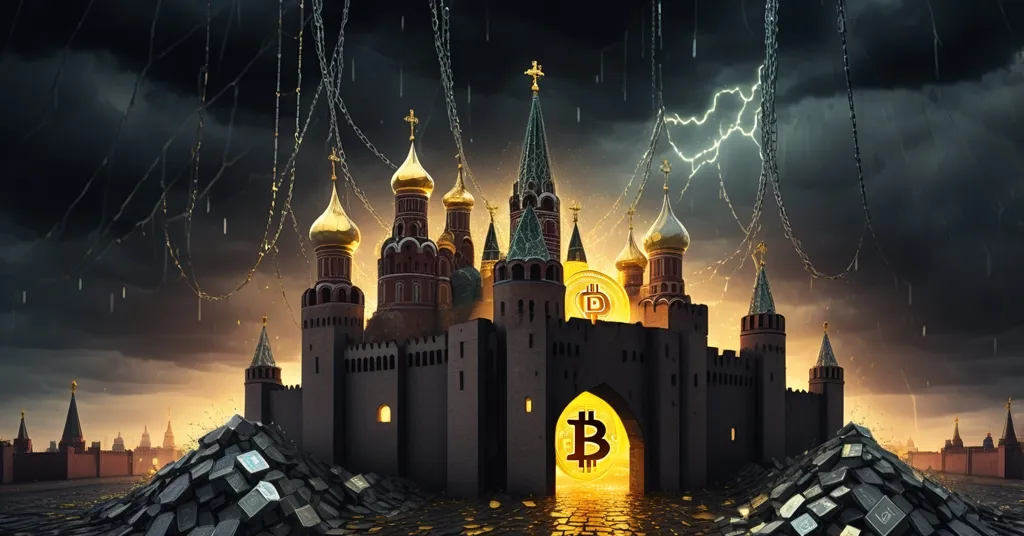
Russia’s external public debt has rocketed to $61.9 billion, a staggering 20-year high that screams economic strain under the weight of war and Western sanctions. As the Kremlin grapples with this financial burden, could decentralized technologies like Bitcoin offer a way out of the geopolitical chokehold, or is this just a desperate fantasy?
- Debt Peak: External public debt hits $61.9 billion, highest since 2006.
- Total Burden: Including private sectors, total external debt is $319.8 billion, up 10.4% since early 2025.
- Crypto Potential: Sanctions and isolation might push Russia toward Bitcoin or a digital ruble as financial lifelines.
The Debt Dilemma: A Financial Warning Sign
The numbers don’t lie, and they’re not pretty. As of February 1, Russia’s Ministry of Finance reported the country’s external public debt at $61.9 billion—a level not seen since 2006, when it peaked at $76.5 billion before dropping to $52 billion in 2007 and $39.7 billion by early 2011, largely due to oil revenue booms. Today, the story is far grimmer. With the war in Ukraine dragging into its fifth year by February 2026, and Western sanctions slicing deep into Russia’s access to global financial systems like SWIFT, the economic pressure is palpable. The Central Bank of Russia pegs the nation’s total external debt—covering both public obligations (federal government, local authorities, and public agencies to foreign creditors) and private sector liabilities—at a hefty $319.8 billion as of January 1, 2026, marking a 10.4% spike since the start of 2025.
Let’s unpack what “external debt” means for those new to the game. It’s the total amount a country owes to foreign lenders—think loans, bonds, or other financial commitments. A chunk of this $61.9 billion comes from the issuance of yuan bonds, a strategic move to cozy up to China and dodge the dollar-dominated markets where sanctions hit hardest. Then there’s the ruble’s recent strengthening, which sounds like good news but actually inflates the value of foreign-denominated liabilities when recalculated. Add to that fresh borrowing by Russian firms, as noted by business daily Kommersant citing Central Bank data, and you’ve got a recipe for a debt pile-up. But raw numbers only tell half the story—context is everything.
A more telling metric, as stressed by analysts like Anton Tabakh from Expert RA credit rating agency, is the debt-to-GDP ratio. Think of it as comparing your credit card balance to your yearly income—a smaller percentage means it’s easier to manage. Russia’s ratio sits at around 15% of GDP, relatively low compared to many developed nations where it often exceeds 50% or even 100%. Historically, Russia faced worse: the 1998 financial crisis saw a default on domestic debt, and 2014 sanctions post-Crimea pushed economic strain, though debt levels were lower then. Today’s figure suggests the burden isn’t yet crushing, but with military spending soaring and global trade doors slamming shut, that percentage could creep up faster than a Bitcoin pump-and-dump scheme.
Official Optimism vs. Harsh Reality
Russian officials are spinning this debt surge with all the finesse of a state propaganda machine. Prime Minister Mikhail Mishustin insists the situation is under control, claiming the national debt remains among the lowest for developed countries, allowing continued funding for government projects—and let’s cut the bullshit, that includes military expenditures bleeding the budget dry.
“The national debt is one of the lowest among developed countries.” — Prime Minister Mikhail Mishustin
Finance Minister Anton Siluanov echoes this, targeting a debt-to-GDP cap of 20% in the medium term, while Alexander Abramov, head of the Laboratory for Analysis of Institutions and Financial Markets at the Presidential Academy, backs that limit as a critical threshold.
“In my opinion, it is necessary to observe the overall limit of 20% of GDP for government debt.” — Alexander Abramov
Sounds reassuring, right? But papering over a 20-year debt high with sunny rhetoric won’t pay the bills. The war in Ukraine isn’t just a geopolitical quagmire; it’s a fiscal black hole. Sanctions have gutted Russia’s economy—pre-2022, over 80% of its international transactions relied on SWIFT, now largely inaccessible. IMF estimates suggest GDP contractions of up to 3-5% annually since the conflict escalated, though exact figures are murky under Moscow’s tight data control. Yuan bonds might show adaptability, but they’re also a neon sign of desperation—swapping one financial overlord for another, just with better dumplings on the side. While state news agency TASS quotes experts downplaying the debt rise, the reality of funding a prolonged conflict while isolated from global markets is a ticking time bomb.
Crypto as a Sanctions Escape?
As traditional financial doors slam shut, Russia might be eyeing decentralized tech like Bitcoin to pry open new windows. With sanctions choking access to global banking, could cryptocurrency—whether Bitcoin, a state-backed digital ruble, or other blockchain solutions—become a lifeline? For those new to this space, blockchain is the tech behind cryptocurrencies, enabling peer-to-peer transactions without middlemen like banks. Imagine sending cash directly to a friend via an app, no bank approval needed—that’s the kind of freedom Bitcoin offers, potentially allowing a sanctioned nation to trade outside the Western financial cage.
Russia’s already dipping its toes into this pool. Reports from 2023 highlight state-sanctioned Bitcoin mining farms in Siberia, leveraging cheap energy to churn out digital assets—possibly as a way to bolster the ruble or generate alternative revenue. The Central Bank has also piloted a digital ruble, a centralized digital currency that could streamline domestic transactions and, theoretically, cross-border payments with crypto-friendly allies. From a Bitcoin maximalist lens, this is a delicious middle finger to fiat systems; Bitcoin’s censorship-resistant nature could let Russia settle debts or move funds without SWIFT or dollar reliance. Even altcoins like Ethereum, with its smart contract capabilities, might play a niche role in decentralized finance (DeFi) solutions for trade agreements—think automated, trustless contracts bypassing traditional intermediaries.
Geopolitical isolation could accelerate this pivot. Russia’s growing ties with China, evidenced by yuan bonds, might extend to crypto collaboration—Beijing’s own digital yuan experiments could pair with a Russian digital ruble for sanction-proof trade. And let’s not forget the ruble’s mysterious strengthening amid this debt crisis; some speculate crypto mining proceeds, quietly converted to fiat, might be propping it up. If true, this isn’t just economic survival—it’s a blueprint for how blockchain can disrupt the old financial guard under real-world stress. For us decentralization advocates, it’s a tantalizing glimpse of effective accelerationism in action, pushing tech adoption through necessity.
Risks and Realities: Playing Devil’s Advocate
Before we pop the champagne for a Bitcoin-powered Russian renaissance, let’s pump the brakes. Crypto isn’t a magic wand, and the risks are as towering as the Kremlin walls. First, Bitcoin’s infamous volatility makes it a shaky bet for a nation already on economic quicksand—its price swings could turn a strategic reserve into a fiscal disaster overnight. No fake price predictions here; we’re not shilling nonsense. Then there’s the regulatory backlash. Western powers, already twitchy about crypto’s role in money laundering, have cracked down hard—post-2022, the EU banned crypto transactions tied to Russian entities. A full-scale pivot to digital assets could invite even harsher measures, potentially tanking any benefits.
Logistics are another nightmare. Scaling crypto for state-level use—securing wallets, managing keys, preventing hacks—isn’t child’s play. Venezuela’s Petro, a state-backed crypto launched in 2018 to dodge sanctions, flopped spectacularly due to mismanagement and lack of trust. Russia could face a similar fate if its digital ruble or Bitcoin experiments prioritize state control over true decentralization, alienating the very crypto community needed for adoption. And let’s not ignore the scam risk—if Russia’s crypto pivot goes public, expect a flood of fraudulent “Russian Bitcoin funds” or phishing schemes targeting naive investors. We’ve got zero tolerance for scammers here, so consider this a heads-up: tread carefully.
On the flip side, sticking to traditional debt markets under sanctions isn’t exactly a picnic. Borrowing costs could skyrocket, and leaning harder on China for yuan-denominated loans risks trading one dependency for another. Whether it’s crypto volatility or geopolitical debt traps, Russia’s walking a financial tightrope over a pit of spikes. The question isn’t just whether blockchain can help—it’s whether the cure might be as painful as the disease.
A Glimpse into Finance Under Fire
Russia’s $61.9 billion debt bomb is more than a balance sheet footnote; it’s a symptom of a nation under economic siege. War costs, sanctions, and global isolation are piling up, and while officials paint a rosy picture, the cracks are widening. The pivot to yuan bonds shows adaptability, but also desperation. Yet, amid this fiscal mess, the potential for blockchain to disrupt the status quo shines through—Russia’s flirtation with Bitcoin, mining, and digital currencies could be a stress test for decentralized tech on a global stage.
For champions of freedom and privacy, this is a moment to watch. If a major power leverages crypto to dodge the old financial order, we might be witnessing the early sparks of a new monetary paradigm. But let’s keep our eyes wide open—desperate gambles can just as easily backfire. Could Russia’s economic bind birth a decentralized future, or is this a high-stakes bet doomed to collapse under its own weight?
Key Takeaways and Questions
- What’s driving Russia’s external debt to a 20-year high of $61.9 billion?
The surge stems from the ongoing war in Ukraine, Western sanctions cutting financial access, issuance of yuan bonds to avoid dollar markets, ruble revaluation, and increased corporate borrowing. - How does Russia’s debt compare to other developed nations?
Prime Minister Mishustin claims it’s among the lowest, with a debt-to-GDP ratio of 15%, far below many Western economies, though the absolute increase signals mounting pressure. - Why is the debt-to-GDP ratio more critical than raw debt figures?
It measures debt against economic output, showing Russia’s burden as manageable for now at 15%, compared to higher ratios elsewhere, despite the alarming $61.9 billion peak. - Could Bitcoin or blockchain help Russia bypass sanctions?
Potentially—Bitcoin’s censorship resistance and digital ruble pilots could enable trade outside traditional systems, though volatility, regulation, and logistics pose massive challenges. - What risks does this debt surge pose for Russia’s economy?
Continued military spending and isolation could drive up borrowing costs or destabilize the ruble, threatening fiscal stability if geopolitical tensions persist.