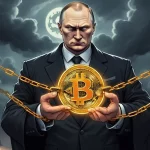
Russia’s Crypto Crackdown: New Laws Cap Investments and Restrict Bitcoin Access
 LTB
LTB Russia’s Crypto Crackdown: Investment Caps and Bitcoin Barriers
Moscow has unleashed a sweeping set of draft laws that could choke the life out of Russia’s cryptocurrency market, slapping hard limits on investments and enforcing state control over a space built on freedom. Approved by the Russian Cabinet of Ministers, these regulations aim to “legalize” parts of the economy but come at the cost of severe restrictions for everyday Russians looking to dive into Bitcoin and beyond.
- Investment Limit: Non-professional investors capped at 300,000 rubles (~$3,700 USD) annually for crypto purchases.
- Curated Assets: Only Bank of Russia-approved, high-liquidity cryptocurrencies allowed after passing risk tests.
- State Grip: Unregulated trades banned, mandatory licensing for intermediaries, and foreign transactions under tight scrutiny.
A Heavy-Handed Regulatory Hammer
The Russian government has signed off on three draft laws—“On Digital Currency and Digital Rights,” “On Amending Certain Legislative Acts,” and “On Amending the Code on Administrative Offenses”—designed to drag cryptocurrency under strict state oversight, as detailed in recent reports about Moscow’s new crypto investment caps. For the average Russian, this translates to a measly cap of 300,000 rubles, roughly $3,700 USD, on yearly crypto purchases, and only through a single regulated intermediary. Want to buy Bitcoin or test the waters with other digital assets? You’ll need to pass a risk-awareness test first, and even then, you’re stuck with a shortlist of the most “liquid” cryptocurrencies—think high trading volume and relative stability, likely Bitcoin and a handful of major players—handpicked by the Bank of Russia. Smaller altcoins or speculative tokens with big upside (or big crashes) are off the table.
For those new to the space, liquidity in crypto refers to how easily an asset can be bought or sold without wild price swings. The Bank of Russia’s whitelist is meant to shield inexperienced investors from getting wiped out by volatile or scam-ridden tokens. But let’s not sugarcoat it—this also means Moscow gets to decide what you can and can’t touch, stripping away the freedom to explore the full spectrum of blockchain innovation.
So-called “qualified” or professional investors fare slightly better. They face no annual purchase limits and can dabble in a wider range of digital currencies. However, privacy coins—cryptocurrencies like Monero or Zcash, designed to obscure transaction details for maximum anonymity—are explicitly banned, even for the pros. And yes, they too must pass a risk test to prove they’re not clueless. Meanwhile, the laws slam shut any chance of unregulated crypto trades. If you’re not using a licensed platform, exchange, bank, or broker, you’re breaking the law, and amendments to the Code of Administrative Offenses promise penalties for non-compliant players.
What about buying crypto abroad? It’s not outright forbidden, but there’s a leash. Russians can use foreign accounts for purchases, provided they notify the Federal Tax Service of every single transaction. And don’t think you can slip through the cracks—Anatoly Aksakov, head of the State Duma Committee on Financial Markets, has hinted at banning trades via foreign exchanges that don’t play ball with Russian-licensed intermediaries. If that happens, wave goodbye to global platforms unless Moscow gives the nod.
“It is expected that trading in crypto instruments through foreign exchanges that do not work with Russian licensed intermediaries will be prohibited,” said Anatoly Aksakov.
Aksakov also justified the puny 300,000-ruble limit as a protective measure for the masses.
“[The limit] is sufficient to allow Russians to test the market without risking bankruptcy,” he argued.
Russian Prime Minister Mikhail Mishustin doubled down, framing these laws as a gateway to a safer crypto experience.
“Using cryptocurrencies will become easier and safer when citizens and businesses start buying and selling them domestically,” Mishustin declared.
These bills are on a fast track. They’re slated for submission to the State Duma, Russia’s parliamentary lower house, within days and could be law by summer. Once passed, they’ll enforce a licensing regime for all intermediaries—exchanges, banks, brokers—and hit non-compliant platforms with strict penalties. The Ministry of Finance has already laid out the fine print for foreign transactions, ensuring the state keeps a watchful eye on every ruble flowing into or out of crypto wallets.
Economic Chess: Sanctions, Rubles, and Control
Why is Russia slamming the brakes on crypto now, when it’s become a lifeline for so many? The answer lies in a messy mix of geopolitics and economic survival. With international sanctions biting hard, cryptocurrencies have emerged as a tool for Russians to bypass financial lockdowns, move capital across borders, or hedge against a ruble that’s taken more hits than a piñata. Chainalysis reports have consistently shown spikes in crypto activity in sanctioned regions, and Russia—once a powerhouse in Bitcoin mining—has seen digital assets as both a threat and an opportunity. Historically, Moscow’s stance on crypto has been a chaotic dance, swinging from outright bans in the early 2010s to flirtations with regulation, often fueled by fears of money laundering, tax evasion, and capital flight.
These latest laws are less about innovation and more about dominance. They align with a global wave of tightening crypto rules—think China’s blanket ban or the EU’s upcoming MiCA framework for standardized oversight—but Russia’s approach is uniquely draconian. By forcing transactions through domestic channels and floating bans on foreign exchanges, Moscow is crafting a walled garden that reeks of economic sovereignty. Critics have dubbed it an “iron curtain” on the crypto market, and they’re not wrong. This isn’t just regulation; it’s isolation, clashing head-on with the borderless, permissionless ethos of blockchain tech.
The Decentralization Dilemma: Freedom vs. Guardrails
For those of us who see Bitcoin as the ultimate middle finger to centralized power, Russia’s framework is a gut punch. Satoshi Nakamoto’s vision was financial sovereignty—money without meddling governments or banks. Yet here we are, watching Moscow not just monitor your wallet but practically hold it hostage. Banning unregulated trades and whitelisting assets isn’t protection; it’s a chokehold that suffocates the very soul of decentralization. And don’t even get me started on privacy coins being axed—governments hate what they can’t trace, and Russia’s no exception.
But let’s play devil’s advocate for a second. Not every crypto project is a beacon of liberty. The space is littered with scams—rug pulls, where developers hype a token then vanish with your cash, are all too common. For a country where the average monthly wage is around $700-$800 USD, that 300,000-ruble cap, while laughable to Western Bitcoin whales, isn’t chump change. Risk tests and curated lists might save newbies from diving headfirst into a cesspool of shitcoins or speculative bubbles. Hell, even I’ll admit that Bitcoin doesn’t cover every base—Ethereum’s smart contracts and DeFi protocols on Solana fill gaps BTC was never meant to touch. Some guardrails could filter out the noise, even if Russia’s feel more like prison bars.
Underground Pushback: Black Markets and DEXs
Here’s the kicker: heavy-handed rules like these often backfire spectacularly. When you slam the door on legal access, you shove users toward the dark alleys of the internet. Decentralized exchanges (DEXs)—platforms where people trade directly without a middleman—could see a surge in Russia, letting users dodge Moscow’s oversight. Peer-to-peer (P2P) trading, where buyers and sellers connect directly, often via cash or untraceable methods, is another likely workaround. These tools embody the unstoppable nature of blockchain, but they also carry risks—scams, fraud, and zero recourse if things go south. If Russia’s goal is safety, pushing activity underground might achieve the exact opposite.
Global Ripple Effects: Isolation or Inspiration?
Russia’s crypto crackdown isn’t just a local headache; it’s a warning shot for the global market. By building this “iron curtain,” Moscow risks cutting itself off from the worldwide crypto economy, stunting innovation and liquidity at home. While nations like the US grapple with regulatory clarity and places like El Salvador embrace Bitcoin as legal tender, Russia’s retreat into isolation could leave it playing catch-up. Yet, there’s a flip side—this might light a fire under truly decentralized solutions. If anything, it proves why censorship-resistant tech matters. Bitcoin doesn’t care about borders or bureaucrats, and tools that resist state control could gain traction precisely because of stunts like this.
Key Takeaways and Questions on Russia’s Crypto Regulations
- What are Russia’s new cryptocurrency investment limits for 2023?
Non-professional investors are restricted to 300,000 rubles (about $3,700 USD) per year for crypto purchases, a move pitched as protection but screaming state control. - Why restrict Russians to Bank of Russia-approved crypto assets?
The focus on liquid, stable coins aims to shield the average investor from wild volatility or scams, but it kills choice and access to the broader blockchain world. - How do these laws undermine Bitcoin’s core decentralization principles?
By outlawing unregulated trades and enforcing strict oversight, they trash the permissionless, borderless nature of Bitcoin, turning it into another state-leashed asset. - Will Russia’s crypto restrictions push users toward black markets?
Without a doubt—tight controls often drive activity to decentralized exchanges (DEXs) or peer-to-peer trades, where users can evade government reach, for better or worse. - What might Russia’s crypto “iron curtain” mean for global Bitcoin adoption?
It could isolate Russia from the global crypto boom, slowing local innovation while underscoring the urgent need for unstoppable, decentralized tech worldwide.
Russia’s latest move is a brutal reminder that the fight for financial freedom is far from won. For Bitcoin diehards, it’s a betrayal of everything crypto stands for. For pragmatists, it’s a grudging nod to the chaos of an untamed market. But one thing is clear: Moscow’s iron grip might aim to tame digital assets, but it could just as easily ignite a rebellion of unstoppable tech that no state can contain. Will this be the end of crypto’s wild spirit in Russia, or the spark that proves blockchain’s true power?