Russia’s Roblox Ban Sparks Protests and Highlights Decentralized Tech Solutions
 LTB
LTB Russia’s Roblox Ban Ignites Protests and Exposes Digital Censorship Failures
Russia’s abrupt ban on the U.S.-based children’s gaming platform Roblox has unleashed a wave of defiance, from rare street protests in Siberia to a digital uprising by millions of young users. Enforced by the state’s media regulator Roskomnadzor over claims of “extremist materials” and “LGBT propaganda,” this move has not only sparked outrage but also laid bare the futility of state censorship in the internet age—and why decentralized tech could be the ultimate counterpunch.
- Russia bans Roblox, citing harmful content like “extremist materials.”
- Youth protests erupt in Tomsk, Siberia, alongside massive online campaigns.
- Censorship’s effectiveness questioned as VPNs render bans porous.
- Decentralized tech emerges as a potential solution to state overreach.
Russia’s Roblox Ban: A Blow to Internet Freedom
Earlier this month, Roskomnadzor, Russia’s government body tasked with monitoring and restricting online content, confirmed a nationwide ban on Roblox. The agency accused the platform of enabling content that could “negatively affect the spiritual and moral development of children,” specifically pointing to what it calls “extremist materials” and “LGBT propaganda.” This framing paints Roblox as a conduit for Western cultural influences that clash with state-defined “traditional Russian values.” It’s not the first clash—back in 2025, Roblox bent to earlier demands by removing games with LGBT characters or symbols. But this time, partial compliance wasn’t enough; a full blackout was imposed.
This isn’t a standalone act but part of a long pattern of digital control. Since geopolitical tensions escalated with the Ukraine conflict in 2014, and intensified further in 2022, Moscow has tightened its grip on the internet. Laws like the 2019 Sovereign Internet Law empower the state to isolate Russia’s web infrastructure from the global network, creating what many call a “Digital Iron Curtain”—a virtual barrier akin to the Cold War’s physical divide, designed to shield citizens from foreign ideas. Roblox, with its global user base and user-generated content, became an easy target in this ongoing narrative of defending against an “information war” waged by Western powers. For more on this escalating conflict over digital access, see the coverage of how Russia’s ban on Roblox has triggered both online and offline protests.
“Censorship is a necessity to defend against a sophisticated information war being perpetrated by Western powers and to protect citizens from decadent Western culture,” Russian officials have repeatedly asserted.
Youth Backlash: Protests and Petitions
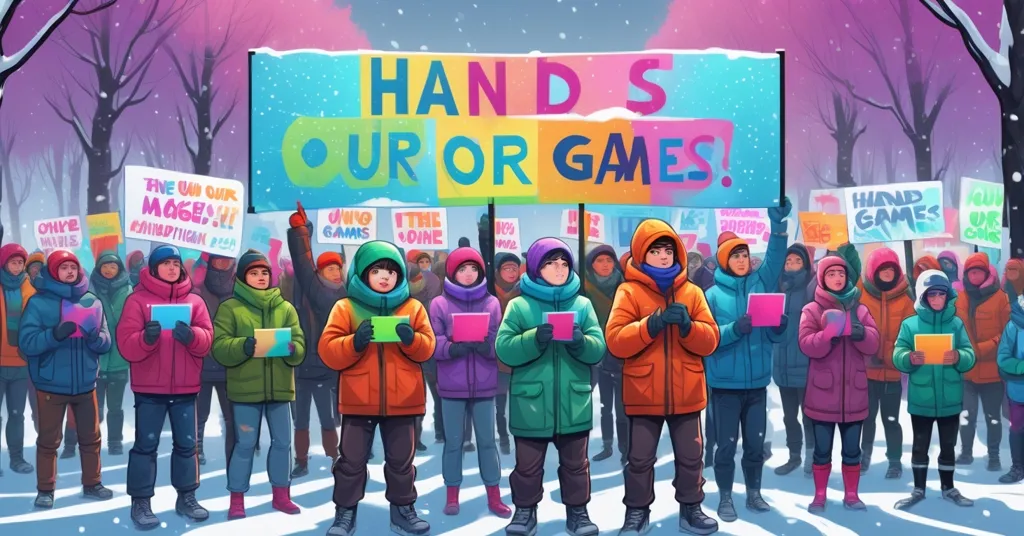
The response from Russia’s younger generation has been fierce and unprecedented. In the Siberian city of Tomsk, some 2,900 kilometers east of Moscow, dozens of protesters—many of them children and teens—gathered in Vladimir Vysotsky Park despite biting cold and snow. Waving placards with messages like “Hands off Roblox” and “Roblox is the victim of the digital Iron Curtain,” they voiced a raw frustration rarely seen in a country where public dissent often comes at a steep cost. Picture a 14-year-old, bundled in a parka, holding a handmade sign in subzero temperatures just to save a game that’s more than play—it’s a social lifeline.
Online, the rebellion is even louder. Millions of Russian children and teenagers have flooded social media with video petitions, while tens of thousands of letters have poured into the Kremlin and pro-Kremlin figures, decrying the ban. Some reactions cut deeper—reports suggest many kids have told officials they want to leave Russia altogether over losing access to Roblox, a platform that for many represents a slice of global connection in an increasingly isolated digital landscape.
“Every second child aged 8–16 had written to me saying they wanted to leave Russia since the restrictions were imposed,” revealed Yekaterina Mizulina, head of the Kremlin-aligned Safe Internet League.
This outcry underscores a stark generational divide. While the state pushes for digital sovereignty, its youth—raised on borderless internet culture—are pushing back, unwilling to surrender their virtual worlds. The Russia Roblox ban of 2023 isn’t just about a game; it’s a flashpoint for broader frustrations with internet freedom in Russia.
Effectiveness of Censorship in the VPN Era
Let’s cut to the chase: how much bite do these bans really have? Roskomnadzor may block access, but the internet is a slippery beast. Many Russians, including tech-savvy kids, are dodging restrictions using Virtual Private Networks, or VPNs. For the uninitiated, a VPN encrypts your internet connection and routes it through a server in another country—say, Germany or the U.S.—making it look like you’re browsing from there. Many VPN apps are free or dirt-cheap and dead simple to download, which is why even a 12-year-old can bypass the so-called Digital Iron Curtain with a few clicks.
This reality guts the logic of state censorship. If millions can still access Roblox despite the ban, what’s the point beyond a blatant power grab dressed as child protection? And where’s the backup plan? Unlike China, which has poured resources into homegrown platforms to replace Western tech, Russia offers no real domestic alternative to Roblox. Kids are left with two choices: sneak around the rules with VPNs or lose a piece of their digital lives. This isn’t protection; it’s punishment—and a poorly executed one at that.
Child Safety or Ideological Control?
Now, to be fair, concerns about child safety online aren’t pure fiction. Roblox’s open environment—where users, mostly kids, create and share games—can be a Wild West. Globally, there have been documented risks of predators exploiting the platform’s chat features or unmoderated spaces to target vulnerable users. Countries like Iraq and Turkey have also banned Roblox over similar fears, citing inadequate safeguards. These are real issues, and any parent would want assurances that digital playgrounds are safe.
But Russia’s approach reeks of agenda over genuine concern. If child safety were the priority, why not demand better moderation or push for parental controls, as other nations have done? Why a blanket ban that alienates millions while ignoring similar risks on domestic platforms? The focus on “LGBT propaganda” and “extremist materials” betrays an ideological motive, not a protective one. This isn’t about shielding kids; it’s about controlling narratives and severing ties to Western influence. And in doing so, Russia risks radicalizing its own youth against the state far more than any game ever could.
Key Questions and Takeaways
- Why did Russia ban Roblox?
Russia claims Roblox spreads “extremist materials” and “LGBT propaganda,” which Roskomnadzor argues harms children’s moral development, though many see this as a cover for ideological censorship. - How are Russians reacting to the ban?
From street protests in Tomsk to millions of online petitions, the backlash is intense, with some children even expressing a desire to leave Russia over losing access to the platform. - Can users still access Roblox despite the ban?
Yes, VPNs allow many to bypass restrictions easily, exposing the hollowness of Roskomnadzor’s efforts to control digital spaces. - What does this reveal about Russia’s tech policies?
The ban fits a wider clampdown on foreign platforms like WhatsApp and Snapchat, driven by a quest for digital sovereignty and rejection of Western cultural influence. - How does this connect to decentralized tech and Bitcoin?
This censorship highlights the need for decentralized systems that resist state control, much like Bitcoin offers freedom from centralized financial power, pointing to a future where tech can’t be silenced.
Decentralized Tech as a Solution to Digital Censorship
Here’s where we pivot to our wheelhouse: the power of decentralization. Russia’s heavy-handed ban on Roblox isn’t just a gaming issue; it’s a stark reminder of why we champion systems that can’t be easily choked by state overreach. Just as VPNs help users slip past internet blocks, decentralized technologies like Bitcoin resist government control over money. Could a similar ethos save platforms like Roblox? Imagine a gaming ecosystem built on blockchain principles—think projects like Decentraland or even hypothetical platforms—where no single authority can pull the plug or dictate content. User sovereignty would reign, not state mandates.
From a Bitcoin maximalist lens, this is the ultimate middle finger to centralized power. Bitcoin was born from the idea that individuals, not governments or banks, should control their wealth. Apply that to digital spaces, and you get censorship-resistant platforms where kids can play, create, and connect without fear of a bureaucrat flipping the kill switch. But let’s not get too starry-eyed—challenges remain. Scalability is a beast; blockchain-based apps often struggle with speed and cost compared to centralized giants like Roblox. User-friendliness is another hurdle; not every 10-year-old can navigate a crypto wallet to access a game. These are echoes of Bitcoin’s early days, where adoption was slow and clunky before infrastructure caught up.
And while Bitcoin remains the gold standard for decentralized freedom, I’ll tip my hat to altcoins and other protocols filling niches that Bitcoin doesn’t touch. Ethereum, for instance, powers many decentralized apps and could underpin gaming platforms with smart contracts ensuring content can’t be arbitrarily erased. These systems aren’t perfect, and some are overrun with hype or scams, but they’re part of the broader financial and digital revolution. The Roblox ban is a case study in why we need blockchain censorship resistance—not just for money, but for expression, play, and community. If Russia can ban a kids’ game overnight, what stops them from targeting other facets of digital life? Decentralized tech isn’t just an answer; it’s a necessity.
A Fight for Digital Freedom
The Roblox ban saga is more than a spat over a game—it’s a battle over who controls the internet and how far state power can invade personal digital lives. Russia’s youth are drawing a line in the snow, showing they won’t quietly accept a severed connection to the global web. Their fight in Tomsk and online could be the spark of a broader movement against digital censorship, not just in Russia but worldwide. As for Roblox’s fate in the region, it’s a coin toss—will user pressure force a reversal, or will the state double down? One thing is certain: in this cat-and-mouse game, tools like VPNs give users the edge, for now.
Looking ahead, the real game-changer lies in decentralized systems. Just as Bitcoin defies financial censorship, blockchain-based platforms could defy digital bans, handing power back to users. It’s not a quick fix, but it’s a vision worth fighting for—a world where no government can dictate what you play, say, or transact. Russia’s misstep with Roblox isn’t just a policy failure; it’s a call to action for freedom in all its forms. Let’s hope the next generation builds on this defiance, with tech as their unshakable ally.